From Agile Founder to Real CEO: The Shifts You Can’t Skip with Michelle Walshe
Jan 20, 2026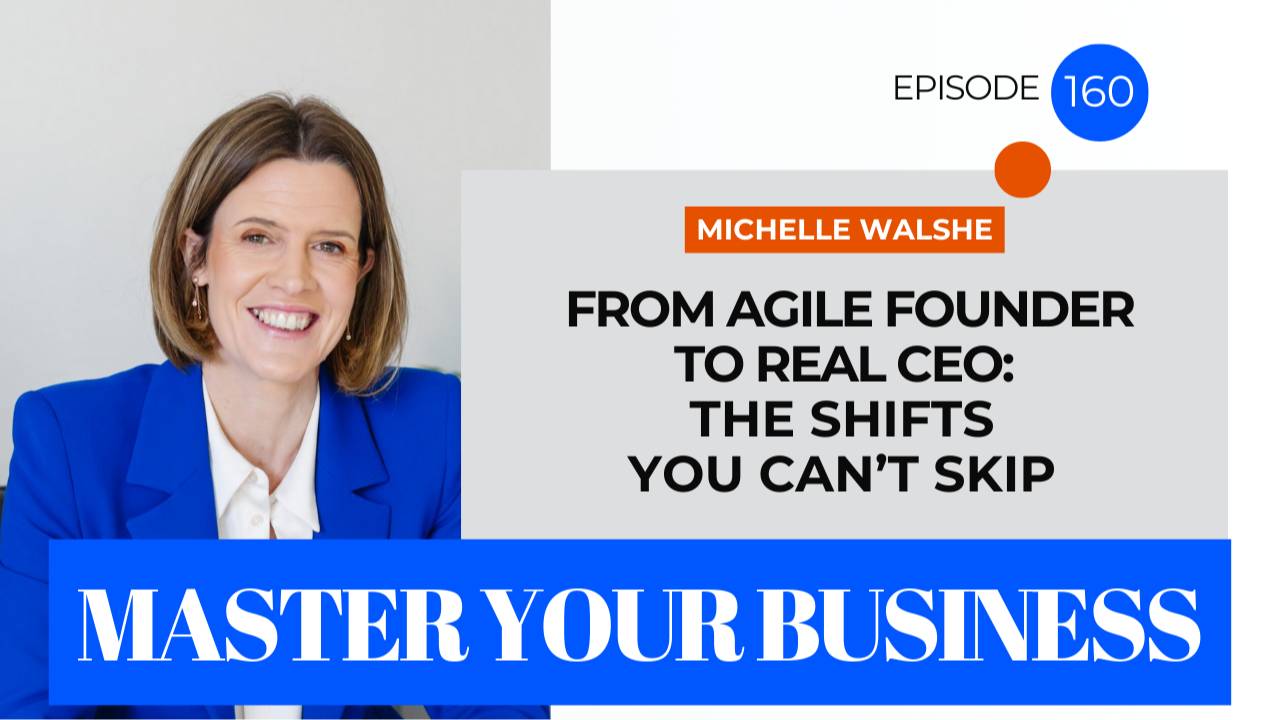
If you’ve built your business by moving fast, trusting your instincts, and making decisions on the fly, this will feel familiar.
That speed worked. Until it didn’t.
This blog based on episode 160 of Master Your Business podcast is about the moment fast decisions stop being an advantage and start creating friction for your team, your cashflow, and your headspace. It’s about the shift founders must make when a business outgrows them.
Key Takeaways
- Build a 13-week cashflow forecast so you see problems before they hit your bank account.
- Stop the daily whiplash by adding simple process and structure your team can follow.
- Reduce decision fatigue by delegating tasks that do not need your skill, and setting clear decision limits.
- Protect trust as you grow by making values visible through consistent behaviour, not posters and slogans.
- Decide your long-term end goal early, scale, succession, or sale, because it changes how you build today.
“They need to have a process, a structure. They need to know what to do every day.” - Michelle Walshe
Fast decisions are often the reason your business exists. You saw an opportunity. You grabbed the bull by the horns. You adjusted quickly as you went along. Clients responded. Momentum followed.
Then your team grew…
I interviewed Michelle Walshe, founder of Walshe Management Consultants, to talk about what really changes when founders scale beyond themselves. Michelle and her colleagues support businesses through scaling, succession, and sale, and she has lived it herself through the growth and exit of her own family business.
“What I see with entrepreneurs is there’s an element of chaos sometimes… that’s great and fabulous, except for if your staff has expanded.” — Michelle Walshe
This conversation is about how to keep the sharp edge that made you successful while building the structure your business now needs.
Keeping Agility Without Confusing YourTeam
Fast decision making works brilliantly when you’re a solo entrepreneur. You can pivot mid day. You can change priorities without explanation. There’s no lag, or red tape.
But, once a team enters the picture, that same behaviour creates friction or even chaos.
“If you keep changing your mind and keep doing different things there, there is an element of chaos that follows.” — Michelle Walshe
Your team starts work based on one direction. Then you decide that the direction shifts. And the result is deadlines slip, people’s confidence drops, you start to feel frustrated and they start to feel unsure.
The solution for this is not slowing down, it’s separating strategic decisions from execution decisions.
Why Fast Decisions Break Down As You Scale
There is a ceiling every founder hits. Michelle described it clearly on the podcast. Effort stops working. More hours don’t fix the problem.
You lose sight of what’s going on because there’s so much going on. And because you’ve got more people, your margins become tighter. And when those people are new, they’re operating at the same level a skilled person would, so potentially cashflow feels unpredictable. And before you know it, control slips without warning.
This is not failure. It is a signal. Your business has moved from personal effort to organisational complexity. The next level requires systems, not more of your stamina. That looks like, you stopping trying to outwork structural problems and start fixing the cause.
Cashflow Forecasting For Scaling Businesses
Most founders think cashflow equals their bank balance. It doesn’t.
Michelle’s advice was simple and practical. Predict what’s due in first, and validate later with it hitting the bank.
“Rather than looking at the bank account, because it’s all too late by the time it’s hitting your bank account.” — Michelle Walshe
A 13 week cashflow forecast gives you visibility and line of sight on what your weekly income and weekly outgoings are expected to be. This helps to reduce surprises.
And it matters because taxes, payroll costs, and delayed expenses arrive after decisions are made.
The outcome you can expect from doing this is that you’ll replace any financial anxiety with foresight.
Reducing Decision Fatigue Through Delegation
Decision fatigue doesn’t show up as tiredness. It shows up as hesitation, frustration, and mental overload. Michelle’s suggested starting point is unglamorous but effective.
Draw your organisational chart.
Marketing. Finance. Operations. Sales. Delivery. Admin.
Your name is likely everywhere on these .
“You are the most valuable person to the business… if you are doing something we can pay someone else to do, they’ll probably do it better.” — Michelle Walshe
Delegation only works when boundaries exist. So create boundaries like:
- Decision limits.
- Define ownership.
- Creating simple rules.
Up to a certain amount, the team decides. Above it, you decide. That way, you’ll experience fewer interruptions, which means you’ll be able to get on with being the CEO who can make better decisions from a calmer state.
The Founder To CEO Identity Shift
Letting go of some of the control is not a systems issue, it’s an identity issue. Your expertise built the business. Clients trust you. Results come through you. So stepping back can feel like losing relevance.
Michelle reframed this with one question.
What do you want?
Not what the business wants. Not what clients expect. What you want.
Some founders should lead. Others should deliver. Both paths are valid.
“No one’s going to work exactly as you.” —Michelle Walshe
As the founder turned CEO, you get to design a role that fits your strengths instead of forcing yourself into one that drains you.
How Values And Culture Protect Trust At Scale
Culture does not live in documents. It lives in behaviour. Michelle made it clear. Founder values often become their business values, whether you plan it or not.
“The values of the founder will be the values of the business.” — Michelle Walshe
If values are not articulated and reinforced, culture drifts into the ether which can weaken trust amongst the team as well with clients. And often, a knock on effect is that client experience becomes inconsistent.
This matters even more if you plan to step back or sell. When you can create trust in such a way that it becomes transferable, the business becomes resilient and is more likely to get to the place where you can step back or sell it with more ease.
Why Long Term Planning Shapes Every Scaling Decision
Most founders are focused on next quarter. Sometimes next week or just today! Michelle urges founders to think further ahead. What is the end goal?
Scale. Succession. Sale.
Each path requires different decisions today. You don’t need certainty that that’s what will happen or where you’ll end up, but knowing the direction or working towards means you’ll stop building your business by accident and start building with intent.
Frequently Asked Questions
Why do fast decisions cause chaos in growing teams?
Because teams need consistency to execute well and frequent changes create confusion.
What is a 13 week cashflow forecast?
A weekly view of expected income and expenses over 13 weeks to spot short term risks early.
How do I reduce decision fatigue as a founder?
Delegate tasks that don’t need your skill and set clear decision thresholds.
When should founders think about succession or sale?
Earlier than they think, because long term goals shape daily decisions.
Do small teams really need structure?
Yes. Even one hire needs clarity on priorities and decision making.
Related Articles and Resources
Xero, accounting software used for cashflow forecasting and projections, access my affiliate link here and get 90% off for 6 months https://referrals.xero.com/xpq7zhv5gu0z
Walshe Management Consultants, advisory firm supporting scaling, succession, and business exits, https://www.walshemanagementconsultants.com
2026 Goal Setting the CEO Way, Direction Over Destination
The Expert Trap: When Growth Kills Scale
How To Automate Without Losing Your Human Touch
3 Ways To Reduce Founder Decision Fatigue Today
Stop Fixing Weaknesses and Start Scaling with Gallup Strengths
Connect With Michelle Walshe
Website: https://www.walshemanagementconsultants.com
LinkedIn: https://www.linkedin.com/in/michelle-walshe-managementconsultant/
Connect with the Host — Deirdre Martin
🌐 deirdremartin.ie
📱 LinkedIn
🧠 Work With Deirdre: Book a call → https://calendly.com/deirdremartincx/first-business-soiree-instagram
Watch or listen to the full episode
Apple Podcasts → https://podcasts.apple.com/us/podcast/the-master-your-business-podcast/id1667327376
YouTube → https://youtube.com/@deirdremartinmyb?si=haAZF5yY4X8pYSbN
Full Transcript
[00:00:00] Why fast decisions fuel early success
[00:00:00]
Deirdre Martin: You know the moment when your business starts to grow faster, then nearly you can keep up. When you're doing well, the clients are coming in, word of mouth. Referrals are strong, but suddenly it just feels harder, heavier, a little bit more stressful maybe. Well, that's the moment that this episode is for.
Hey, I'm Deirdre Martin and welcome back to the Master Your Business podcast. Today I'm joined by Michelle Walshe, founder of Walshe Management Consultants, and she's someone I've wanted on the show for ages. Michelle helps business owners, especially family and founder led ones, navigate the three big steps that typically come.
With growth, scaling sustainably, planning succession, and preparing for sale, she's lived it herself. She led her own family business through expansion and a successful exit, and now she helps other founders avoid the crazy chaos. That literally can come with growth. So here's what I love about this [00:01:00] conversation.
There's no theory. It's straight talk and practical advice about what it really takes to scale a business and still be able to sleep at night. 'cause hey, that's definitely always a bonus, right? We're gonna be talking about why most founders don't plan enough and what happens when they don't. We're going to unpack what a proper cash flow plan looks like and spoiler, that does not mean just looking at your bank balance. And Michelle is also gonna share some of the smartest, simplest ways to spot overwhelm before it hits by literally mapping where your time and money go. Now we're also going to dive into a little bit around the identity shift that happens when your business outgrows you, when you need to start letting go and trusting others and leading a little bit differently.
It's uncomfortable. For sure, but it's totally necessary. And it's exactly what moves your business from built to built to last. And by the end of the [00:02:00] episode, you're gonna know how to forecast your cash flow without having a finance degree. You're gonna know how to make scaling decisions without losing control and keep your culture strong even when you start to step back.
Alright. Grab a coffee, take a breath, and let's jump in.
Michelle, welcome to the Master Your Business podcast.
Michelle Walshe: Thanks, Deirdre. Great to be here.
Deirdre Martin: Well, it's taken me a while to get you on. I have been asking you for a while because I just know how incredibly talented and skilled you are and I am excited to talk through some of the amazing things that you do with your clients.
So. Obviously you and I know each other, but for the people who are listening who've no idea who Michelle Walshe is, please tell them a little bit around the type of work that you do.
Michelle Walshe: Thanks, Deirdre. Well, so at Walshe Management Consultants, there's three of us at the moment, and our work really focuses around three areas.
One is helping companies scale. So a lot of companies like [00:03:00] many of your listeners are scaling and scaling at pace, but sometimes that can become a bit overwhelming and they need assistance with what's the best way to scale in a sustainable way, a way that will secure you into. The future and avoid any big pitfalls.
So that's on the scalability side. We then look at the succession piece so often. And lots of businesses may be founder led or maybe family led, and at some point we have to look at what's next. Either the founder has wants to take cash off the table and move on, and they need to bring someone in, or the family members.
We're moving through generations. So we work very closely with families around that. And the third element we look at then is the sale of the business. While we don't necessarily do. What corporate finance houses do around mergers and acquisitions. What we do is help the family or the founder to navigate that because selling our business, like I would've been leading the sale of our own family business back in 2019 and [00:04:00] 2020.
It's very complex. It can be somewhat daunting and it's good to have someone on your side that can help you navigate that. So they're kind of the three areas we focus on.
Deirdre Martin: So important, and I think probably a lot of listeners have not even thought that far ahead to think about what are they doing with the business or you know, they're probably thinking about at this stage we're recording it, the end of 2025, they're probably thinking, what's my 2026 plan would not maybe thinking beyond that.
So where should they or when should they start to think beyond that?
Michelle Walshe: I think when you are thinking about where your business is going, I think it starts at the very start of your, if at all possible. So you are kind of, when you set up your business or when you have an idea, you what is the end goal here?
Yes, you can set up and you want to grow this business, but to where do you want to grow it? Because what I find a lot of businesses, to your exact point, we're currently [00:05:00] thinking about 2026. And you'll be lucky if most of them are thinking about 2026. 'cause we're all so caught up in the day-to-day. We're busy, busy people.
And it's hard then to focus on five years out because if you want to grow your business for example, and you want to take money off the table. Well, five years out is a very good time to start thinking about that because there's so many things you could do to enhance your business if you want to sell it.
However, if you want to continue your business and you want to have a legacy and you want your family to have that legacy, then that's, there's a different set of criteria to look at and a different things to do, but you still need to do them. And I think. Knowing what the end goal is, whether it's in five or 10 or 15 years, time, will frame how you run your business.
It'll frame how you structure it. And I think that's why people need to start it at any time. So even if you're in a startup phase, it's coming. Right? You know, am I pushing this? You know, okay, I'm at, I'm. Six [00:06:00] figures in, I've six figure turnover. Now what do I wanna do next? Where am I going? Do I want to get someone in to help me grow this business?
Or I'm happy where I'm at. I'm happy with my work-life balance. I'm happy whether I'm achieving it, just it's making the decision to be honest.
[00:06:15] When agility starts confusing teams
Deirdre Martin: And I've seen people and I've kind of hit a decision point as well myself, Michelle. So this might be a little bit of free consultancy. I'm getting here nearly, but it's a little bit like, you know, for a couple of questions that I have are come to mind and in my own brain are you reach a tipping point where it's like, oh, this could actually really take off and grow bigger. And for some people who are listening, they're coaches. And okay, this is a total point of view that I have here on this now, but a lot of people who I speak to who are coaches, they just see themselves as coaches.
They don't necessarily see themselves as business owners or entrepreneurs or CEOs or anything like that, but if they're good at what they do and they're good at getting referrals, getting [00:07:00] clients in the door, there's great capacity for them to grow and scale beyond. Just themselves. And I think what I see happening with people is and even for myself and my own business, is that you reach a point where it's like, this could really grow legs and it could take off.
I, there's potential to help and support a lot more people. But in doing that, there's maybe a leap or a risk that people have to take in terms of investing and staff and people. Can you talk through that a little bit for the solopreneur who's maybe at the growth point?
Michelle Walshe: Yeah, it's first of all deciding do you have that, you know, like you, you said we have an idea here.
I think we could scale this and then for me, what I say to people is. Make that decision, yes, I'm going to do it. Decision one, two, how much money am I willing to spend on this? Because you know, you put on the table, right? I'm willing to put, [00:08:00] we'll put a figure. We put 40,000 euros. That's my investment.
I'm going to sacrifice, potentially, I'm willing to lose 40,000 Euro. To back myself. Now you're backing yourself as well. You're investing in you. So that's there's, it's a very positive thing to do, but I think sometimes it's deciding you're doing it. Step one, it is a risk and. But it's a risk work worth taking.
And then it's saying, okay, this is how much it is. And then working on that saying, I'm going to invest. 'cause to be honest, to grow, to make, as you've said, to make that step, you have to, more than likely you may have to employ someone and that in itself brings a cost and a risk. But nothing ventured, nothing gained really.
[00:08:45] What cashflow forecasting really looks like
Michelle Walshe: And I would say for what you do, and I'm a stickler for this and I had a meeting this morning with someone I'm mentoring and it's all about the cash flow and knowing where the money's going and when is it going, because I think you can [00:09:00] back yourself. I totally agree. And I think as solo entrepreneurs you should consider it, but then understanding from a cashflow perspective.
How much money do I have and how much runway do I have? It shouldn't be a surprise then when we're, you know, we may have a cash crunch period and that's normal. But knowing you have a cash crunch ahead is really important. And I think that's what I find with people when they're scaling of any size, any size at all, they get caught.
When they haven't done the cash flow projections and they're not looking, not talking about a big fancy spreadsheet or anything, literally how much money am I going to spend in the next six months on this scaling and how is it gonna work for me?
Deirdre Martin: And so I have a couple of questions on this then.
So cashflow, I get what it is from my bank manager days and assessing loans and all the things. But for people who are like cashflow, is that not just what comes into my bank account? Michelle, can you explain to them exactly what [00:10:00] cash flow is?
Michelle Walshe: See, what I want people to do on around cashflow is to predict.
Rather than looking at the bank account 'cause it's all too late by the time it's hitting your bank account. Okay? So what you want everyone to do is just a very simple spreadsheet of all the money that, the different types of money that can come in. So for many of you, that'll be money coming from their customers.
Money, maybe from a loan or money from grants, from the government. And you put that in and you plot that in for the next six months. 13 weeks will do if you can get it to 13 weeks. And I do it weekly. And then the second section is what outgoings to have, you know, I have my own salary going out. I may have all my different licenses or different things for your systems on your computers, and then plot that out.
It's literally one minus the other. So income coming in and incoming out. But the question I the thing I ask everyone to do is the forecasting of it. So what is it going to look like in 13 weeks time? What you do then is what you just said, Deirdre, you look at this week, which I predicted, [00:11:00] and I look at my bank balance and my bank account and go, right, did I get it right?
And if I didn't, then let's change it. And what does that mean for the future? It sounds. Tedious or it sounds, no, it sounds daunting to people who haven't, who don't do this, but honestly it's very, very straightforward once you set it up and it's nice and easy to do, but it gives you, do you know, lots of sort of entrepreneurs will have this.
But also a lot of entrepreneurs will have this in the sense of people running companies as well. Is he the sleepless night? Waking up at four o'clock in the morning? 'cause we're not sure if we have enough money to get to the end of next week. So I think having that ca cashflow make a difference. It gives you peace of mind.
Deirdre Martin: Absolutely. Honestly, and I use Zero to manage mine and I look at it, yes, I look at it probably every day, but I sit down and look at projections properly, at least every week, if not two weeks. Yeah. And where's the money coming from? Where's the money going to? How much is going to be coming in then? How much is going out then?
[00:12:00] And rather than you, as you say, waiting for it to hit the bank account, you can keep an eye on where it's at all the time.
Michelle Walshe: Yeah. And we often get caught. People get caught with p oe or paying the government for your government taxes. They tend to come out later. So you may pay the wages this week, but the government taxes related to that are coming out in three weeks time.
And that can be a surprise, or you're VAT if you're paying value added tax that comes out later again, so, you know, depending on which country you're in. So again, they can come as a surprise and then it's not a good surprise.
Deirdre Martin: They always catch me. Even when I prepare for them. I'm like, oh, darn.
And the other question I have related to this is it's not just about the money side, it's about the extra workload and maybe the extra people, maybe the extra pivot. And I've come across people who've scaled their business up and then scaled it all the way back down so that they could come back to being a solo entrepreneur or an entrepreneur with a small [00:13:00] team.
I'd love to hear your thoughts on that.
Michelle Walshe: I think when you scale up, so as of now, when you're working for yourself, you have that autonomy. You can do what effectively you have to keep your customers happy. But the problem is when you scale up your next thing, you have people working for you and you have other commitments and it draws from what you used to do.
So I think what I say to people is. You are gonna end up stepping away from what you're currently doing, you then a portion of your time is going to go into management. It's going to be, and also where obviously your expertise is required is that whole business development, right? So you, if you've an extra person or two.
In your business, suddenly you are really focused on getting extra business into the funnel and you're also really focused then on managing those people. Are they delivering to your brand? Are they keeping things aligned to the way you want to do it? 'cause no one's gonna work exactly as you. And I think that's what we all struggle as founders struggle.
Is the next. [00:14:00] People don't, who work with you don't exactly carry things out the way you want to. And that can be frustrating. So, and the other reason maybe people scale back down is that doesn't, they don't like it. They don't like all the extra admin, the extra management, the extra business development that comes with scaling.
And the stress might be too much. And I think that's why it's planning it. It's really sitting down and saying, right, this is how we're going to do this, and am I comfortable that? With the change,
[00:14:26] The hidden chaos founders don’t see coming
Deirdre Martin: I dunno if you've experienced this, but for some of the clients and founders that I've met, what I've seen or experienced for them is they've just kinda started their business and then they just kept running it and it was like it was just growing and they just kind of went with it without any.
Really clear intention or direction just moving forward as such. And I know you've worked with a lot of ambitious founders and leaders obviously as well, and I'm curious when they're doing that, at what point do you [00:15:00] see that they typically hit that first ceiling when. When even the hardest amount of work stops working.
Michelle Walshe: Yeah. 'cause founders are amazing people, right? They just work so hard and work so fast and you know, they're working the five to nine and not the nine to five. And for them they work exceptionally hard. But it comes a point to your exact point, there comes a ceiling.
No more of my end work will get them through. Where I see it, Deirdre, is when they no longer have control over everything. In our family business I was running one of our plants and when we took it over, it was very small. But I knew everything. I knew everything that was going on all day, every day.
And as we expanded, you know, suddenly we, you know, you don't know what's going out the back door today. You don't know the orders that came in. You have an idea, but you don't know the, you don't know, like you used to know it. And I think that loss of control, that's when they suddenly realize there's a problem now.
[00:16:00] What I see with entrepreneurs is there's an element of chaos sometimes around entrepreneurs in a good way. They, you know, the whole reason they got to where they got to and why they're so successful is they're agile and they go and they make changes and they make decisions really, really quickly.
That's great and fabulous, except for if you have a staff of, you know, if your staff has expanded, you can't be doing that. They need to have a process, a structure. They need to know what to do every day. And if you keep changing your mind and keep doing different things there, there is an element of chaos that follows.
So for me, entrepreneurs, when they get to that point where suddenly the margin is suffering, maybe the cash flow is suffering, it's because while they're in the business working seven days a week, they don't have that control anymore. They've lost some of the control, whether it's of the delivery, of the service, of the product, or it's the management of the cash.
Something has been, the ball has been dropped somewhere, and that's because they're just too busy.
[00:16:55] Decision fatigue and delegation challenges
Deirdre Martin: You talked a lot about decisions and that decision overload, [00:17:00] and that can be huge 'cause that decision fatigue is real.
And actually it's come up so often. This past month I've heard I'd say four or five different founders talk about decision fatigue and how do you help them. So when you go in and you work with clients on this, like what do you do? Or what do you focus on that actually moves the needle, but maybe. Reduces some of that cognitive overload that they experience.
Michelle Walshe: See, the big challenge for all founders and entrepreneurs is the wonderful word of delegation, Deirdre. So what we try to do is we do one of my friends, she's a serial entrepreneur, she always says, you should draw the organizational chart, right? So, and put everyone on it, but also put all the roles on it that you do.
So you might be in charge of marketing, hr, it, finance and operations, right? And then you may have someone who's in charge of customer service or someone who's in charge of logistics, right? But put all of your roles on so that's the [00:18:00] starting point. So this is how many things you're doing and what you're covering.
So then we kind of have to look, the fact, what we look at then is should we be hiring? Is there a position here? That needs to be filled to, to help you with that decision fatigue, because you will need to build your management team. And that's what often we see happen is they haven't brought their team up with them or they haven't brought in someone who can help them.
That's a, that's one of the issues. And the other thing is I always ask them to write down for the first week what they do. All week, you know, and you have 15 minute slots, what do you do? And then I ask them, could I pay someone else in the building to do those tasks? So which tasks are you doing that I can easily outsource?
Or could I bring someone in? Could I bring you in like a personal assistant or someone? What? Who could we bring into the business that can do all of these tasks that genuinely don't need your [00:19:00] skill? Because what I say to people, Deirdre is. You are the most valuable person to the business. So irrespective of what you pay yourself, you're the most valuable person to the business.
If you are doing something that we can pay someone else to do, and they'll do it probably better than you, by the way, they will do it better than you because they're focused on it. You are not focused on it. So that's what I try to do is see if there are any gaps can we fill Now, that's all contingent on having the cash flow to do it.
Then we look at process and procedure. So possibly there are decisions coming up every day that they could actually just have a process and a decision tree that says, okay, up to this 5,000 euros, you can make the decision. Anything over 5,000, I want to make the decision. So I think that's where we try to get process and procedures meetings.
I know not everyone's a fan of meetings, but some are needed. And it gives everyone clarity of their role and roles and responsibilities is the big thing. So what am I delegating at? Who am I giving it to? It's really about that structure, process, [00:20:00] procedures. But let's be honest, no, like entrepreneurs aren't mad about.
That structure and processes, well that's okay, but we do need it for the rest of the team. And the other thing we like to put in is reporting and KPIs. So if you are delegating, how do you know the piece person is doing the job you want them to do?
Deirdre Martin: Yeah, I think that's really important and I think. And I don't know, I'm guessing there's a little bit of a transformation in terms of identity for the founder as well, because they're probably have built what they have and the success that they have based on their expertise.
The thing that they do is what's resulted in the business being where it's at today. And maybe to get to the next level, they need to be able to deliver that through others, which can trigger that bit of an identity crisis. So, I, what I'm wondering is, and you've touched on this a little bit in terms of delegation, and you mentioned like other people are going to come in and do it, they're not gonna do it as well as you might do it, [00:21:00] but how can they let go from an identity perspective, but also and I know processes you're going to say will still help to maintain the control, but how can they really let go?
Like what works for people?
Michelle Walshe: It is probably the most difficult thing to do, and I think step one is when I sit with an entrepreneur or founder, it's my question to them is, what do you want? Not what the business wants or needs. What do you want? So there's no point in starting any process unless they genuinely really want to step up a bit or step out a bit, depending on the role here.
And if they have a willingness, then what I'm saying to them is it's really slow as well, the process. You're talking about instead of being in the office maybe five days a week, you are in the office four and a half. It's just a small little things, it's little changes in behavior. Sometimes it's changing your office so that [00:22:00] maybe you're working with everyone on the floor or you're in and then you're moving into a separate office and it's just the little tweaks there.
And then. It's very, very hard to let go because everyone, as you said, it's their skills that have brought it to here. So then that poses a different question. Are they the right people to run the business? Or should they step sideways and focus on delivering the product or delivering the service and allow someone else to run it.
And I what I, you know, what is most important to them is a big thing. And where should they focus? And what are your skills where, you know, all founders and entrepreneurs aren't skilled? Necessarily aren't all skilled at leadership and skilled at leading people and growing an organization, but they're exceptionally skilled at the, what they set up.
So I think it's making that decision be for me if they're, if you're not ready, there is no point.
Deirdre Martin: Yeah, I, had Margaret Kennedy come on recently and talk about strengths, which really aligns with what you've just [00:23:00] said there. And it's like really leaning into what your strengths are. And I think, like for me, I, if I was handing over my business to let somebody else swallow it, I think it'd be a bitter pill to swallow to a degree.
But actually I've seen, even with my husband, he's gone in as a general manager in a company where the founder was like, owner run business, and the founder has stepped aside to do something else. Literally what you've just described is what's happened there. And I think what's important around that as well is it's the people piece and themselves in terms of human systems.
So it's their own wellbeing too. Potentially the culture, the team psychology, and you know, how teams grow and farm and stuff and the company culture overall, like what do you see happen when founders ignore that aspect?
[00:23:48] Values and culture in growing businesses
Michelle Walshe: You were talking there about culture. A huge part of this for me is values.
So most of the values of the founder, because they will be the values of the business. I think for a lot of companies, Deirdre you can't ignore [00:24:00] all of that. You have to get that right. How do you embed that? Because a lot of the culture of the business, the values of the business, the vision, the mission, are within the founder.
It's all of them. So. It's really, really important that they then have a plan of how to articulate the values, articulate the mission and vision. Put them up. And then, but also, how do you make sure everyone's living by those? How do you make sure everyone's behaviors are living by that? And then it's putting a program in place that reinforces the values, that reinforces the behaviors you want.
Because then at least the founders, the way of doing things has been ingrained into the business. And it's not something you can ignore at all. Because if you step away. You are the driving force. You are the influence. You are the person. You are. The reason something is done a certain way, if you haven't brought that to the floor, to the, to everyone in the business, what's to keep them on the straight and narrow essentially.
Deirdre Martin: So true. And [00:25:00] some of the bigger clients I've worked with 50, 60 employees, they have said the most valuable work that we did together was actually values and how the values are measured because it's so profoundly impacts a client's experience and the internal culture and. How I typically tell people to, to look at values and to measure them is to take them from how might a client experience that value?
In what way can it be demonstrated and internally across functions and team members, what does it look like and how can somebody say that they demonstrated this value? So it needs to be a demonstrable value if it's not. It's not worth the paper it's written on. And they were like, whoa, that's actually really good.
'cause you can measure it then from a performance review perspective and you know when people are doing a good job. So yes to that 100% agree with everything you just said there. And I think a lot of that comes down to trust as well. And trust is one of those invisible assets inside a company, [00:26:00] but also out.
Side too, right? Because that's the intangible value, potentially on a balance sheet for somebody if they're going to look to buy your business or grow it, scale a tick, tick over if they're gonna acquire you or whatever. How do you maintain that trust internally and externally with the team clients, if, for example, somebody's going to sell the business.
Michelle Walshe: Yeah, that's more difficult. So if the business is solely to the outside world, let's start with the outside world. If everyone, your clients, your suppliers your partners all see you, the founder as integral to the business and the reason it does what it does, then once you go, or if you go. That's very difficult to replace.
However, and the same internally with the team, you, the team should be able to trust. When you go, because everything, the systems are [00:27:00] there the way they work. They understand they don't need your day-to-day management or leadership. So they should, it should manage it. It depends again, on the sale and who's taking over and their approach, which then may change the culture and change how people feel about a business.
So I think that's a big part of understanding or the trust element. But again, it's back to the original point is of how ingrained and how integral you are. To the business and if someone is contemplating sale.
[00:27:28] Scaling, succession, or sale: choosing the right path
Michelle Walshe: So if any of your listeners are contemplating sale. If you want to exit the business soon after sale, so a year or two after sale, then you have to work yourself outta the business so that when the person buying you comes in, they're not going, well.
If Deirdre leaves, this thing is going to fall apart. So I think there's a bit there about the trust. Yes, should not be lost because your client should be able to look in and say, yeah, Deirdre is really important. However, the key account manager who looks after me is brilliant and services [00:28:00] all my needs every week.
So that's the way you should get it. But there's a lot of preparation if you want to go down that route.
Deirdre Martin: We've talked a lot about scaling and growth and processes, procedures, and I'd like to just touch a little bit on maybe acquisition as well. So not so much selling but the acquisition side.
'cause it's come up recently with two people. One person runs a business and was thinking about, you know, maybe if I collaborate with these people and I'm like, how about you grow big enough to acquire them? Would that be better And maybe get. Their book, but I'm like, I'm just thinking bigger and trying to expand people's dreams.
And I know somebody else who's been approached recently and asked if they'd be interested in buying a business. So when you're in a position like that, what are the things to consider?
Michelle Walshe: So if you're going for acquisition, right, you want to acquire someone. There's many, many, many questions, right?
But number one, I suppose is it the right time for your business? Because [00:29:00] acquiring someone is a huge chunk of time. So. Your business has to be able to run without you during this process. Your business needs to continue business as usual so that you can spend the time working on the acquisition.
Because an acquisition is a huge transaction. It's one of the bigger transactions you'll do. I always say to people when they're selling their business, it's possibly the biggest transaction you'll do in your life. Now if you're acquiring it's equally a big transaction and you want to get it right.
So what do you need to look at for? Is the company that you're looking to acquire the right fit? If you're looking at them, what are they going to bring to the table? What are they adding to you? So you know, if you want to grow this, most likely you just want to grow. And this is one of your growth strategies is acquisition.
But do they fit with you? Do they align with your values? Because if you bring them in and their values are different to your values, then we're gonna have conflict, and that's really part of the [00:30:00] acquisition. Where I see a lot of difficulties around acquisition is the integration thereafter. Because often when you're acquiring a business, yes, you're buying, you want to buy them because of their customer book their skills, their people.
But then are there synergies you saw? Do you see that? Okay, we may be able to merge the two accounting departments. Well, if that's the case, then. How is that going to work? So there's a lot of work once you, for me, it's deciding that yes, they are the right fit. Yes they have the right values, but yes, I can afford to buy them.
And are they at the right price? 'cause there's a whole question there, Deirdre, about how much is it worth. That's where the experts would have to be brought in because how do you put a value on a business? Yeah, everyone's gonna say it's a multiple of your earnings before interest tax, depreciation and monetization.
But what is the multiple, you know, is there, are there figures correct? Do you believe in them? Who's gonna run the due diligence? And then there's the wonderful [00:31:00] legal. Work that has to be done thereafter. So it's a huge transaction, Deirdre. It is. Yes. It's a great way to grow, but you need to have good people in working with you through it because you've never done it before.
That's the thing here. It's a whole new thing for people. So, my big thing is making sure first it's the right fit, right values, and then bringing in the experts. If you think you're going to go ahead with it and get it lined up.
Deirdre Martin: Michelle, I've already referred you. Michelle's like, oh great. You know, the lovely headache.
So that's super to hear that from the acquisition perspective. Let's talk a little bit around succession. So let's say my business, my daughters could come in and potentially work in my business and, you know, it would be nice to know that my legacy continues beyond me. Yeah. What factors are most important when considering succession?
Michelle Walshe: Oh, there are so many do Deirdre. But anyway what I, [00:32:00] again, it's the first thing I do when I meet a family. I try to meet them. As a group, but then I try to meet them individually because what are we trying to establish in the first meetings is what? What are the true ambitions and goals of each family member?
Because. You know, sometimes the children have a different ambition than the parents or a different understanding, and you'll, you know, that's, and they're afraid sometimes. Sometimes parents don't want their children to be involved because they don't want them to go through the really hard work you've gone through.
Or sometimes the children. Don't want to be involved, but don't want to tell their parents. They don't want to be involved. So what we try to get to is the truth by sitting down and going, right, what's everyone's goals here? What are your ambitions? Can we get alignment across the family? So I think that's kind of step one.
And it's very much just to clarify, that's the personal goals of everyone, not the business goals, not what you wanna do and what you want to grow. It's the personal goals. That's what we tried to do first, I [00:33:00] think that established and agreed across the board. Then you can move on to what we say then is looking at the business and where's the business going.
What are the long term, because to your point about legacy, family businesses run at a different timeframe than other companies because you're a family business or a founder led business because you have a long term view. You are looking five years out, 10 years out, you are not a, you're not under a private equity or venture capital where you're, you know, you're selling in five years.
You, you want this long term. So I think that's where we look and say, right, where are we going in five, 10, and 15 years? And how are we going to get there? That's the next step. And I think then who, to your point about your, you know, if your one of your daughters wants to lead that well, then who's the right successor?
That's a difficult one. Especially if there's competition, right? So if there's two of them going for it, it's trying to figure out who's the right person to lead the business and it may not be a family member, [00:34:00] right? But I think it's something that we all have to agree on, and that's difficult too. And then after that.
When you find the right successor, are they then qualified to do it? I suppose they may need to go to another business, learn the trade. They may need education to do a course, to do a few courses. They may need to grow through the business. What is the right course of action and that needs to be decided.
And one of the things I say to families, it's really hard to do, Deirdre, you'd know this separating family and business. So, you know, sitting down at the kitchen table on Sunday, discussing the business for next week, you know, yeah, we all do it, but you have to leave the relationships. Outside the boardroom table, so that's difficult.
So we find that hard. And then what we look at then is setting up the organization. So if you wanted to bring in more of your family, well then the exact same process of scaling the business, what we put in place, and then we look [00:35:00] then and see, is there anything else the next generation need to start doing today?
So that's possibly some instances. Deirdre. I prefer them to try work somewhere else first. Bring some expertise home. And then the final thing is to write it all down and go for it.
Deirdre Martin: Hmm. I'm like, whoa there's a lot there. Probably more than just here. Lovely daughter. You just step in and take over.
Michelle Walshe: Yeah, it is, and it's sometimes doing it at the right time. Do you know the way depends on your age of your kids. Do you know? And sometimes they're too young or they have other things they want to do in their lives. I say to parents, it's important that your children come to you and want to do it, rather than you go to them sometimes.
Because if you go to them, there is a risk. They're doing it out of loyalty or out of feeling. They have to. And that's never, you want the children to come in going, yep, loving this, really want to do [00:36:00] it. I spent most of my life saying I didn't want to be involved in our family business. Actually said I would never want that changed.
That changed. And eventually I came around and said I did. So, that worked. But yeah, it took me a long time to get to that point.
Deirdre Martin: And then you grew it exponentially and sold it.
Michelle Walshe: Yeah. Then it worked. Yeah. We worked, we were very lucky. And then, that's what I say to people. That's why I like working with family businesses.
Like our family business was set up in the late seventies by my grandparents. And then my aunt and my dad and various other people were involved the whole way up. And then myself and my brother joined, and everyone, like the cousins, everyone worked in the business at different points. But we were lucky.
We had a successful business, but we also worked very well together. And it was unusual, those four of us there. But we worked well together. There were moments. But we got out the other side. But yeah, family business is fantastic. It's great. And that's like a lot of my clients are family businesses and it's a, I feel it's a totally different dynamic, a totally [00:37:00] different culture.
And I like it.
Deirdre Martin: Yeah, it's interesting, and actually I have several clients who run family type businesses as well. I have two clients whose sons work in their business and another client whose wife works with them. So it's interesting to see the dynamics and the different roles that people play and.
One client recently whose son works in their business with them. And, you know, something had happened and I had asked him, what does your son think about that? Haven't shared it with them. And I'm like, oh my God. Yeah. You know? And the idea is that he takes over the business eventually.
I'm like, he needs to be, he needs to be brought into the loop on this. Yeah. You know?
Michelle Walshe: But what happens, Deirdre is parents protect. Yes. They go into parent mode and they're like, oh, I couldn't put the stress in them. Yeah. I couldn't give them the stress. And you're like, you do eventually want them to run the business.
Exactly. So they need to start stressing a little bit.
Deirdre Martin: That was one part I, and I think the other part as [00:38:00] well was the, this founder had worked by themselves for so long. Mm-hmm. That it was like sharing the load. If they were sharing it with me, but wouldn't have ordinarily shared it with anyone. Yeah. And so even to do that was impactful, you know?
Michelle Walshe: Yeah. And that it is, it's a good term actually, sharing the load. That is the lovely thing when you bring in the family members is that you are beginning to share the stress and the load and that, you know, they can help and they can help where there's problems. I truly, I really admire husband and wife businesses.
'cause that's not somewhere I couldn't, I just couldn't visualize it. I just think it's amazing people who, husband and wives that work together and I've worked with many husband and wife combos and I just, I have great admiration for them.
Deirdre Martin: Yeah. Tomorrow I have a full day session with the husband and wife business and they're super, they get on great and it's like, they're so dynamic and work so well together.
They're so complimentary in all the calls. So it's wonderful to see [00:39:00] that. And it's bad. Yeah. What's mad is they work remotely as well. So they work from home together. They work together, live together. I'm like, oh gosh, no. Not for me much as I love my husband. No, I don't think so.
Anyway, Michelle, it's been such a pleasure having you on what an informative session and I think really down to earth and make sense for the people who are listening to the show.
What's coming up for Walshe management consultants and yourself.
Michelle Walshe: Yeah, so we're, as I said, there's three of us now, and I have a new colleague who's just joined us working remotely actually. And obviously my dad works for us as well. Well with us when he when when we ask him to help us out in situations.
So we're really, again. We're looking to expand again next year. I suppose that's what's on the horizon for us because, you know, we've great clients and I think we've more clients, especially around the family business element that we can work with. And I think I'm hoping to collaborate with my brother.
And 'cause again, [00:40:00] we always worked well together, so hopefully that's something we can do into the future as well and work with, because he has a totally different skillset to me and to my colleagues actually. So I think it'll complement what we offer. So I think there's exciting things ahead and exciting year ahead.
So, yeah, looking forward to.
Deirdre Martin: Fantastic. Well, very best of luck with that. And folks, thank you. I will be sure to share Michelle's details and contact information in the show notes where you can go and check them out.
Michelle, thank you so much for joining us on the show. It's been a pleasure.
Michelle Walshe: Thank you Deirdre much appreciated.
Deirdre Martin: What a conversation. Michelle brought so much grounded wisdom today, the kind that only comes from being in the trenches and doing the work night and day. Here's what I hope sticks with you first. Growth needs a plan. It's not about going faster, it's not about pushing water uphill. It's about deciding literally where you're going.
Setting the sat nav and giving yourself enough time to be able to get there. Second is cash [00:41:00] flow, is clarity. I would've said cash flow is king. But after chatting with Michelle, I would say it's clarity, knowing what's coming in, what's going out, and when it's, oh, I can't even tell you how important that is, and I've learned this the hard way in my business.
Not once now, but twice. So those 13 week forecasts, Michelle mentioned. It's peace of mind. It's also allows you to strategically invest back into your business in a way that's going to help your business scale sustainably. And finally, you can't scale alone. Delegation isn't a sign that you're stepping back.
It's not a sign that you're not committed to your business. It's none of those things. It's how you make space to lead and to breathe. So if this episode hit home, take one small step today. Open out a blank spreadsheet and sketch out next week's cashflow. That single move will give you more control than any to-do list ever [00:42:00] could.
And if you want to go and check out anything that Michelle was talking about, you can reach out to her and her website. Or via LinkedIn or via details in the show notes. So share this episode. Please, please, please share this episode with one business owner who you know, who's ready to scale and really take their business to the next level.
And then do me a favor and hit follow. Leave a quick review, and join me next week for more real talk about building a business that gives you freedom and does not burn you out. Until next time, keep mastering your business.
Get the next one in your inbox. One idea a week on becoming known, generating demand and growing beyond yourself.
We hate SPAM. And we will never sell your information, for any reason.