The 5 Behaviors Behind High-Performance Teams
Mar 03, 2026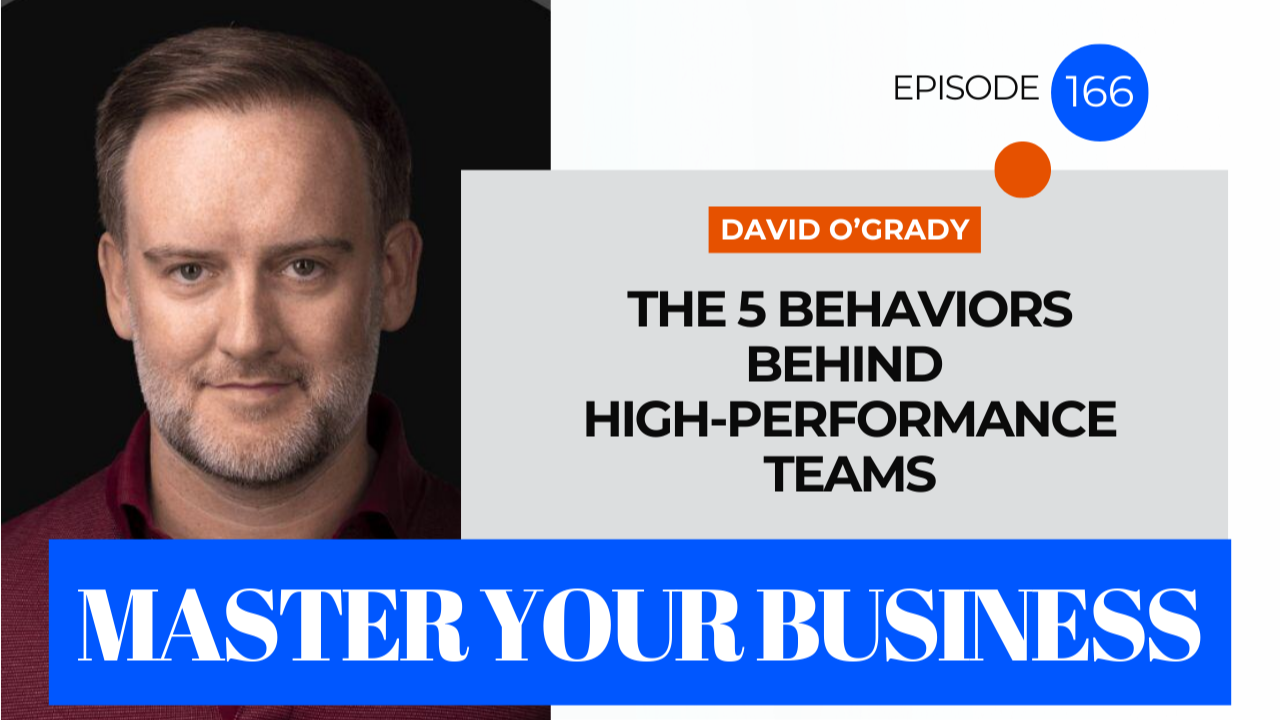
This is the five-behaviour blueprint that helps teams handle conflict well, own accountability, and deliver results that last.
Key Takeaways
-
Diagnose team friction by checking the sequence: trust first, then healthy conflict, then commitment, then peer accountability, then results.
-
Stop treating accountability as a manager’s job; high performance happens when peers hold peers to the standard.
-
Expect fast results to wobble if the team never built a foundation, pressure hides cracks until it doesn’t.
-
Use team coaching and simple psychometrics to speed up clarity and connection, but never outsource the human conversation.
“A lot of people, when they think about accountability, they're thinking about the most senior person in the room holding everybody accountable, which is not what high performance is about.” - David O’Grady
If your team avoids hard conversations, you’re paying for it, with slow decisions, simmering resentment, and “alignment” meetings that align nothing. And the worst part is how normal it can look from the outside. You can have smart people, good intentions, and a strong strategy, and still feel like you’re driving with the handbrake on.
In this blog, I sat down with David O’Grady, an organisational psychologist and team performance specialist, to discuss the 5 behaviours of high-performance teams and why most leaders know only one of them. They focus on results. They push harder. They call another meeting. Meanwhile, the foundation stays cracked.
“Teams are under such pressure to achieve results that they go hard and fast quickly, and they do get results in the short run, but they haven't built a high-performance foundation.”
We walk through what actually creates team performance that lasts, plus the practical coaching lens that helps you spot what’s missing fast.
Why team performance breaks down under pressure
Most teams do not fall apart because people are lazy. If and when they do fall apart, it's usually because pressure changes an individual's behaviour. Suddenly, people go into self-preservation or self-protection mode. They stop saying the risky thing. They hedge what they're going to say. They delay saying or doing things that they would ordinarily do. They vent sideways instead of directly.
David described a common pattern. Teams sprint early, hit short-term numbers, then the wheels start to come off because they skipped the groundwork.
“They do get results in the short run, but they haven't built a high-performance foundation.”
If you lead teams inside an organisation, or you coach leaders who do, this is the moment to stop blaming effort and start checking the foundation. It is the difference between a team that performs in calm conditions and a team that performs when it matters.
Reflection step for you to take:
Think about the last month. Where did the pressure show up first: meetings, handoffs, decision speed, or the tone in messages?
The 5 behaviours of high-performance teams and the order matters
Here’s the core idea. These five behaviours stack on top of the other. You do not skip any of the steps. If you do, the team looks “fine” until stress hits. David referenced the Five Behaviors model, which is rooted in Patrick Lencioni’s work on team dysfunctions. If you want the official overview, this is the authoritative source I recommend reading after this post: https://www.fivebehaviors.com
“At the baseline of performance, you have to trust one another.”
The five behaviours, in sequence, are:
- Trust
- Healthy conflict
- Commitment
- Accountability
- Results
That sequence is your diagnostic tool. If accountability is weak, look down the stack. If conflict is fake polite, look down. If trust is low, everything above it gets brittle.
Reflection step for you:
Pick one meeting this week and listen for what is not being said. That is often where the trust gap lives.
Trust first, and what trust really means in teams
Trust is not about everyone being best friends. It is about intent. It is about believing the other person is not trying to harm you when they disagree, challenge, or move fast. David explained it in a way I loved because it’s grounded. If trust is missing, people assume the worst. They hesitate and take necessary action (or inaction as the case may be) to protect themselves.
“If you take a team who don't trust each other, how likely are you to be committed to each other? You're not, because you're kind of waiting for the other person to stab you in the back.”
If you are a coach or consultant, this matters because trust is also how you sell. People do not tell you the real issue until they trust you. We even referenced that on the episode when I mentioned a previous guest.
“People won't tell you things until they trust you.”
Practical how-to steps you can try this week:
- Ask for the “unsaid” in the room, once, and then wait longer than is comfortable.
- Name intent before you challenge: “I’m pushing on this because I want us to win.”
- Reward directness, do not punish it with sarcasm or status games.
Healthy conflict beats fake harmony
If your team avoids conflict, it does not mean you have peace. It means you have silence. Silence becomes side conversations. Those become politics. Politics becomes fatigue. Then you wonder why everything takes so long, or people are leaving, or ganging up on you.
David’s sequence makes this simple: Trust is what allows conflict without damage. Conflict is how teams solve real problems instead of rehearsing updates.
A useful reframe. Conflict is not a personality flaw. It is often a system issue. People do not know the rules of engagement, so they play safe.
Action step for you:
Set one ground rule for conflict. Something like, “We challenge ideas, not people.”
Then model it. If you don't, nobody else will.
Commitment happens when people are heard
Commitment is not consensus. It is clarity. It is everyone knowing what the decision is, what good looks like, and what they own. This is where many leaders get stuck. They want buy-in, so they over-explain. They keep talking. They keep reopening the same decision because somebody looks unconvinced.
In practice, commitment comes from two things:
- people had a real chance to contribute
- the decision is now closed, with clear next steps
If you coach teams, you can watch commitment in the room. Eyes. Energy. Follow-up behaviour. Ideally, it's practically visible.
Action step for you:
At the end of your next meeting, ask one question: “What are we doing, exactly, and who owns it?”
If the answers are fuzzy, commitment is not there yet.
Accountability is peer-to-peer, and most leaders get this wrong
This is the section that usually makes people sit up. Accountability breaks when it becomes a hierarchy problem. One person chasing everyone else. That is not high performance. That is babysitting.
“A lot of people, when they think about accountability, they're thinking about the most senior person in the room holding everybody accountable, which is not what high performance is about.”
When peers hold peers accountable, standards stick. The team protects the culture because it belongs to them.
How to move toward this without forcing it:
- Make standards visible. Behavioural standards, not just KPIs.
- Call out misses calmly and quickly. Avoid any drama or theatrics.
- Praise peer accountability when you see it. That is the behaviour you want to multiply.
A tip I learned over the years is to praise in public, condemn in private. So if you do have to haul someone over the coals for not holding up their end of the agreement, do it privately. Accountability stops being emotional. It becomes normal.
Why most organisations get team forming wrong
This part hit hard because it is so common. Companies often onboard leaders with documents, tools, logins, and polite introductions. Then they hand over the keys and disappear.
“Organizations do a really good job in the sense of, you know, here's your onboarding induction side of things... But then it's kind of like, well, best of luck, buddy.”
David also pointed out something many leaders do not want to hear. Even when done well, building a high-performance foundation can take time. That is normal.
“It often, even done well, it can often take 6 months.”
If you are a consultant or coach selling into organisations, this is an entry point. Team forming is a business problem. It affects delivery, retention, and revenue. Leaders feel it. They may not have the language for it yet.
Action step for you:
If you work with corporate clients, build a simple diagnostic around the five behaviours and use it to start the conversation.
Tools that support team coaching without replacing the conversation
We also talked about how tools can speed up trust and clarity. David referenced using psychometrics and behavioural tools with clients. These can help teams name differences without blame. They can also reduce the time it takes to get to a real conversation.
We also touched on AI. The theme was clear. Use it to support thinking and output, not to replace the human relationship.
Conclusion
High performance is not a personality trait, particularly in teams. It is a sequence of behaviours that stacks. Trust. Conflict. Commitment. Accountability. Results. Skip the base, and you get performance that cracks under pressure. Build it properly, and you get a team that can handle the hard days without turning on each other.
If you lead a team, or you coach leaders and consultants who do, this episode gives you a clean framework you can apply immediately. Press play, take notes, and use the sequence to diagnose what is missing.
Frequently asked questions
What are the 5 behaviours of high-performance teams?
Trust, healthy conflict, commitment, accountability, and results, in that order.
Why does my team avoid conflict at work?
Low trust makes conflict feel unsafe, so people choose silence and side conversations instead.
How do you build trust in a leadership team quickly?
Set clear norms, reward candour, and model intent before challenge, then keep repeating it.
What does accountability look like in high-performing teams?
Peers hold peers to standards, not just the manager enforcing rules from above.
How long does it take to build a high-performance team?
David shared that even when done well, it can take around six months to build a strong foundation.
Do psychometric tools improve team performance?
Not directly. The advantage of using psychometric tools is that they can speed up clarity and connection, which, when used effectively, can lead to real conversations and behaviour change.
Can AI replace a coach or team facilitator?
It can support thinking and workflows, but it cannot replace trust-building and human relationship work.
Tools and Resources Mentioned
-
The Five Behaviors - Team effectiveness model based on Lencioni’s work on team dysfunctions, used as the core framework in this episode. https://www.fivebehaviors.com
-
The Five Dysfunctions of a Team by Patrick Lencioni - The underlying concept David referenced when discussing trust, conflict, commitment, accountability, and results. https://www.tablegroup.com/product/the-five-dysfunctions-of-a-team/
-
Insights Discovery - A personality preferences tool often used to build self-awareness and communication in teams. https://www.insights.com/products/insights-discovery/
-
Everything DiSC - A behavioural assessment used to improve communication, teamwork, and leadership. https://www.discprofile.com/
-
Hogan Assessments - A set of personality assessments often used for leadership and talent development. https://www.hoganassessments.com/
-
ChatGPT - Mentioned as an AI tool David uses with clients to support work. https://chat.openai.com/
-
Claude - Mentioned as an AI tool used alongside ChatGPT. https://claude.ai
About David O'Grady
David O’Grady is an Executive Coach, Team Facilitator, and the Founder of David
O’Grady Coaching Ltd in Ireland. He is Ireland’s only dual authorised partner and
distributor for Everything DiSC® and Insights Discovery®, helping HR and L&D teams
translate behavioural insight into practical, sustained change. With over 20 years’
experience in senior HR and leadership roles, including at 3M and HubSpot, David
focuses on reducing communication friction, building trust, and accelerating
collaboration. He’s the creator of Fast-Forming TeamsTM, a six-week system that helps
new or reforming teams achieve early team alignment, so momentum compounds
rather than drifts. David is an award-winning coach known for a calm, structured, and
human approach.
Connect With David
LinkedIn: https://www.linkedin.com/in/davidogradycoach/
Website: https://www.davidogradycoaching.com/
Related Articles
Why Clients Don’t Get Results and What Client Success Really Means ☞ https://www.youtube.com/watch?v=lhpgD6eDm9Y&t=145s
How to Use LinkedIn to Create Trust and Qualify Better Leads
☞ https://www.youtube.com/watch?v=FTqYfbMqGnk
3 Steps to Build Trust So You Win Clients Faster
☞ https://www.youtube.com/watch?v=6f-dtQD40aE
Watch or listen to the full episode
Apple Podcasts → https://podcasts.apple.com/us/podcast/the-master-your-business-podcast/id1667327376
YouTube → https://youtube.com/@deirdremartinmyb?si=haAZF5yY4X8pYSbN
Full Transcript
[00:00:00] Why team performance stalls
[00:00:00]
[00:00:00] Deirdre Martin: If you are leading a team, even a tiny one, and it feels like you're herding cats while trying to grow a business, it doesn't mean that you're bad at leadership or you need to go off and do a leadership course or anything like that, but possibly what's going on underneath is that you're missing that foundation that starts when teams start to form together, and that's trust.
And here's the thing, most teams don't implode because they're incompetent. What happens or where things explode is because communication gets weird. When people come under pressure, everybody's busy, everybody's stressed, and suddenly you are in back-to-back meetings thinking, why does this feel so freaking hard?
So if. If that's ever happened to you, or if it's happening to you on the regular, well, today's episode is gonna be a treat because you're about to hear how David O'Grady shares some of his expert trade secrets. The kind that make you stop blaming your [00:01:00] team. Stop blaming yourself and start fixing what's actually going on under the surface.
I'm Deirdre Martin Award-winning business coach. Bestselling author and I help entrepreneurs hit 100 K months or years without burnout, bottlenecks, or building a business that you secretly resent. And my guest today is the incredible David O'Grady, a team and leadership. Specialist with a deep background in organizational psychology and behavioral science.
He works across three levels, the individual, the team, and the organization. And he is brilliant at turning, you know, we're making progress, but the energy is off type sense in the workplace into real cohesion and genuine sustainable performance. And in today's conversation, David breaks down why high performance doesn't start with a tool.
It starts with that foundation and why trust comes before absolutely everything else. We'll talk about the difference between intent and impact, how teams can create healthy [00:02:00] conflict without it turning personal and why AI won't replace great leadership, but it will expose weak communication very quickly.
By the end of the episode, you'll know exactly how to spot the hidden friction that maybe exists in your team or to make sure that it doesn't and what to do next. To build trust without turning a workplace into a kumbaya circle. All right, let's go.
[00:02:26] David’s background, org psychology, team performance work
[00:02:26] Deirdre Martin: David. Welcome to the Master Your Business Podcast.
[00:02:30] David O'Grady: Thanks, Deirdre, great to be joining you today.
[00:02:32] Deirdre Martin: Oh, well I think it's well over due, David. Our paths have been crossing in multiple different capacities, having met on LinkedIn, so I'm really pleased to have you here to talk a little bit around what you do, who you help, and maybe share some of your worldly insights and experience with some people listening today.
So first off, why don't you just share a little bit around the types of clients that you typically work with and the type of work that you do with them.
[00:02:59] David O'Grady: Yeah, no [00:03:00] problem. Deirdre. Yeah, it's rule reversal. 'cause we did a LinkedIn live a few weeks back as well, which is nice. In many ways the clients I work with ties very directly to my background in corporate.
If I can just sidestep for a second, you know, I had 20 years in corporate and in medical. And also in tech doing hr, learning and development, leadership development and so on. And a lot of the clients I'm working with now over the last couple of years similar type of organizations different size organizations.
Some are, you know, more startups, some are scaling up, and then some are more enterprise level and what they're doing. But a lot of the work that I do, it links in very directly to working with teams, team forming dealing with team challenges, whatever the case might be. And then my background is very much in org psychology or behavior.
So I take a lot of that science and learning and behavioral science and integrate it and weave it into what I do with several different psychometric tools.
[00:03:52] How to land corporate clients using your warm network
[00:03:52] Deirdre Martin: A man of many talents with great experience by all accounts, David. A couple of things there that you touched on that I'm like, oh, tell me [00:04:00] more on that, because I know there's some people listening and their coaches or their consultants and they're like.
You work with corporates, how do I get in the door to corporates? Might be one question that people might consider. And the other thing is some people who are listening might work with individuals but not work with teams. So I'd love for you to touch on both of those two things, if that's okay.
[00:04:23] David O'Grady: Absolutely. So, just for context, I'm starting my third year of business. So if I'm honest with the listeners, my first six months I didn't even have a single client to be honest with you. And I was really considering just going back to corporate. If I'm honest, I was. They're building websites and no conversations.
In terms of getting in with corporate. The obvious starting point was my warm network. So you start to realize, wow you actually know more people than you think you do. So you don't get too fancy with marketing. You just reach out to your direct contacts. Be honest and say, listen, I'm trying to get a start on this and I'm trying to get in way, I think I could add value understand their pain points and what's showing up.
I have a good sense of [00:05:00] that from working in the role that they've worked in and then saying, listen I've got these two or three offerings, would they be of interest? And I think one of my first gigs was over in the UK delivering to a leadership team. And then it started to build slow momentum where now you've got a case example of, delivering something.
You start to feel more like your business and then you're working a bit of. I'd say a lot of repeat business to be honest with you. That's something I share with a lot of people, Deirdre, is that there's often, when you go onto LinkedIn, you often think that, wow, I need hundreds of leads to go and build a business.
I'm a solopreneur, and what I've realized is that I just need a handful of clients. And my, I prefer that 'cause I get to go a bit deeper. And generally what happens is that when I deliver, say to a leadership team, what they'll ask is, well, we want that for multiple teams across the organization. So suddenly it cascades into the organization.
So for a solopreneur like me, business to business, a lot of my leads are actually in the same organization. It's just about getting in the door and getting started.
[00:05:56] Deirdre Martin: Great insight, and I completely agree.
A handful of amazing [00:06:00] clients is all, anybody needs to be successful and to earn enough revenue so that you don't have to go back and do the nine to five. Okay? And so that's how to get your foot in the door, leverage your warm network. The second part is. Team coaching. Mm-hmm. Can you touch a little bit on that?
'cause again, a lot of people listening might be coaching individuals or working one-to-one with people. What are the pros and cons of doing a bit of the team coaching in your view? David?
[00:06:28] David O'Grady: Yeah, it's a great question. I really work with organizations at three levels. The individual, the team, and the organizational level, you know, individual, obviously being one-to-one coaching organizational level is taking like a psychometric tool and rolling it out across your organization, integrating it into your strategy.
[00:06:44] What shows up in teams first, tension, friction, conflict
[00:06:44] David O'Grady: A huge amount of the work is working with teams. And that brings me to sort of the challenges that, why would you bring in a team coach for all of a sudden to work with somebody? Well, generally what you find is that people within teams are communicating under slightly different frequencies and they don't know [00:07:00] what it is, just things aren't clicking the way they hoped.
And often what happens is I'm brought in maybe five, six months down the line and it's like. You know, we're making some progress, but, the energy isn't there or, there's a bit of friction building up or a bit of tension building up, and it's very difficult for the leader to unravel all of that because they're caught up in the dynamics of it as well.
So I think what a lot of organizations realize. Is there's such value in bringing in somebody external to facilitate a conversation. So even though I've got all these psychometric tools that I love, it's far less about the tool and much more about the conversation. It's just that certain tools enable much better conversations.
And once you get in there and you start, you know, asking the right questions and getting a conversation, energy going, you start to see an awful lot of the same themes which in many ways is just personality traits in friction with each other. And the best part of what I do is just those aha moments where somebody.
Stop thinking of somebody as good or bad and realizes they just communicate differently than I do. They've actually [00:08:00] the same intent. They want us to be successful as a team. They're just coming at it from a different lens or different communication style, and what I often say to people is this is that.
There's very few bad people in an organization. There's a few psychopaths around, let's not kid ourselves, whatever it might be. But for the most part, the person you think that you wouldn't get on with, if you met them in a coffee shop, you'd probably get on with them fine, because you're outside of that team dynamic and environment.
It's just that when you're in the organizational context and pressure and strain is coming your way, is that we lean into our natural way of communicating. Which might be very different to the person across from us, so just understanding how we can make small adaptations can just change the game completely.
[00:08:44] Deirdre Martin: Oh, there's so much in what you've just said there, and it's very, very rich, I think in context as well and makes so much sense. Like I can see that from when I look back in my own career with teams and it is like even working in the team, it's like everybody's trying to [00:09:00] sing in harmony, but sometimes every so often there's a bum note and you're like, where's that?
One note coming from, you know, and it's a really great way to describe it in terms of energy and frequency and sound. I love that description.
[00:09:12] David O'Grady: Yeah. You'll often, Deirdre, I often say, talk to people about intent versus behavior or intent versus impact. And this is what something a lot of coaches will be familiar with, is that idea that if somebody communicated in a way that I found upsetting.
In the past, I would think, well, I mightn't say it out loud, but it's like, I don't appreciate that behavior or the way you communicate it. That's too direct for me. But if somebody pointed the finger back and said it at us, we'd often respond, oh, hang on. That wasn't my intent, so we judge it or people by their behavior, but us by our intent.
And what I say to folks is just take a pause and flip the script. And just think for a second. They mightn't have communicated in a way that you like, but what was their intent behind it? Because in most cases it was actually a positive intent. They wanted you to be successful, the team to be successful.
It was just on a different [00:10:00] frequency to the way you like.
[00:10:02] Deirdre Martin: Yeah, I love that. Impact versus intent. Really, really great thing to consider. I mean, that happens in every relationship, doesn't it? And ultimately all relationships are won and lost based on the level of communication that we have with each other.
And David, I'm curious as well, when you're working with teams what problems aside, you know, is the core thing that there's friction, they're making some progress. Like you said earlier, or is there something else that's cropping up that's causing clients to come to you when the teams aren't working well?
[00:10:35] David O'Grady: Yeah, often I love using frameworks, Deirdre, to be honest with you, because I think when somebody sees something visually, it's like a diagnostic. It's like, ah I know where we're at in this. And, you know, a lot of what we hear about in corporations is that, well, we want to be better performing.
[00:10:48] The 5 Behaviors framework, the sequence behind performance
[00:10:48] David O'Grady: We ideally want to be a high performance team. You hear this all the time. But if you ask people, well, what is that? It's like people struggle to answer what that actually is. So I always pull [00:11:00] out at the start of my workshops and facilitation. My favorite model is Patrick Lencioni's model. If anybody's read Five Dysfunctions of a Team, it's a workshop called the Five Behaviors of a Cohesive Team.
The very same framework, but it's a wonderful framework because it explains what's required for high performance. And if you think visually looking at a triangle and think that each of these.
[00:11:20] Trust, what it really means (and why it’s first)
[00:11:20] David O'Grady: Stack on top of each other to, to achieve the top result at the baseline of performance, you have to trust one another.
Okay? There has to be strong trust amongst each other. And you know, I underst again, it goes back to intent. You didn't communicate the way I'd like, but I know actually you've got good intent for us to be successful.
[00:11:37] Healthy conflict, why avoiding it slows everything down
[00:11:37] David O'Grady: The second room on that ladder effectively is healthy conflict. It's that we're not overly polite.
We're challenging each other, but it's not personal. We want the best outcome here. So we need to challenge ideas in what we're doing.
[00:11:48] Commitment, what changes when teams actually commit
[00:11:48] David O'Grady: Once you've had a chance to actually weigh in on something, you're far more likely to be committed to something, which is the next part of that ladder.
[00:11:55] Accountability, why it can’t be “the boss chasing adults”
[00:11:55] David O'Grady: Once you're committed to something, the next part is quite difficult is that you start to hold [00:12:00] each other accountable. Which is quite difficult. A lot of people, when they think about accountability, they're thinking about the most senior person in the room holding everybody accountable, which is not what high performance is about.
If you think about all the teams you follow the team, the peers are holding each other accountable for standards around how they're working. And the final part of that is once you see teams holding each other accountable they're not just likely to achieve exceptional results. It's likely to sustain over time.
Okay, so just a recap on that. You have to have trust, so you can have healthy conflict. Then you're more likely to be committed, you're more likely to hold each other accountable, and you're more likely to achieve greater results. The reason I shared that is that goes back to your questions. Well, what's often happening in teams?
[00:12:42] Results that sustain over time, not short-term sprints
[00:12:42] David O'Grady: Well, often what's happening is that. Teams are under such pressure to achieve results that they go hard and fast quickly, and they do get results in the short run, but they haven't built a high performance foundation. So when I'm coming in, it's actually to circle back on building trust and enhancing communication, getting better [00:13:00] with conflict.
Get the foundation building blocks right, and then build from there.
[00:13:05] Deirdre Martin: I think that is relevant in any business who has more than one person working in it. Because I think trust is foundational in everything really, isn't it? recently on the podcast I had Tony Banta and Tony was talking about customer success and he was like, people won't tell you things until they trust you.
And I think that probably applies in terms of teams and colleagues as well. They're not gonna tell you things unless they trust you, because it's just that safety piece, isn't it? If it doesn't feel psychologically safe for them to share the thing, and they might feel vulnerable or exposed by opening up and sharing something, if that trust hasn't been formed yet.
[00:13:42] David O'Grady: Absolutely Deirdre and Amy Edmondson talks about that. psychological safety isn't some sort of kumbaya moment. It's actually holding each other accountable, but feeling safe that you're holding each other accountable. That's what you've agreed and that's the way we operate.
[00:13:55] The trust triangle, authenticity and how trust breaks under pressure
[00:13:55] David O'Grady: But going back to, you know, me in frameworks the best framework I've seen out there for [00:14:00] trust she's a phenomenal lady and person and she's a Harvard professor called Frances Frei. And she's a TED Talk for anybody who wants to see in more detail, but her model of trust is exceptional.
And it really boils down to three parts. And I think for those listening in to really have a think about this, because generally what you find is that. We're particularly strong in one reasonably strong in two, and maybe have a wobble now and again, and a third side of things when we're under pressure.
But once we understand these three component parts, not only can we build strong trust with clients or customers or friends and family for that matter, but we can also rebuild trust as well. So the three component parts of that is that are you being authentic? Think about authentic at the very top of the triangle is.
The second part is how strong is your logic? In your reasoning for saying something. And the third part of that then is are you demonstrating empathy? So when you think about the people who trust you, they're seeing those three things. You're coming across as authentic. You've got good strong logic, and you've got [00:15:00] good, strong empathy.
What often happens is that. When we're under pressure and strain, you know, those moments where somebody gives us a skeptical kind of look and go I'm not so sure about what you just said there. They're having a doubt about one of those three things. And once we understand that, then we can sort of, okay.
I need to work a little bit more on that. And if you don't mind me using you as an example I'll sort of bring it full circle. I'm using triangles and circles at the moment to all these examples. So I love reading your posts on LinkedIn and what do you talk about? You talk about.
Being authentic in how you show up. You'll take a picture at any moment in the day and you'll say, this is me. This is who I am, this is how I speak, here's the words I use. You'll also share that it took you a while to get to that stage to feel comfortable just being yourself in that regard. You're also sharing really strong logic around, you know, if you want to build your business or scale your business or improve your LinkedIn strategy or whatever, here's the things we see that work, and here's how things are changing month on month or year on year.
But you also share empathy. 'cause it's like, here's the challenges I've had going through this journey and here's how I've [00:16:00] overcome them. I know it's very difficult for you out there and what you're doing. I empathize. And that those three component parts of being authentic, logic and empathy are the reason that so many people are following your poster and enjoying it.
That's what people are clued into. If that makes sense.
[00:16:15] Deirdre Martin: Totally. And actually as you were talking about this earlier, I was going to say, oh my gosh, like this makes so much sense for showing up on social media as well. When you're trying to create trust. That same framework will apply for social media.
So kudos. David you connected the dots in the circles and the triangles. You love it. Okay.
[00:16:33] Tools that speed up team clarity, Insights, DiSC, Hogan
[00:16:33] Deirdre Martin: So when you are working with teams, and with organizations, but also with individuals, I know you use some particular tools and I love that, you can come with your toolkit and pull out the things that are relevant based on what's happening or the situation in front of you.
And from our previous conversations, I know that you use DISC and insights discovery. So can you talk to us a little bit around what those frameworks are and [00:17:00] then why you've chosen to use those in particular?
[00:17:03] David O'Grady: Yeah, absolutely. I've certified in about five different psychometric tools.
I love personality and behavioral tools and psychometrics, but I'm actually an authorized partner for both insights and everything DISC as well. The reason I love them ties in with exactly what we've just been talking about. So if you think about what we've. Said we've looked at high performance from a framework level.
Then we've looked at trust from a framework level around the, at that baseline around authentic logic and empathy. But a lot of people don't actually know. Well, I give a sense of what I'm strong at, but I'm not sure what I'm weak at exactly. And also not sure what my colleagues are strong at and what they're weak at, or whatever it might be.
And that's a perfect example of where disc and insights come in. It's because, for example, if you were leaning towards a D style and a C style and disc, well there's a good chance you're quite strong on the logic and I think about it like a continuum. It's not a one or the other.
Whereas if you're leaning towards an INS in the model, you might lean a bit more [00:18:00] towards the empathy side of things. And similar in insights, you know, fiery red and cool blue might lean more towards the logic side of things. Sunshine, yellow and earth green lean more towards empathy.
So the reason I share that is that because all of a sudden you've got this simple looking model in front of you that's visually very sort of striking and clear. But it's not simplistic. You're starting to see some of the nuances in behind that very, very quickly and go, oh my God, I can see now why I get on with this colleague or this teammate.
I can see now why maybe we're struggling to connect with our wider organization, that actually there's not enough empathy in our communication or whatever the case might be. Now that's just one of the scales I'm talking about. There's other scales in that as well. But bringing it full circle, it's the idea of this simple model that isn't simplistic,
what I say to people is insights and DISC are the perfect resolution to scale across your organization and create a shared language. People just get it quickly and it's like, I understand it. I can apply it today, tomorrow. [00:19:00] Organizations love it for the very same reason. There's an energy it creates and people are using it straight away.
Now you can go other psychometrics that are higher resolution like when I'm doing one-to-one coaching with directors and above I will tend to use Hogan, which is more in depth and higher resolution. But that works really well for one-to-one coaching and going into the depth. It doesn't work well for scaling across an organization.
It's not necessary, so for me, insights and DISC is a perfect resolution, the perfect level of model to be able to create a shared language that, again, is feeding into that high performance foundation that we spoke about just a moment ago.
[00:19:36] Deirdre Martin: I think they're fantastic tools and you know, for anyone listening, there's a couple of things I've learned from having had these done on me over the years in organizations and just to share really quickly is that they're great for self-awareness and employees.
I feel like we all, and not even as an employee, but as humans, we love to learn more about ourselves so people can, you know, take them in and look at [00:20:00] them. Also what I've realized over the years is that mine have evolved and I think possibly they've evolved because of different roles I was in or where I was at in my life.
So I'm curious what your thoughts are around that happening, David? And the second thing I would say is, and just to share quickly here before I lose this. Thought in my brain mm-hmm. Is there's a tool that you can connect to your LinkedIn that actually ties in disc. So if you're familiar with DISC and you leverage it and you are making proactive outreach using LinkedIn, there's a tool called Crystal Knows.
It will do like a disc reading of the person that you're trying to connect with, so I'll share a link for that under the show notes as well. Now, what I'd say is on LinkedIn to go back to David's point, not everybody is authentic on LinkedIn and they may have a different type of persona, so the disc may not be entirely accurate.
But if you're like, Ooh, freaking out about a sales pitch [00:21:00] conversation, it might be a helpful tool to go and use if you're familiar with DISC and know how to apply it. Okay, so sorry, slight tangent there, but relevant to disc and you're mentioning LinkedIn, so come back and talk to me about what might happen in terms of over a period of time and those insights, results changing or the disc changing.
[00:21:21] David O'Grady: You know, in many ways these two questions tie into each other really well. So it might actually make sense to go with the second one initially. The reason I say that is that for DISC in particular nobody actually owns disc. So you've got a multitude of vendors out there that are claiming, here's my DISC model.
What people need to be very careful with any psychometric tool is the reliability and validity of it. Okay, so the validity is basically, is it measuring what it says is going to measure in terms of what you're trying to assess. And the reliability is, you know, if I do it on repeat and I do it multiple times, how close are the results going to be over time?
It's the idea of, measuring something with a ruler, like if it's [00:22:00] too flexible or whatever like that, you're gonna get different results each time. The reason I say that is that there's a lot of tools that are not as good as the claim to be out there. So you need to be very careful. The one I'm an authorized partner with is with Wiley. And that's because I've seen it used in corporate and it's really reliable and I know they're researching data in behind and you know, a lot of coaches and consultants get certified through me as a partner and they get, 'cause they get the Wiley certification insights as well.
Again, I find particularly reliable and valid. But what I would say is that. To any of our listeners, there is no psychometric tool out there in the world to be clear. That is going to tell you absolutely everything about yourself and what it's going to be. You've just answered a hundred questions, like there's more to you than a hundred questions, let's be honest.
But an awful lot of what we are trying to do is actually. It's the perfect level because it's really just a case of understanding differences in traits. And if I make a small adjustment here, I'm going to have a big influence on my client, customer, or even at home over here. Okay. Going back to your first question, it goes back to the part of reliability is that you shouldn't [00:23:00] see dramatic change.
You can see changes, but they shouldn't be dramatic on your report. So what do I mean by that? Well. You're not gonna see somebody go from highly extroverted to highly introverted over the space of two or three years. You know, that's not going to happen. And if an assessment shows that up as kind of a red flag but you can very easily see small standard moves and standard deviations around what, what's shifted and change and.
You know, for me example, in corporate where there was far less pressure and strain, it was corporate's tough, don't get me wrong. I would've lean very much into sort of an eye style or sunshine yellow and kind of, you know, very collaborative and outgoing Since I've gone into my business side of things, which is very much about pressure on results and getting things done, I still have that piece of me, but I did my own assessment recently and it's shifted just slightly more towards.
Tasks and getting it done. That's not a massive leap by any means, but it is a shift in a change and I could feel it in myself in terms of how I show up in my day to day. Absolutely. So again, the best tools out there, you will [00:24:00] absolutely see some small shift and changes Absolutely. Depending on the work you're doing environment, but if there's any dramatic changes, then a red flag about the tool.
[00:24:10] Deirdre Martin: That's really great and practical advice on the tools. And David, I'm curious like what are your thoughts for teams? If it's a team of two, you know, is it worthwhile doing stuff like that even for a team of two? And if so, what kind of change in behavior might somebody expect from introducing something like that?
And obviously it's going to help them maybe understand themselves a little bit better, but even for a small team, what might the impact be.
[00:24:37] David O'Grady: I'd highly recommend it. I'd highly recommend it even with, you know, partners at home. I've done it. It's fun. It's 'cause that's whole, that's not a point of it, by the way, is it takes the formality outta things and you can have a little bit of fun and say, oh actually, here's your color, my color.
Here's where some of those differences there. And it kind of makes things lighthearted, which I think that's why it works so well in teams as well. We both know a particular VA as well, and that was [00:25:00] one of the first things that I did.
I sent it on because I wanted her to experience it, but I also wanted to see some of the differences and nuances of how we might work together well and. She's wonderful as you know, and she's got different traits to me. I'm not very process oriented. I'm not naturally, it would drain my energy in that regard.
She's fabulous in that space and that's exactly what I needed. And that becomes a lovely conversation to have with somebody around actually, God, we've got similarities here. But actually you've got strengths here that I really could do with leaning on. And it just builds that connection between people because a lot of the time, regardless of the size of the teams, whether it's 2, 10, 20, whatever it might be, people often feel that they're unsure what they bring to the table or is there are their traits of strengths valued and we start to list them out and see the differences.
You go. All of these traits are really important. What's different sometimes is that, well, what's the context in front of us? What do we need most right now? And it's like, actually now [00:26:00] Mary's traits skillset are invaluable. Or that perspective from John is going to be in valuable. And the question becomes, are we leveraging it?
Which is a nice conversation to have.
[00:26:09] Deirdre Martin: Yes. And leveraging it can be what the thing that makes the business. Go forward and become that high performing team. And I'm curious as well, like what are the dangers of somebody completing the assessment or using the tools in the way that they think they should?
And I'm using, you know, air quotations here. What are the dangers of that? Have you seen that happen? Does it happen, does it give like, I wanna say a false, I dunno if this the correct terminology, but a false reading or you know, what happens if somebody. Fills out the form in the way that they think they should.
[00:26:45] David O'Grady: Oh, so as in, they want a particular style to show up at the end thinking that's okay. Yeah.
[00:26:50] Deirdre Martin: Yeah. Or maybe they're not even familiar with what the different styles are, but they're reading it, thinking, what does my organization want to hear? Or what is my [00:27:00] organization looking for from me?
And they need to answer in a particular way.
[00:27:04] David O'Grady: It is a great question. It's something that comes up all the time. People do try to often answer in a certain way. So there's two things. A reliable tool. What it's actually doing is it's asking, while there might be a hundred questions it might be more like.
10 questions. Ask 10 different ways if you will. Okay. So, 'cause it knows you're gonna try and do that. And what it will do is it will know from factor analysis that if you answer a particular set of questions in this way, then it will benchmark against population. It's quite likely you lean back in towards this particular style.
So the more reliable ones are pretty hard to fool and even one. The Wiley disc one. It has this functionality in it that if you really are inconsistent in your're answering, it will act. It uses computer adaptive testing and actually drops in something like another 20, 30 questions until you actually start to lean a particular direction in what you're doing.
So that's something in particular. The other thing I'd say to people is. You know, say they, which is most likely the case. They've [00:28:00] got their style, which is a accurate reflection of them, but now they're unhappy because they think, well, I need to be this style to be a senior leader in an organization or, you know, a CEO or whatever it's going to be.
I've had vice president nearly break down in tears because he wasn't happy with his style. He thought I couldn't get further along. That's a true story. This goes back to our conversation at the start. It's like, well, first of all, there's no particular style that dictates where you go in your career, whatever.
It's just self-awareness around who are you in this space? And what the best leaders do then is they say, well, I know I'm particularly good in this space and I need to surround myself with people who are stronger than me and X, Y, and Z. That's what the best leaders do. And if you really look at it, what a lot of leaders do when they move from organization to organization, they take their people with them.
Because they know that they need that strength to come with them to go and do it, and they trust them. Okay? The other part of this as well is that if you're not accepting of yourself, I know this sounds a little bit deep, but if you're not accepting of [00:29:00] yourself in terms of your style and your personality, then you're breaking that first part of trust building because now you're not showing up as authentic.
And I see, this all the time when I'm coaching people. You might have somebody that's, you know, very empathetic and normally quiet and reserved and very much people oriented. They get a promotion and they think they've gotta turn up like this sort of alpha, I dunno what coming in the door at somebody and direct and first of all, people can read that.
It's like, that's not you. I just had coffee with you a month ago and like you were the nicest person going. It's not you. Two, it's absolutely exhausting for them because they can't maintain it. That's not them. So it's just gonna drain their energy. So you see this flip-flopping all the time, and that's why it's invaluable for organizations is that you don't just work at the team level, that you give a bit of extra attention to at least the leader of that team.
And that's a lot of the work I do and often several members of the team where you get to work in the background and just sort of a sense of reassurance and just, you know, an appreciation [00:30:00] of what they do bring to the table and where they might need help and that's okay.
That's perfectly fine.
[00:30:05] Deirdre Martin: Hmm. And like I imagine that is evolving as well as AI now starts to enter the picture and tasks are changing and maybe people are relying on it and using it and other people are not using it.
[00:30:20] AI in coaching and consulting, why human connection wins
[00:30:20] Deirdre Martin: So I'm curious, in this work that you're doing, where has AI been genuinely useful?
Or where do you think it's had limits as well or stifled growth or performance?
[00:30:33] David O'Grady: Yeah. Look, and I, off the bat I'm the biggest fan of ai. I think it's just amazing. And, you know, for me, for every, anybody I'm working with going forward, the whole conversation was about AI replacing everybody for the next number of years.
For me, it would be, you know, AI augmenting what somebody does, so it's not a case of. How quickly can I get rid of my accountant? Like I'd rather my accountant say I use ai. And it's actually gives me a sense of [00:31:00] reassurance that you're using this absolute brain box intelligence. But you also understand me and my business, you've got that combination of trust and also genius to be honest with you.
Well, the same with the coaching side of things, and I we're having some really rich conversations with coaches and consultants right now around how they're leveraging ai. There's a couple of things I found really effective already. So when I do workshops and things like that I'll send out learning nudges afterwards, but those learning nudges now might be an AI prompt, which will actually, you know, ask questions and they will bring it into their day to day, and they create a development plan or whatever it might be like.
It's an incredible follow on tool for learning nudge. The second one, which I must actually do a post about it. Six months ago, I took all of I've like done nearly most assessments you can imagine. I took all the sort of best.
Personality behavior assessments I've done, including some we've mentioned there, and I've dropped it into my custom instructions in chat GPT. I put together a prompt. First of all, I put that into instructions, but it has all of my assessments in there. Now, why did I do that? [00:32:00] Well. If you look at an assessment like Hogan, Hogan looks at something like, you know, you in a good day, but also what are your potential derailers when you're under stress and strain?
One of my potential derailers, which I never noticed in corporate, was what I do notice in business 'cause of stress and strain, is I'm highly excitable. And what that means simply is, as you can tell, you're nodding your head is kind of, you know, I can get drawn very quickly to something new.
So if someone said to me, there's a huge opportunity to do insights with polar bears in the North Pole, I could be very quickly, you know, oh, that sounds exciting, let's go after that. So AI knows that about me. So I love idea generation and I'll go in and I'll be thinking. Oh, I've got this idea for adding in.
I can, we think it through, but now AI is tuned into my instructions. It comes back about three times a day. Re going, David, just to watch out here. That sounds like you're highly excitable showing up in terms of your thing. It's like, yes, that's exactly it. And it goes, maybe that's something that you'd be better off delegating to an assistant or support or whatever it might be.
That's not your natural [00:33:00] thing. Like that's wow. It's exactly what I need. It's kept me on track like in an incredible way. And like organizations need to figure this out for themselves in terms of what they want to share in ai. I'm not saying, you know, I have all the answers around whatever it might be, but it's invaluable.
And I'll give you a third example I now use it in my coaching one-to-ones. This is a very direct approach for coaches. So, and again, permissions are all in place. But people are very, very open to what I have to say. So someone's assessment and data.
Okay. I've safeguarded it. We can use that, but also transcripts from our coaching conversation can put it into a project type folder that's secure. And what's amazing about it is this, is that it allows me to fully focus on the coaching engagement like never before. I, we surface insights around what's going on in, for themselves, but the AI would pick up and stuff that I could never have picked up on at the same time.
So all of a sudden when I go and I have a trained to be like a an ICF coaching supervisor, a mentor as well. [00:34:00] So it's giving me feedback on where I did well and where I can improve and ask better questions so I can feel that feedback loop straight away. But it's also picking up insights for the individual themselves.
And then I'll send a follow on email around some of these insights, which they absolutely love. They're like going, this is just such a quick follow on with some actions, stuff like that. So I have just found it incredible working one-to-one with people. And I'm probably hitting the mark where. I may only work one-to-one with folks if they're open to that process because it has just been a complete game changer.
[00:34:31] Deirdre Martin: Oh, I love that. What a smart way to use it as well, and I mean, that's it. There's so many ways to use tools like this, and I love your idea of putting in your results into your prompts and helping you focus. What a smart. Idea folks, if you're not doing this after listening to this podcast, you should be.
[00:34:49] David O'Grady: But you know, Deirdre, it's still the point of this is what people need to really listen to. The key variable is trust, is that the coaching clients will trust the coach that's listening on this call because there's the human [00:35:00] connection piece. But now you just sort of superpowered yourself on top of that, you've made yourself a better coach by just using a really clever tool, but they still want the human connection piece around the communication.
So it's those in tandem are what I think are gonna separate the top coaches out there over the next decade.
[00:35:15] Deirdre Martin: Yeah, and I think it's really interesting as well in terms of AI adoption and AI usage. And just this week as we're recording this, Gallup released research, I don't know if you've seen this yet, but Gallup released research that said in, in the US it was based on, but over the last quarter, that usage hasn't increased significantly.
Quarter on quarter. The adoption whereby the people who are using it are using it more. So it's really interesting as well in terms of the sectors where it's being utilized and where it's not being utilized. But I think, and I use it all the time with clients as well, and my clients have no objection to me using it.
And even often when I meet people for the first time, I have my little note taker coming in. Well, it is about [00:36:00] permission. I'll never let it record or I'll stop the recording and I'm like, don't say anything until I have your permission to record this. Yeah. And if you don't want it, booting it out.
But I think you're right. It's that safety piece at the start is really important. But AI is evolving and I love the AI augmentation piece. I completely agree with you on that, David. So it'd be interesting to hear what people listening think when they hear this episode. Okay let's wrap it up shortly, David, 'cause I could talk to you all day my dear, but you know, probably not the best thing to be doing.
[00:36:31] David O'Grady: I just can't believe I really, really joined the conversation. And actually just 'cause you mentioned Gallup I'm Gallup certified coach as well. So that was one of the assessments I dropped in as well. So it brings up my top 34 in terms of natural talents and strengths and so on.
So it, it's another prime example, but what you shared there in the research makes sense. It's that a lot of folks have been dipping in a little bit with, can you rewrite an email and stuff like that. Once you go a little bit deeper and you start to just spend a bit of time with, you know, changing the instructions and, you [00:37:00] know, to suit yourself and how can you really leverage it in terms of your own growth and development and feedback and stuff like that.
It's like it starts taking it to another level. And even recently believe it or not I've built an entire. Two, two or three landing pages for my business. What I would think that they looked for me, they looked great. They were done through coding and ai. I still to this day have no idea how to code Deirdre.
It's like, just using Claude, giving instructions, giving some prompts, and all of a sudden the magic of showing up at a landing page is just mind blowing. So I think once you start to see these things, there's just no going back.
[00:37:34] Deirdre Martin: It's so cool. I've built apps and I mean, you know, I actually did study computer applications in university all those years ago, and I do understand code, but it's a bit like, you know, I'm Irish, I learned Irish.
I was fluent Irish when I was a kid, but ask me to speak it now and I'll be like, oh. So I think I'm a bit like that with coding right now. I have a bit of an understanding, but No, so [00:38:00] kudos. To you, you leveraging it smartly. I love that. So it's January, the end of January as we record this. What is coming up for you in 2026?
What do you see happening for the rest of the year, David?
[00:38:13] David O'Grady: Yeah, my three core offerings really, and the third one is new for 2026, but it actually integrates the first two. So again, I mentioned I'm an authorized partner for Insights and disc, which is in essence, you know, my focus on helping leaders and teams work better together.
But a lot of folks, you know. Internal in organizations and also coaches and consultants, they'll reach out because they want to get certified in these. So you can get certified by going through myself, you have to go through a partner. And what I always say about certification is that certification without enablement is kind of a waste of time because you need practice, you need support to be able to go and take something you've learned over a few days and put it into practice in front of an organization.
What I would say just on that is that you asked the question about getting into organizations. These types of tools are really well known in [00:39:00] organizations. So somebody coming in certified in insight or disc and there's other ones out there is helpful in terms of starting a conversation because a lot of the internal, say HR L and d folks, they'll know them really well.
[00:39:11] Fast Forming Teams, why it can take 6 months, and how to shorten it
[00:39:11] David O'Grady: The third piece of this, which I'm excited about, is actually I've created more of a productized service, a more packaged offer which is leaning very much into team forming. So I shared with you. At the beginning, a lot of the time I'm called in. It's like a team is together six months down the line and things aren't working, and how can we redo things?
What I've seen in corporate and what I've seen in business is that there's not enough support given early on to the team forming process. Organizations do a really good job in the sense of, you know, here's your onboarding induction side of things and your documents and your files, and access to a platform and say hello to, to whoever.
But then it's kind of like. Well, best of luck buddy. Get on with it. We've hired you as a leader and go and do that, but as we've just sort of unraveled, it's incredibly complex to sort of build that high performance foundation quickly. It often even done well. It can often take six months, [00:40:00] so, so I've created a new offer called Fast Forming Teams.
And really what it's doing is trying to decrease the length it takes for people, teams to get to high performance from six months down to six weeks. And I'm talking about the High Performance Foundation. Okay? And what that involves is four different pillars. So, that's on the landing page, but it's that behavior clarity.
So again, that's the profile around actually, let's get a quick visual look around some of the similarities and differences in what we're doing. The second pillar is behavioral connection. So it's a case of bringing in myself to go and facilitate the conversation. We spoke about the team coaching side of things so we could start to.
Start having honest, open conversation and create some psychological safety. The third pillar of that is behavioral coaching, where actually I work one-to-one with the leader over the six weeks. So we start putting some of these insights into practice so that they feel reassured. They're learning about their own leadership style and what they can go and do.
And the fourth pillar of that is then behavioral consolidation, which is basically, as you can tell by the name, it's kind of like a [00:41:00] wrap up session around what did we learn, but also mapping out a plan for the following months. So my aim with this is that we instill the right behaviors and understanding of the right behaviors in the first six weeks, and then teams will see that compound over the following months leading to, to truly high performance.
[00:41:17] Deirdre Martin: That sounds like an incredible offer and oh my gosh, bringing it down to six weeks, that is like high performance right there. Summed up David. I love it. I love it. Okay, and I think one last question I have for you is Sure is I think around organizations and. Both leaders and teams, what do you think is going to change over the next while for them where maybe there's an opportunity for somebody who is a coach consultant to go in and support them?
If you could wave a magic wand and say, this is what I think is gonna happen what do you think that's gonna be?
[00:41:54] David O'Grady: I think that the demand for. Support around human connection is [00:42:00] only gonna get higher and higher. And, you know, I spend hours and hours listening to tech folks and experts in the AI space, but they're always asked the question around, you know, job displacement and everything around that.
And they always say the same thing. To say that the thing that's going to be most prominent from a human perspective and most in need and most in demand, is strengthening human connection going forward. So you think about the stuff I've talked about with insights and DISC and stuff, it's really what that is, is interpersonal communication and human connection.
Just understanding the personal in front of you. So I think for a lot of coaches and consultants out there. Don't get overwhelmed by the AI side of things. You know, displacing the, it's still going to be for many, many years people in an organization. And so anybody that can come in with ideas that are really going to tap into human connection are going to be huge in demand for many, many years to come.
And it's just anchoring it in a framing of, you know, a better workplace you know, high engagement higher performance whatever feels [00:43:00] like the right anchor. But at its core, it's going to come back to human connection.
[00:43:05] Deirdre Martin: Oh, the human in the loop is the phrase I've been hearing all the time lately.
And yeah, that might apply for ai, but I think it's the human in the loop, in a business, in the organization. It's the relationship, it's the individual, it's the communication, it's the humanness.
[00:43:20] David O'Grady: And by and by the way, Deirdra, you know, 'cause I speak obviously, I'm always thinking about business to business and corporate, but it'll be also outside of companies.
You know, the human connection piece is going to be evermore in demand. And I think it's a skillset and understanding that's. Really under strain right now because look at, people spend so much time, forget about ai. People spend so much time on their phones and on front of screens and things like that locked away.
It's like just that human connection piece is under so much stress and strain that if any culture consultant can tap into that, you know, people feel disconnected, they feel lonely, that they don't know why they don't get on with certain folks and they feel isolated. I think anybody can tap into that and [00:44:00] support that in any way is.
Is going to be very busy for a long time to come.
[00:44:04] Wrap-up, in-person shift, links in show notes
[00:44:04] Deirdre Martin: Oh, very powerful stuff there. I completely agree, David. I'm all for in-person sessions in 2026 and no or less screen time where possible. So folks in the US, if you're listening, you know, have passport, can travel or anywhere else, always willing to come and see you, and I'm sure you're the same.
David, I know you've been abroad quite a lot too with clients and servicing. But yeah, I'm like, I have my laptop. I can be anywhere in the world, and I just love to travel. So it's one of the benefits of working for yourself, isn't it?
[00:44:35] David O'Grady: You're so right on the in person. 90% of what I do is virtual, but I'm definitely seeing a big shift where people are like going, can you travel?
Can you come here? People want to get in person. They want that connection piece. Even those, you know, there's often a thing that people say, well, maybe people are introverted, don't they? They absolutely do. They might want it every day of the week. But they want that human to human connection and what they're doing.
So seeing a big shift towards in person and [00:45:00] communities and things like that, which is, I know something you excel in yourself, Deirdre.
[00:45:03] Deirdre Martin: Oh, thank you David. David, like I say, I think we better wrap it up or I'd be talking to you all day, which would be lovely, but maybe listeners might be like, oh sure.
So thank you so much for being on the show, David. It's such a pleasure to have this conversation with you finally. And I will share all of your links beneath in the show notes so anybody can catch up with you. So thank you again for joining me today. Appreciate it.
[00:45:26] David O'Grady: Yeah, thank you so much. Absolute pleasure.
[00:45:28] Deirdre Martin: Okay. Here are the big takeaways I want you to hold onto after this episode. First, high performance is so. Something that's built and not wished for. And it starts with trust, not tactics, not more meetings. Trust, simple as that. Second most conflict isn't about people communicating things and coming from a place of bad intent.
It's about different communication styles. When people feel under pressure and oh my gosh, so many people are feeling under pressure right now. [00:46:00] But if you can separate. The intent from impact, as David said, flip the script. You can stop turning. Normal friction into personal drama. Who doesn't want that?
And thirdly, AI won't save you if your leadership is not where it needs to be. But if you use it to augment your thinking, to augment your task, to help keep you focused, like David talked about, while keeping the human connection front and center, you are gonna move faster in your business, in your career with far less.
Chaos. So at the end of each Master Your Business episode, I try and give you an action step to take away. And today's one is dead simple. I want you to pick one relationship in your team that feels maybe a little bit off, and maybe it's an energy thing or something, I dunno what it is, but figure that out.
And instead of replaying their tone in your head, ask yourself what was their intent? And then have the conversation you've been avoiding. Clear the [00:47:00] air, and if you want help speeden up the team forming piece. Well, David's got his fast forming teams resource linked in the show notes. I will share it below also.
If the trust piece hit home, go and listen back to my episode with Tony Banta, where we talk about customer success and why people actually won't open up to you until they really believe that that trust is real. So it pairs perfectly with this episode. And if you know one founder, team leader who is.
Maybe finding things a little bit difficult with their team due to communication breakdowns. Send them this episode one share can save somebody months of stress and lots of sleepless nights. If you enjoyed today's show, please rate and review it. It helps more ambitious people and business owners avoid burnout and make business feel a little bit easier.
And lastly, until next time, keep mastering your business.
Get the next one in your inbox. One idea a week on becoming known, generating demand and growing beyond yourself.
We hate SPAM. And we will never sell your information, for any reason.