Scale Smarter: What to Do Next When You’re Ready to Grow
Feb 24, 2026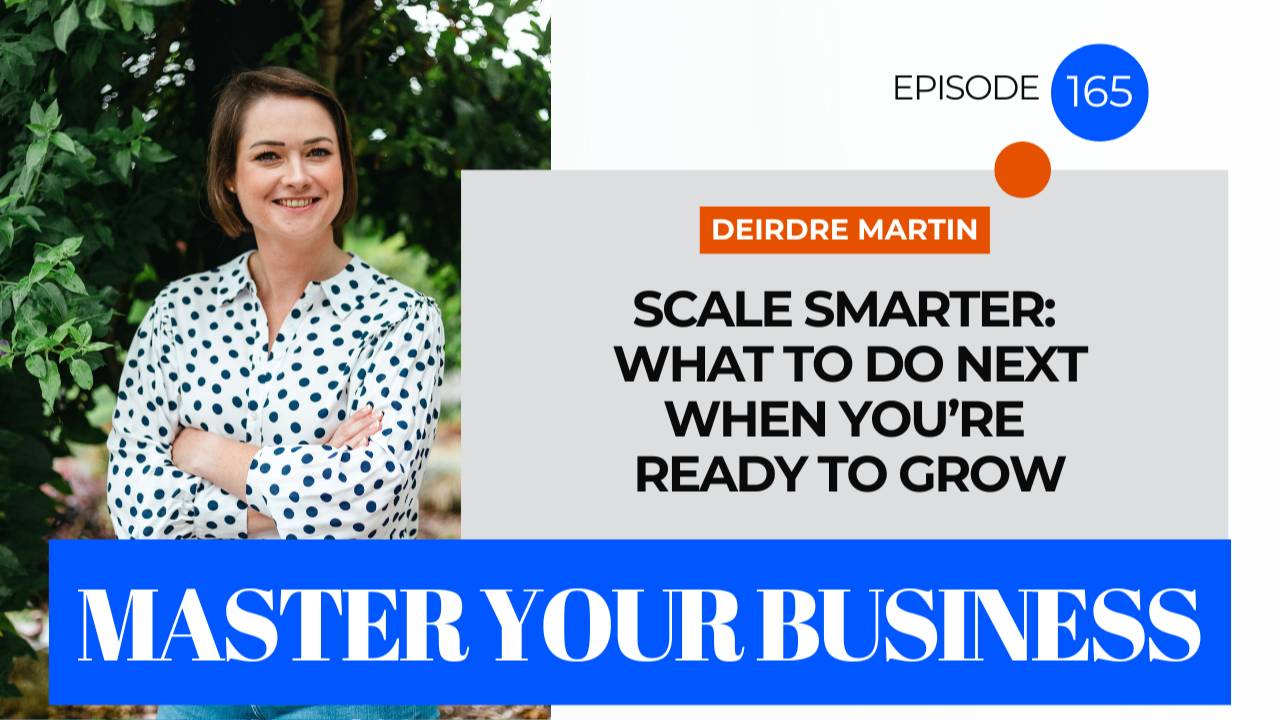
If you’ve got referrals coming in, happy clients, steady revenue, but have the feeling that you’re capable of more growth, you’re in the right place.
Key Takeaways
- Use one diagnostic question to decide what to do next to scale, then stop second-guessing every direction.
- Create capacity before you chase more visibility, or growth may turn into pressure and messy delivery.
- Build decision lanes so your team stops routing tiny decisions back to you all day.
- Stop trading time for money by packaging outcomes into offers and retainers.
- Commit to one move for 30 days, then reassess with data, not emotions.
“Stamina is not a scale strategy.”
Quick question. Answer it honestly. If you got five new clients this month, would you be absolutely buzzing? Or would your stomach flip with excitement about the revenue, then flop because you’ve no idea how you’d deliver without everything feeling like it’s on fire.
If your stomach flops at the thought of more demand, you’re not weak, dramatic ore even stressed necessarily. You’re getting information. You’re ready to grow, but the way the business runs still depends too much on you. That’s why this stage feels so irritating. You know you’re capable of more, and you are, but the busyness of the business keeps eating your attention.
I’m Deirdre Martin. I help consultants and service providers scale with neuroscience-backed business and mindset strategies without sacrificing their health or the people they love most. In this blog, I’m giving you a structured way to decide what to do next to scale your service business, without breaking client delivery or risking your reputation.
A question to reflect on and keep coming back to as you read through:
“What is the next best move that creates capacity and growth for you in your business without breaking your client delivery?”
What to do next to scale starts with one diagnostic question
Most founders are entrepreneurial and have ideas galore, so you don’t need more ideas. You need a filter to help you when you’re at the crossroads, and every option looks important. For example, when hiring feels risky, marketing feels necessary, and changing your offer feels like a big move. Sometimes, you get to those decision crossroads and do nothing because every direction feels like it has massive consequences if it doesn’t go your way.
“If you don’t choose your next move deliberately, the business is going to choose for you.”
This question above, forces you to think like a CEO. It pulls you out of random tactics and back into structure. It also keeps you honest, because you can want growth while also refusing to build it on burnout.
How to use this question this week:
- Pick one goal you want in the next 90 days: more clients, steadier income, or a stronger pipeline.
- Ask the question, what move creates capacity and growth without breaking delivery.
- Choose the move that makes the next two moves easier. That is often the right one.
Keep the question visible. When a shiny idea pops up, run it through this filter first.
If you are doing all the delivery, create capacity before you market more
This is the part that surprises people. Many service providers assume the answer is more visibility. Upping the level of content, networking, and paid ads all to get more reach. It sounds logical. It is also often the wrong order.
“If you’re already at capacity, more visibility just creates more pressure.”
Referrals feel safe. They also keep you reactive. You stay busy enough to avoid building a proper growth engine. Marketing becomes the thing you should do, but never properly do, because you’re delivering, managing, answering, fixing, and thinking. Then you get to content, and you go, not today.
That cycle doesn’t break with willpower. It breaks with capacity. Here’s a real world client example:
One of my clients, a founder was doing all the delivery in their business. Referrals fed and sustained the business. But growth plateaued because there was no bandwidth left to market or take on new clients.
So we started with hiring a VA. They got back 12 hours a week from that alone. Admin is a sneaky thief. It is rarely one big thing. It is the drip, drip, drip that keeps you in reactive mode. Then they hired a contractor to take some delivery behind the scenes, with the option to become client-facing later. That extra space turned into momentum.
Within two weeks, they quoted for five proposals over five days. Before that, it might have taken a month to have five proposals, never mind get them out so quickly. They also had time to network again. That led to speaking engagements, which increased visibility and credibility without being online every day.
If those five clients for you this month, would you be excited or panicking?
If you’re panicking, your next best move is to focus on creating capacity for yourself in your business. Full stop.
Do this next:
Track everything you do for a few days: Emails, admin, delivery, finance, marketing, sales follow ups and everything in between.
Then draw two columns:
- What can only I do
- What someone else could do with an SOP
One client used an Excel sheet with those columns and marked each task with an X. Simple. Effective. It makes delegation visible.
The next step to scaling your business is hiding in that second column.
The identity trap that keeps experts overfunctioning
Even when the strategy is clear, founders resist it. This is where growth gets personal. If your identity is built on being the expert who delivers, letting go can feel like lowering standards. It can feel like risking your reputation. It can also feel like you’re giving something up.
“If your self-worth is tangled up in being the one who does all the things all the time, growth is going to start feeling like you’re giving up something.”
You are not giving up quality. You are changing your operating model. Quality should live in standards, process, and clear expectations, not in your nervous system.
Pick one deliverable you do repeatedly. Document the standard for it. Then test delegation on that one thing. Build proof for your brain.
Decision lanes break the founder bottleneck
This is where founders get caught after hiring. They get help, yet still feel busy. Not because the help is bad, but because every decision still routes back to them.
Approvals. Questions. Tiny micro decisions. Escalations. It drains your attention.
“You’ve hired help, but all the decisions still route back to you.”
This isn’t only a leadership issue. It’s also an attention and time stealing issue.
The American Psychological Association explains that task switching creates a switch cost. You lose time and performance every time you reorient. Source: https://www.apa.org/topics/research/multitasking
Harvard Business Review reported knowledge workers toggle between apps about 1,200 times a day, costing almost four hours a week just reorienting. Source: https://hbr.org/2022/08/how-much-time-and-energy-do-we-waste-toggling-between-applications
So if your day feels shredded, you’re not imagining it.
What you need are decision lanes. Clear rules for what your team decides without you.
Examples you can copy:
- If it’s under X amount, you decide.
- If it’s a repeat problem, document the solution and propose the standard, I approve once.
- If it impacts scope, draft the message, I greenlight within a set window.
- If it’s not urgent, it goes into weekly review, not random Tuesday mornings.
Now rate yourself.
On a scale of one to 10, how often do you get interrupted for decisions someone else could make if the rules were clear?
If you are above six, your next best move is creating lanes.
Do this next:
Pick one decision category, client comms, scheduling, invoice follow ups, and create one lane for it this week.
Stop trading time for money with offers and retainers
“If you bill by the hour, your income lives and dies by your calendar availability.”
That is simple maths. This is why repackaging matters.
Retainers create steadier income. They also create structure. They define what is included in the project or delivery scope, what is not, and what done looks like. That makes delivery easier to delegate, easier for clients to understand, and easier for their expectations to be met.
And sometimes it might surprise you to learn that a contractor delivers faster than you. Better than you. Because they are not carrying the mental load of the whole business.
If you took a month off, would your revenue keep coming in, or would it pause while you were away?
If it pauses, there is no shame. It’s great information. But it’s worth reflecting on this:
What outcome do I deliver repeatedly, and how do I package it so it’s not priced by the hour?
This is how you stop acting like a human timesheet and start acting like a CEO.
The real cost of doing nothing is a stamina-based business
Here is the consequence most founders avoid looking at. If you don’t fix this now, you build a business that depends on your stamina. And stamina is not a scale strategy.
Financially, your revenue is capped because capacity caps. Mentally, you are always on. Leadership-wise, your team cannot step up because you are still the hub.
The alternative is not a dramatic reinvention. It is a sequence.
Capacity, then lanes, then packaging.
If you’re thinking, "I know this, but I just cannot implement it while delivering," that’s normal. Most founders don’t struggle because they don’t know what to do. They struggle because implementing while delivering is brutal.
FREQUENTLY ASKED QUESTIONS
How do I know what to do next to scale?
Use the diagnostic question, then choose the move that creates capacity and growth without breaking client delivery.
Should I market more or hire first?
If delivery depends on you and you are near capacity, hire first, then market from stability.
What should I hire first, a VA or a contractor?
Hire a VA first if admin steals your time, hire a contractor first if delivery is the bottleneck.
How do I break the founder bottleneck quickly?
Create decision lanes so fewer choices and approvals come back to you each day.
How do I stop trading time for money as a consultant?
Package outcomes into offers and retainers with clear scope, boundaries, and a definition of done.
What if I fear quality will drop when I delegate?
Start with one repeatable deliverable, document the standard, and test delegation in a controlled way.
Related Articles & Resources
- 3 Ways to Reduce Founder Decision Fatigue Today
- American Psychological Association on Multitasking, research on task switching and attention costs, https://www.apa.org/topics/research/multitasking
- Harvard Business Review toggling research, data on app switching and time lost reorienting, https://hbr.org/2022/08/how-much-time-and-energy-do-we-waste-toggling-between-applications
- Excel, used to map tasks and identify what can be delegated with an SOP
Full Transcript
[00:00:00]
[00:00:00] The question that reveals structural fragility
Quick question and I want you to answer it honestly. If you got five new clients this month, would you be absolutely buzzing? Or would your stomach flip flick excitement about the revenue, but then flop because you've no idea how you would deliver it without everything in your business feel like it was literally going on fire.
And by the way, if your stomach flocked, that's not an indicator of stress or anything like that. It's typically a signal of structural fragility because if your first reaction is it's the new clients, but your second reaction is, holy shit, how would I cope? You've got some structural challenges going on behind the scenes in your business.
That's actually great news, my friend, because structure is fixable. So stay with me because by the end of this episode, you'll have a structured way to decide the next best move for scaling your business. Whether that's hiring, getting outta the founder, bottleneck, or repackaging your [00:01:00] service so you stop trading time for money.
[00:01:02] The “I could do this in my sleep, but what now?” stage
Now, this is for the founder whose business is already working. And the next step is to take your business to the next level. But that next level feels weirdly difficult to choose, and you're not in chaos. You've done the chaos before and you can handle any chaos that comes your way. This is different.
It's that okay, I've done pretty well. I could nearly do this in my sleep stage, but what now stage, if you know what I mean. So it's those questions that are cropping up, that are keeping me awake at night. Do I hire, do I need to market more? Do I need to start doing paid ads? Do I change what I'm selling?
Do I change my pricing? Do I build a team? Do I stop doing delivery and hire somebody else in to do the delivery for me? And if I stop doing delivery. Who does it and what does that mean in terms of quality and do I wanna risk my reputation on that? My current clients and that and all of the things, these are questions that come up [00:02:00] so often with the clients that I'm working with.
And the frustrating part about asking all those questions is, you know, you're totally capable of more and you fricking are. That's what makes this stage so irritating. You've got like this incredible untapped potential in your expertise in your business, and you can feel you're underusing that potential because the busyness of the business is consuming your attention.
And here's the thing, if you don't choose your next move deliberately, the business is going to choose for you. It's gonna pull you back into the weeds with delivery. It's gonna pull you back into being the decision maker about every little tiny minute detail that needs a decision. It's gonna pull you back into being the person that.
Everybody in the business depends on, and you don't want that.
[00:02:53] The core diagnostic question, your next best move
So this whole episode is going to be anchored on one question, and I'm gonna keep coming back to it [00:03:00] time and time again. And that question is, write it down if you want. What is the next best move that creates capacity and growth for you in your business without breaking your client delivery?
Okay. Good question right now if you get clarity there. What will happen is you'll stop spinning at the crossroads that you're at in terms of which direction, and you'll know which direction to take. By the way, if we haven't met yet, hey and welcome. I'm Deirdre Martin. I help consultants and service providers scale with neuroscience backed business and mindset strategies without sacrificing their health or the people that you love most in the world, right?
We're gonna into three. Moves in order, and then I'm gonna give you a simple rule to decide which one to take first.
[00:03:48] Move 1, create capacity before marketing
So the move one. If you're doing all of the delivery, this might surprise you to learn, but your next move usually isn't more marketing or paid ads or anything in that direction. I've had [00:04:00] so many clients who are service providers come to me and they're ready to grow, and they already have regular referrals coming in.
They have repeat clients. They have a good steady income coming in, and that's a great sign because your work is. Working, right? You're getting results for your clients. They're achieving success. What you promised them in the first instance. They're accomplishing that and that's why they signed up with you.
They're now advocating for you, and that's fricking cool and well done if that's you, by the way. And you know, sometimes we don't stop and celebrate those things often enough. So just tell me, give yourself a pat in the back if that's you right now. But, and unfortunately there is a but. Referrals have a downside.
They can keep you busy enough to avoid building a proper growth engine because what happens is they're coming in but you are not being proactive. And when that happens, marketing becomes the thing that you should do, but never. Properly [00:05:00] do or never get really intentional behind it because you're so busy delivering, managing, answering, fixing, thinking, and by the time you get to content you're like, oh no, not today.
Right? And this is where I see so many founders go wrong. They think the answer is, I need to be more visible. I need that. But hold on, if you're already at capacity. More visibility just creates more pressure. It creates more fixing, thinking, managing, and all of the things. So for a lot of founders, the next best move isn't marketing.
It's actually finding a way. It's like clearing that fog to create capacity for yourself and your business.
[00:05:40] Real example, VA + contractor, 12 hours back weekly
And this has come up. Recently with a good few clients one was constrained because of time and personal commitments, and was close to max capacity, but not ready for visibility until capacity had been created and the other was completely on the other end of that, a founder doing all the [00:06:00] delivery.
Referrals feeding the business until recently and for years, the business was stable, but growth felt unclear because there was no bandwidth left for anything that actually moves it forward. They had no capacity to market. They had no capacity to create the visibility and to build additional demand. So the first move for them was to hire a VA and to outsource some of the admin work that they were doing.
It's not glamorous or sexy, but it's really fricking smart. And my founder who did that, they got back 12 hours a week. So super quickly because admin is like a sneaky thief and you find yourself doing it all the time 'cause it's just a thing that you do. But usually it's not one big thing. It's that drip, drip, drip of tiny little things that keep you really busy, but also keep you in that reactive cycle.
The next hire that that founder made was a contractor, somebody that could do some of the delivery [00:07:00] and behind the scenes. So the client didn't necessarily need to be aware of that, but then this person has the potential to come and be client facing as well. And this is where things got really interesting because that capacity, then that extra space turned into momentum for my client.
[00:07:16] The momentum shift, 5 proposals in 5 days
And within two weeks of having more space, they quoted for five proposals over five days. And previously that might have been a month's worth of stuff that came in all off the back of referrals only. And because they weren't drowning anymore, they had the capacity to be out networking that led to speaking engagements.
It led to visibility and credibility without having to be online every day. And that's where those proposals came from.
[00:07:42] Self-check, excited or panicked by more clients?
So if this is sounding any way vaguely familiar for you, I want you to do a quick little self check right now. I want you to just reflect on this. If five new clients landed this month for you, would you be really, really excited or would you be panicking?
If you're panicking, [00:08:00] your next best move is to create that type of capacity. Full stop. And here's a tip I give my clients when they're trying to create capacity. Grab a pen for this pause if you need to for a few days. Track everything you do in your business, all the emails you send, who you're sending them to.
The types of emails they are like are they just setting up meetings? What are they? CRM management follow up with clients delivery. Whether it's admin, that your admin delivery, whether somebody is at x stage in their journey with you, and this is what has to happen then. And you know, what does that look like?
Marketing? Maybe blogs or articles, newsletters, social media content. Whatever it might be. Do you need to create that? Could somebody else create that? Finance your invoicing, checking your banks, matching the stuff between your bank and your finance stuff.
Sending out invoices, following up on unpaid invoices, right? All of those things. Track everything that [00:09:00] you're doing. And then on a piece of paper, just draw a line down the center to create two columns and on the left side, right at the top, what can only I do? And on the right side, call it what someone else could do with an SOP.
Now one of my clients, we were looking at this actually only yesterday, and she had done it with an Excel sheet and she had just listed all the things and she had her two columns up at the top for only I could do or I could delegate this, and she just put an X as she was going through the stuff in each column so that she could see visibly what she could delegate.
The next step in terms of creating capacity for her is hiding in that second column. So if that's you, that's where there is an opportunity for you, but also in this very space when you're at that crossroads. There's an identity edge that I've seen crop up with so many clients as well at this stage, and that [00:10:00] is.
If your self-worth is tangled up in being the one who does all the things all the time, growth is going to start feeling like you're giving up something. But if you go ahead, you're not giving up quality, you're just literally changing the model. You're changing your operating model in terms of how you work, and that's totally okay.
[00:10:22] Move 2, decision lanes to break the founder bottleneck
So next is what happens when you create that capacity, but you still feel like everything roots to you or through you. And this is the best part. I think that this is the part where I see founders say, I hired help and I'm still busy. I totally get that because you've hired help, but all the decisions still route back to you.
You have to maybe approve things because you've guardrails in place or people are coming to you with questions saying, what do you think about this? Am I doing this right? All that sort of stuff. And there are tiny little micro decisions and there are things that those people are [00:11:00] escalating because they don't know what decision is right for you and your business yet.
[00:11:05] Research insight, switch cost and why you feel scattered
So everything still needs your brain. Ugh. And you're not imagining how exhausting that is. It is. Literally, there's a name on this. It's called a management tax, right? And interestingly, the American Psychological Association explains task switching, which creates an extra cost. It's like a switch cost.
So every time. You reorient to answer those questions or make those micro decisions and it distracts you from what you're working on. Your performance drops. Compared to staying on one task and literally seeing it through to completion, and also this one status is worth hearing because it explains why your day feels shredded.
[00:11:48] HBR stat, 1200 toggles a day and the real time loss
Harvard Business Review reported knowledge workers, so people who are service providers, consultants, coaches, all the people listening to this show, they. [00:12:00] Toggle on average, guess how many times? This number is nuts. I'm like, oh, I nearly like to track this for myself. On average, we toggle between apps about 1200 times a day.
What? 1200 times a day? That's costing almost four hours a week, just reorienting between tabs and apps and stuff like that. That's nuts. So yeah, no wonder, some days it feels like. What did I actually do today? 'cause you're so busy just switching between apps. Hyperfocused. Oh my gosh, hyperfocused. That's what we need.
So when your day becomes constant micro switching, you feel busy, but you don't feel effective. Oh, that's so me, that genuinely. And then you start thinking you need more discipline, more productivity hacks. Willpower, all those things, but no, you don't. What you actually need are lanes. So the next best move [00:13:00] here is to create decision lanes, not vague delegation, not on this lane.
It's things like if it's under X amount, you decide if it's a repeat problem, document the solution, and propose the standard, then you only have to approve it once. If it impacts scope, draft the message and then say that you'll greenlight it within a set window, right? If it's not urgent, it goes into a weekly review meeting that you have with that team member, so it stops hijacking your random Tuesday mornings.
So here's another quick self check-in I'd love for you to do. On a scale of one to 10, how often do you get interrupted for decisions someone else could make? If the rules or standard operating procedures were clear. Now, if you're above a six, you don't need another system. You simply need clearer leadership design.
You need to set some boundaries around your availability, but [00:14:00] also set expectations around what other people are empowered to do. And now let me call this out, that this is particularly useful for foundries around the a hundred K to one millionish. Stage where proof and demand are there, but delivery and decisions still depend on you because if you're trying to land your first consistent clients, this isn't your stage yet.
You don't have other people probably working for you. And this isn't really relevant just yet, but it's useful to have this one in the bank for later on once you're there. And here's the identity piece that I see at this stage for founders. If you're overly available, whether to clients or team or even your fricking family, sometimes you teach people to overly depend on you.
And I had this with another client where he had an office and he used to sit in the office with his team. Every phone call, every conversation, he was getting sucked into it and he didn't realize it. But what he was trying to do was to control every single outcome. And even though he thought he was [00:15:00] helping, he was actually stripping away people's autonomy.
And really pissing them off to be frank. And he was giving away his power, his capacity, his time. And when he realized this, when I coached him through it, the solution was to work from home a couple of days a week. And the difference was profound. Like yes, it took him a little while for the team to adapt because they were so dependent on him, but him too, to be fair.
He was like, oh my God, what do I do in this time? Like when I'm away and I'm like, this is your business development time. This is your time to work on your business and not in it. Fast forward, I wanna say two years later now his business runs autonomously without him and he's now set up two or three other business.
Right.
[00:15:48] Move 3, packaging into retainers, stop trading time for money
So once you've got capacity in lanes, then you can move into the money model because when income feels a little bit lumpy or clunky, founders tend to clinging a little bit harder, [00:16:00] bold tighter. They stay on like all of the time. And then what happens is it reinforces the whole cycle.
And this is where I say, stop. Trading time for money as your only option because if you bill by the hour, your income lives and dies by your calendar availability. It's simple maths. Let's say you work 40 hours a week, you've got 10 hours of admin, that's 30 hours that you are available for delivery.
If you're only charging per hour for that, your ceiling is capped. You've literally built a job for yourself. So the next best move to scale is repackaging. Offers retainers, but focused on clear outcomes. And again, so many clients, when we look at their revenue generation streams, the result is often moving from hours to retainers.
So income is steadier, delivery is clearer, and delegation stops been a guessing game because the work now takes a shape. Retainers force [00:17:00] clarity around what's included, what isn't, what are the boundaries, what the definition of done look. Like what gets delivered consistently. And when you have that, you can bring in a contractor and your contractor can sometimes deliver way fucking better and faster than you can.
And that means the client service improves, you get better testimonials and the quality improves. And hey, before you know it you're laughing, right? Your business is profitable.
[00:17:28] Self-check, does revenue pause when you’re off?
And here's what I would love to you to reflect on now, self-checking number three. If you took a month off, would your revenue keep coming in or would it pause with you while you're off enjoying your break?
If it pauses with you, there's no shame in that, none whatsoever. But boy, that's fucking great information and I'd love for you to write this down. What outcome do I deliver repeatedly and how do I package it so it's not priced by the hour? I'm [00:18:00] telling you there's a way. If you haven't figured that out yet, maybe we need a conversation.
But there is definitely a way, and you don't need the perfect answer today, but you definitely need to start thinking like the CEO of a scalable model and not like a human time sheet.
[00:18:14] The deeper cost, stamina is not a scale strategy
Okay, so let's put all of this together. If you don't choose the next move deliberately, you're going to default to what you know, delivery, delivery delivery, client delivery, right?
And over time, that has a cost. Financially, your revenue caps, because your capacity caps. Mentally and emotionally, you're always on. Even when you're off leadership wise, your team can't truly step up because you are still the central hub holding everything together. Probably a lot of it lives in your brain, but here's the deeper consequence.
Most founders never say out loud, but I've seen this happen. If you don't fix this, now you build a business that depends on your stamina. And stamina is not a [00:19:00] scale strategy and that's why this matters because the alternative isn't a dramatic burn it down reinvention of your business or your life or anything else.
[00:19:11] What to do in the next 30 days
It's literally a sequence. It's create capacity first, hiring that VA or contractor and look at what can you automate, eliminate, delegate, and maybe even get your VA to help. Apply that right? Then create lanes, so decisions stop coming back to you. And that means empowering people. And then look at repackaging, so you stop trading time for money and your income starts to become a bit steadier.
Now if you need proof, this isn't theoretical. That client who hired that VA and contractor, that move for them created 12 hours back per week, which turned into five proposals, quoted in one week instead of a month, plus speaking gigs. Plus, the founder finally had bandwidth to be visible in the [00:20:00] right rooms.
Now you know the way, you don't know what you don't know. Well, here's the bit that I see founders don't know that they don't know, is that when they are at that scale crossroads, this is where they get caught. They struggle to scale because implementing growth strategies whilst being full-time in delivery is brutal.
There's just no capacity and it makes you feel stretched and overwhelmed. And that's where having some support can help you change that speed.
[00:20:31] Work with Deirdre, Strategic Reset call
So if you're sitting there thinking, yeah, this is exactly my stage, then stop trying to solve it alone. Book a call with me. We'll identify your next best move in 30 minutes or less, and I'll tell you what to do first.
So you stop wasting weeks trying to pull the wrong lever. Click the link in the show notes to book your call today
[00:20:50] Watch next, decision fatigue episode
and if you want to know why the tiny decisions keep pulling you off track, just listen to three ways to reduce founder decision Fatigue today. The [00:21:00] link is in the show notes as well. Okay.
I always give an action step as we wrap up each episode. So here goes this one, pause and pick your next best move. Is it creating capacity? Is it deciding on lanes or is it repackaging? Pick the one that if you did it in the next 30 days, would make everything else easier for you. Write it down. Put a date beside it.
Stick it on your laptop, your computer, whatever. Make it real. Make it visible and tell people as well so you really commit to it. Okay. Full recap. If you're doing all the delivery, your next move is capacity, not more content. If everything routes back to you, your next move is lanes, not more effort. And if you're selling hours is your only option, your next move is packaging, not more time.
So share this with one founder who's doing well. Keep saying, I don't know what to do to get to the next level, or I don't have time, or whatever. And if you haven't done so before, please do me a favor. Please rate reviews as. [00:22:00] Subscribe to the show wherever you're streaming from today, and until next time, keep mastering your business.
Get the next one in your inbox. One idea a week on becoming known, generating demand and growing beyond yourself.
We hate SPAM. And we will never sell your information, for any reason.