LinkedIn Works Better When You Decide These 3 Things
Feb 10, 2026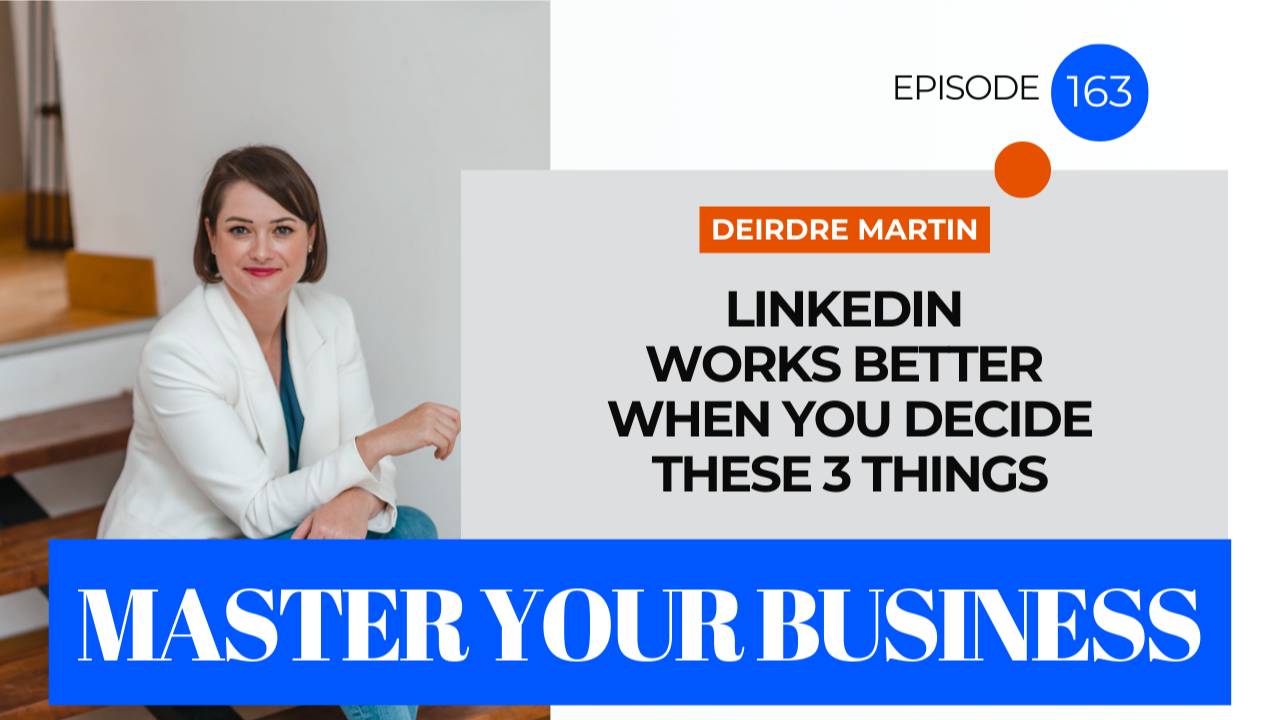
When LinkedIn feels like effort with no payoff
If you’re showing up, posting consistently, and still wondering why LinkedIn isn’t bringing clients, this blog will land close to home. The issue isn’t effort. It’s what you decided, or didn’t decide, before you started posting.
Key Takeaways
- Decide what LinkedIn is for in your business, or you will post for activity and still miss clients.
- Set one 90-day LinkedIn goal and attach a clear rationale to it so your actions remain consistent.
- Define success in outcomes, not vanity metrics, so you stop rewriting posts in circles.
- Fix your LinkedIn positioning before you post more, because generic messaging makes you forgettable.
- Share a point of view, not just tips, because demand comes from clarity and conviction.
“Visibility without positioning drains you. Whereas visibility with clarity is what builds your authority and thought leadership.”
Are you posting on LinkedIn but not getting clients? Showing up, trying hard, still getting a poor return on effort. If that is you, I understand the frustration. It is exhausting to do “the right things” and still feel invisible.
In this week’s Master Your Business, I share what came up repeatedly during my LinkedIn Visibility Challenge and why most advice about “posting more” misses the point.
“Posting more isn't a strategy. It's like LinkedIn cardio.”
Getting clear on the three decisions that make LinkedIn work better: your goal, your outcome, and your LinkedIn positioning, including the point of view that makes you memorable, is what helps to make the difference.
LinkedIn return on effort drops when your goal is vague
Most LinkedIn problems start before you write a single post. They start with a fuzzy goal.
You tell yourself you want more visibility. More reach. More impressions. Maybe you even want to “go viral.” It sounds like a plan, but it is not a plan. It is a wish.
“Most people set LinkedIn goals like they're ordering off a menu.”
When you don't define what LinkedIn is for in your business, you end up doing what almost everyone else does. You scroll. You compare. You copy. You post random content when guilt spikes, then you decide the platform does not work for you. LinkedIn works. Random effort does not.
There is also a mental load problem here. Your brain hates ambiguity. It tries to conserve energy and protect you from overwhelm. When you have to make constant micro decisions, your mind looks for shortcuts. That is one reason visibility feels draining when you haven’t decided upfront what your plan is on the platform.
Decision fatigue is well documented in behavioural science and medicine. It shows up as reduced decision quality, avoidance, and default behaviours when mental energy runs low.
Pick one LinkedIn goal for the next 90 days. One. Then finish this sentence.
This matters because….
“If you can't finish the sentence, you don't have a goal yet, you have a wish.”
Once your goal is specific, you can stop chasing everything and start building momentum behind one objective.
LinkedIn works better when you define success in outcomes
The next gap is success. Most people never define it. They say they want to be visible, but they never decide what “visible” looks like. That is why they keep second-guessing.
In the challenge, this showed up repeatedly. People were posting, deleting, and rewriting content, wondering whether it sounded too much like AI had written it. They were not short on effort. They were short on direction.
“They have no clear intention for what they're doing on there. The second is there's no defined outcome in terms of what success actually looks like.”
An outcome is not a vanity metric. It is a business result that LinkedIn supports. Here are examples you can use to inspire you. Pick one or decide on something that fits your business model and capacity.
- Two client conversations per week
- One qualified lead per week
- One speaking invitation per month
- One consultation booking per week
- One referral per month
This is especially important for coaches, consultants, HR advisors, cybersecurity service providers, and other professional services. You are not selling a low-priced product. You are selling trust. That means the metric that matters is conversation quality, not likes.
“This is not about not putting in the effort. This is more actually to do with direction.”
Decide on the one business outcome you want LinkedIn to support. Then build content around that outcome, not around whatever seems popular.
LinkedIn positioning is the fastest way to stop being invisible
Posting more does not fix a positioning gap. If your message sounds like everyone else, your content may get polite likes, but it will not create demand. Your ideal clients are surrounded by bland, recycled content. If you blend in, they will scroll on by.
“If your positioning is generic, your content becomes invisible.”
I created a framework called The Uncopyable Code™️ to help clients identify what makes them distinct and hard to compare. The biggest risk on LinkedIn is not being imperfect. It is being ignored.
“The biggest risk in a busy marketplace isn't showing up and doing something that is imperfect or scrappy. It's actually the biggest risk is being ignored and being forgettable.”
Here is a simple test.
If your headline could be swapped onto ten competitors’ profiles without changing a word, your LinkedIn positioning is too generic.
Now contrast these two statements from the episode.
“I help business owners scale.”
versus
“I help ambitious entrepreneurs on the verge of burnout stop doing more and build a business that actually holds space for them to generate the revenue and lifestyle that they dreamed of.”
One is generic. The other is specific. It speaks to a person, a pain, and an outcome. It also signals a point of view.
Write your positioning line like this
I help [specific person] who has a [specific struggle] get a [specific outcome] without the [thing they hate].
Do not write it to impress. Write it so a real client recognises themselves in it.
Once you write the sentence, look at your last ten posts. Do they match it. If not, your audience gets mixed signals.
“If your posts don't match your positioning, your audience is gonna get confused and confused people don't buy.”
Your point of view creates demand faster than more content
Many smart professionals default to being helpful. Tips. Frameworks. Lessons learned. It is good content, but it can still be forgettable. Especially if there is no point of view.
One of my clients, Mike, was posting weekly on LinkedIn. He had a newsletter. He covered what his niche podcast covered. He talked about his clients. The content was helpful and safe. But it was so far from personal that people did not know him.
So we made a strategic shift.
The easiest, fastest way for him to be known was one weekly video. Short. Direct. His thoughts and opinions about what he was already covering.
He did not need to post daily. He did not need a content factory. He needed to share more of his identity.
“He stopped being a narrator and became a commentator.”
A narrator says, “Here is what the episode covered.”
A commentator says, “Here is what you are getting wrong, and here is what I would do instead.”
That difference creates demand.
“Demand doesn't come from just showing up and being helpful. It comes from being clear, specific and brave enough to have a point of view.”
Thought leadership on LinkedIn needs facts and feelings
LinkedIn rewards story right now. Not fairy tales. Real stories. Observations. Tension. A shift.
The reason stories work is attention. Your brain pays attention when there is tension and uncertainty about what happens next. That is a neuroscience-backed truth, but you do not need to overcomplicate it.
“Stories create attention because they create tension, and tension triggers your brain's pay attention system.”
If your posts consist only of facts, frameworks, and tips, they can read like AI. People are tired of content that feels cold and generic. That is why combining facts with feelings works. You don’t need to feel like you’re confessing, but showing up with some honest humanity will work wonders.
It lets the reader recognise themselves in your content.
What to post this week:
- A real observation from your work
- One feeling, one line is enough
- The shift you made
- The belief you now hold
- An invitation, not a pitch
A simple action plan for LinkedIn strategy in 2026
If you want LinkedIn to work, stop treating it like a slot machine. Decide the three things first.
- Your 90-day goal
- Your success outcome
- Your LinkedIn positioning and point of view
Then align your content to those decisions. Your energy will improve. Your message will sharpen. Your audience will understand what you do and who you do it for.
If you want a deeper dive into turning visibility into clients, check out LinkedIn Strategy 2026, Turning Visibility Into Clients.
And if you want a quick way to pressure test your clarity, use the free LinkedIn Visibility Checklist.https://www.deirdremartin.ie/LinkedInVisibilityChecklist
Frequently Asked Questions
What is LinkedIn positioning in plain language?
It is the clear statement of who you help, what problem you solve, what outcome you deliver, and why you are the right choice.
How often should I post on LinkedIn to get clients?
Consistency matters, but volume does not fix unclear positioning. Post at a consistency you can maintain, whether that’s with one strong post per week that matches your point of view or seven.
Is LinkedIn still worth it for consultants and service providers in 2026?
Yes, if you decide the outcome and build content that supports client conversations, not vanity metrics.
Do I need to use video on LinkedIn?
No, but video can speed up trust because people experience you quickly. Use it if it feels sustainable.
How do I stop rewriting posts and second-guessing?
Decide your goal and outcome first, then write posts that serve those decisions. Less ambiguity means less mental friction.
What should I post in a conservative industry like HR or cybersecurity?
Share a clear opinion based on patterns you see, then explain your reasoning and what to do next.
How do I know if my message is too generic?
If a competitor could publish your headline without changing anything, your message is generic.
Tools & Resources Mentioned
- LinkedIn Visibility Checklist - A free checklist to pressure test your goals and LinkedIn positioning. https://www.deirdremartin.ie/LinkedInVisibilityChecklist
- LinkedIn Strategy 2026 – Turning Visibility Into Clients.
Full Transcript
[00:00:00] Why LinkedIn feels like a waste of effort
[00:00:00]
[00:00:00] Deirdre Martin: Are you fed up with your LinkedIn return on effort right now? If you're listening and you're thinking, Deirdre, I'm posting, I'm showing up, I am doing the fricking thing, and it's still not translating into clients. Oh, I get it. It's so frustrating.
And here's the thing, posting more isn't a strategy. It's like LinkedIn cardio.
And if you're using LinkedIn like a treadmill, sweating your fricking ass off. Praying the algorithm throws you a bone, then you're not building authority on the platform. You're not building your thought leadership. You're burning calories, wasting energy unnecessarily.
[00:00:39] The biggest myth about posting more
[00:00:42] Deirdre Martin: I see this all the time, and in fact, my LinkedIn visibility challenge, I had people show up on that and they were telling me that they had gone and done courses with so-called LinkedIn gurus who literally told them you need to post on the platform three times a day.
What? No, you do not need to post on LinkedIn three [00:01:00] times a day.
[00:01:00] What came up repeatedly in the LinkedIn Visibility Challenge
[00:01:00] Deirdre Martin: With that frustration and exhaustion, it came up again and again and again. These were seriously smart people who showed up for the challenge. Serious operators and ambitious entrepreneurs, people who know that they're great at what they do, but they're starting to wonder if they're a little bit invisible online, and their return on effort was just not paying off. And so what came through was a pattern that was really painfully clear. They weren't. Not getting the clients because they're not trying hard enough. They are on the platform posting. They are reaching out, inviting people to have conversations.
[00:01:42] Why smart consultants feel invisible online
[00:01:42] Deirdre Martin: The reason that they weren't getting the results that they deserved for the efforts that they're putting in was because they had a gap, and that gap was around positioning.
But also goals, and I'm gonna dive into this a little bit today because here's [00:02:00] what I see coming up all of the time with nearly every single person that I meet who is showing up on LinkedIn first, they have no clear intention for what they're doing on there. The second is there's no defined outcome in terms of what success actually looks like.
And then there's no real anchoring in terms of their visibility. So instead of building momentum, what ends up happening is they get stuck in this kind of decision loop that ends up burning them out and creating all of this decision fatigue. So where they're. Constantly posting and then deleting and rewriting and second guessing.
Putting it out there, wondering if it's enough of them, if it's too ai, then wondering why did it work, why didn't it work? And not actually understanding what's going on with the platform. And listen, I totally get this. This is not about not putting in the effort. This is more actually to do with direction.
If we [00:03:00] haven't met yet, I'm Deirdre Martin. I work with ambitious entrepreneurs who are fricking brilliant at what they do, but they're totally on the edge of burnout because they're doing too much without seeing the returns that they absolutely deserve.
[00:03:13] Visibility without positioning and burnout
[00:03:13] Deirdre Martin: And what I've learned over and over again is this, is that visibility without positioning.
Drains you. Whereas visibility with clarity is what builds your authority and thought leadership. So today I wanna help you close that gap in terms of positioning and goals. So we're gonna be talking about why just post more is a total and utter waste of time. Seriously, bad advice, and how to decide what LinkedIn is actually being used for in your business.
And then how to position yourself so your visibility creates demand, and you're not just on there for the sake of it. So this is grounded in what came up from the live challenge that I did, backed in some of my unique frameworks and also shaped by real client work [00:04:00] and my own work and my own visibility.
So this is not just theory bs, this is like what's working on LinkedIn right now. What helps you get visible and get clients on the platform. So if LinkedIn is feeling a little bit heavier than it should if you're showing up, but questioning whether it's worth it, like what's the point if you're doing all the right things.
But you still feel like you're not getting traction. Stay with me. Because once you fix the thinking behind your visibility, the strategy gets a whole lot easier. So I'm gonna break this into three parts. First one is, your goal isn't a goal if it doesn't have a why attached. So here's the thing.
Most people set LinkedIn goals like. They're ordering off a menu. I want more followers. I want more reach. I want more impressions. I want to go viral. Okay. Yeah, those things are cute, but tell me. For what? Why do you want that? Because if you don't [00:05:00] decide what LinkedIn is for in your business, you'll do what everybody else does.
You'll go on the platform, you'll scroll, you'll compare yourself to your competitors. You'll copy what you think is working or model your content on that. You'll post random stuff when you feel guilty because, oh, you haven't posted in a few days, and then you'll decide, no, LinkedIn doesn't work for me.
Does that sound familiar? I've been like that. I've been that soldier on Instagram, I have to say. Right? And I find Instagram so hard to show up on consistently, whereas LinkedIn, it just feels so much easier for me. And so like a lot of what I'm talking about here applies to different platforms. while I'm talking about LinkedIn because it's where most of my ideal clients use as their primary platform.
Let me tell you that this works. LinkedIn works. What doesn't work is you treating it a little bit like a slot machine, which tends to be my approach to Instagram. It's like, ugh, okay, I'll put a coin in here [00:06:00] and pull the lever and see what happens. But in the challenge that I ran recently, I used a marathon analogy because it's the truth, right?
You know, it's a little bit like entrepreneurship generally. When the a gun goes off and you take off, you're full of adrenaline and still by mile one you're feeling unstoppable, you're buzzing. You're like, yeah, I'm in a rhythm. I can do this. Or you know, if it's January, it's like, yeah, new year, new me, watch me go, all that sort of stuff.
And that's all adrenaline. But what happens is over time, adrenaline wears off and you end up in this kind of messy middle. And if you don't have a real target, as in if you don't know where the finish line is of the marathon, what ends up happening is you actually end up quitting.
[00:06:48] Decision fatigue and the cost of unclear goals
[00:06:48] Deirdre Martin: And it's not because you are weak or you're not good at the platform or because your competitors are better than you.
It's because your brain is doing what brains do. It's trying to [00:07:00] conserve your energy, it's trying to protect you. Your brain hates ambiguity. It hates open loops. It hates, I'll figure it out as I go. Your brain actually hates that. And if you're making a thousand micro decisions every day about what to post, who are you talking to on the platform?
What angles should you take when you going to show up? What offer are you planning to sell? Your mind is going. Fuck off. It's like that's just too much. It's mental overload. So it's actually starting to look for shortcuts and there's research out there that the average adult makes an estimated 35,000 decisions per day.
And entrepreneurs, seriously, you can amplify that because you're running the business, you're running the whole show. You're wearing so many hats. And that's one reason that visibility feels so fricking exhausting because it's more than. Just posting. You're not just posting. You see, you're deciding and you're deciding constantly.
So [00:08:00] here's what I'd love for you to do. I'd love for you to think, I have a dream for LinkedIn. What is that dream? Pick your I have a dream and make it super specific and don't make it be more visible. Try something like, I wanna generate two client conversations per week from LinkedIn.
Or I wanna build authority in one niche, so referrals start happening without me chasing them, or I wanna book speaking gigs. I wanna sell X number of spots in a program, and then ask yourself the question that most people avoid. What is the motivation behind that? Why do you want to do those things? Is it because you want freedom, flexibility, you wanna travel, you wanna pay off the mortgage in your house?
You just wanna feel relief from having some financial stability coming in. What is it? Because motivation beats discipline every single time. So here's what I'd love for you to do right now. I want you to write down one [00:09:00] LinkedIn goal that you're gonna focus on just for the next 90 days one, and then finish this sentence.
This matters because, okay, if you can't finish the sentence, you don't have a goal yet, you have a wish. Once you have a real goal, then you're gonna move to the part so many people skip, and that is point two.
[00:09:24] The Uncopyable Code and standing out
[00:09:24] Deirdre Martin: If your positioning is generic, your content becomes invisible. Now, this is a truth bomb that nobody wants to hear, but I'm gonna drop it anyway.
Most posting won't work. It won't get you clients. It won't, because it doesn't fix a positioning gap. And what I mean by that is if your message sounds like everyone else, your content won't actually create any demand. It might get polite likes, it may even get comments, like Great posts, or, you know, love this. Da da da.
But it won't actually convert [00:10:00] because your ideal clients are swimming in so much AI generated bland BS stuff that is like rampant on every social media platform right now. So the framework that I use with clients to help get through this and really identify what makes you unique is what I call the uncopyable code.
The biggest risk in a busy marketplace or in a busy platform isn't showing up and doing something that is imperfect or scrappy. It's actually the biggest risk is being ignored and being forgettable, people not remembering you. And I want you to feel the difference between these two statements as an example, right? I help business owners scale. That's the first one. Versus I help ambitious entrepreneurs on the verge of burnout stop doing more and build a business that actually holds space for them to generate the revenue [00:11:00] and lifestyle that they dreamed of.
One is like a flat piece of wallpaper, and the other is a mirror.
[00:11:09] Red ocean content vs becoming uncopyable
[00:11:09] Deirdre Martin: And in the Apex offer architecture that I work on with clients, there's this concept that, we've entered a red ocean of storytelling, meaning everyone's using the same type of storytelling frameworks or the same copywriting techniques.
Everyone's using the same hooks, they're literally being rinsed and repeat. And everyone's positioning the client as the hero and themselves and the guide. Story brand style, which I love and I absolutely advocate for. And don't get me wrong, I love it. It's clean, it's clear, it's really effective, but it has its place.
And I think that place is for bios and websites, but when everyone uses the same structure, it actually stops differentiating you because those frameworks become an anchor. Holding you back instead of allowing you to. Take off in your [00:12:00] own unique way. And so ubiquity becomes a liability. So if your LinkedIn strategy is basically like tell a story, be consistent post value, you're playing in the Red Ocean game.
And if you're like, what is the Red Ocean game, Deirdre? Just think about like one fish and a ton of sharks. Red ocean versus blue ocean, no sharks, right? The sharks are your competitors and they're right beside you, splashing around, and they are yelling the same thing. They're all fighting for that one fish.
The goal isn't to be better at the same stuff. When you show up on LinkedIn, the goal is to become uncopyable, which means that you stop trying to be. A service provider or a coach and you become a category, you literally become a category. So in the challenge, I had people look at their who in terms of their demographics.
Sure. Because on LinkedIn that helps you find those people like their job [00:13:00] titles, industries, location, but also a little bit deeper in terms of their psychographics. What keeps your person awake at night? What are they terrified of? Like what do they crave? And then we asked why should they care about why you say? what difference do you actually make?
What do they get on the other side after having worked with you? Because when you nail those answers, you stop sounding like. A freelancer, a contractor, a consultant, or a coach or whatever you call yourself and you start sounding like the only logical choice for that kind of person that's positioning.
[00:13:42] Client story, shifting point of view and results
[00:13:42] Deirdre Martin: And one of my clients actually showed up for the challenge when I hosted it live, and his name is Mike. And I'm just gonna share a quick story about Mike. He was literally showing up on LinkedIn weekly, but all of his content was client talk and topic talk. It was helpful, [00:14:00] informational, it was safe, but safe doesn't stand out.
So we worked on his brand strategy and his positioning, and what we determined was the thing that was actually missing was his point of view. And once he showed up and started to share that, suddenly his content didn't just inform. It actually started to signal who he was, what his identity was. So he was able to show up and say, this is who I am, this is what I believe, this is what I see in the market.
And people started to really follow that. People started to really trust him. And yes, it generated incredible results for him. It generated over a million impressions for him on the platform in less than a year, but more so it opened doors for him that he didn't even know existed. So I want you to take an action step here as well, and I want you to answer this in one sentence.
I help. Who do you help? [00:15:00] Who is, what is the struggle that they have? Get specific outcome without the thing they hate. So let me recap that. I help specific person who is, who has a specific struggle, get a specific outcome without the thing they hate. When you can write that sentence and make it human, make it real, make it sound like something that you would actually say that your client would actually say, then what you can do is you can take that pressure, test that positioning, and use it to help spot the gaps fast.
That is a great way for you to determine if what you're talking about is actually landing. Now I have also created a LinkedIn visibility checklist that ties in so well with what I'm talking about here and how you can show up on the platform in a really strategic and intentional way. So go and grab that.
It's free and you'll get it at deirdremartin.ie slash LinkedIn visibility checklist. Now when you are [00:16:00] writing that headline, don't overthink it. Use it to reflect on these questions and tighten your direction.
[00:16:06] Facts vs feelings in thought leadership
[00:16:06] Deirdre Martin: Okay, now we're gonna move on to the part that actually turns your positioning into visibility and converts, point three, and that is that facts don't create trust.
Feelings do, and your point of view helps seal the deal. So. One of the things that's really prevalent on LinkedIn right now is that it's rewarding story, not the once upon a time in a land far, far away type stories, but real actual stories, observations that you've made and that you share based on a situation that you talk about that maybe has a little bit of tension, that created a feeling in you and that resulted in a shift.
And the simple reason that that's working and why that is so effective is that when your content has feelings in it, it makes people feel [00:17:00] something. And that's what makes them stop scrolling. Because if all of your content is facts and frameworks and tips. AI can write that now, and it reads like something that AI did write.
And so people are actually starting to be repelled by that stuff and not because AI is evil. It's not, and I couldn't live without it. I use it all the time, but because AI feels a little bit cold flat, soulless, because guess what it is. So facts are great, but feelings are fricking greater. And you might say something like, I was doing everything right and it still wasn't working.
From the outside, it looked fine, but inside I felt panicky. The frustrating part wasn't that I was posting more, it was what it was costing me. I. That's human, that's relatable. And that's the kind of stuff that builds trust. And there is neuroscience behind this, right? Stories create attention because they create tension and tension triggers [00:18:00] your brain's pay attention system. Oh, that was a bit of a mouthful. I just try saying that quickly three times. So your client's brain doesn't care about your top five tips.
It cares about wait. What happened next in this story? And this was where for Mike, that shift that he did was genius. And the strategy that we created was he didn't need to start to post daily that he didn't have the capacity to be able to do that. We didn't make him, you know, stand up and dance in front of the camera and do crazy TikTok shit.
We didn't make him become someone he's not. We literally chose the easiest, fastest way for him to be known. And that was one weekly video where he shared his thoughts and opinions about what he was already covering in his podcast and newsletter that was already going out weekly. So he wasn't creating anything from scratch.
He was literally translating, and the key was this. He stopped being a narrator and became a commentator. And the difference is a narrator is like, here's what we've [00:19:00] covered in this episode. Whereas a commentator is like, here's what I think you're getting wrong, and here's what I do instead. And that's the difference and that.
Opinion that he started to share was what generated demand. And like demand doesn't come from just showing up and being helpful. It comes from being clear, specific and brave enough to have a point of view. And that's exactly why I teach Dramatize for LinkedIn stories because it creates that story arc, it creates the emotional, Paul creates the oh shit, or oh God, that's me moment.
[00:19:33] Permission-based visibility that converts
[00:19:33] Deirdre Martin: And when your story and positioning a line, your content stops being content, it becomes sales, pre-work persuasion. So here's an action step I want you to take on this as well. That's three for today. I this week I'd love for you to post a story, some story that includes a real observation from your business, a feeling you had, and it can be one line.
It doesn't need to be a full diary entry, but [00:20:00] like something that talks about the shift that you made and the belief that you now hold, that kind of thing. And when you. Go to end the story, finish it with an invitation, not a pitch, not book a call. Now more like, if this resonates with you, drop me a message.
I'd love to point you in the right direction kind of thing. And when you do that, what you're doing is you're leveraging permission marketing, and permission beats pressure every single time. It also helps. To generate trust. And by the way, if you want a bigger, more tactical 2026 strategy to turn visibility into clients on LinkedIn, go and listen to episode 157, the LinkedIn strategy for 2026.
It's one of the best complements to what we're talking about today.
[00:20:43] Final reset, deciding what LinkedIn is really for
[00:20:43] Deirdre Martin: Okay, recap. Time today was simple, but not easy. A goal without a why for LinkedIn or any other platform can quickly become a bit of a guilt spiral. And posting more won't fix a positioning gap. Facts inform, feelings [00:21:00] connect and point of view helps create trust, which is what generates conversions.
So write your positioning statement. Because if your posts don't match your positioning, your audience is gonna get confused and confused. People don't buy. Okay, again, go and grab the LinkedIn visibility checklist at www.deirdremartin.ie slash LinkedIn visibility checklist. You can use it today. It'll take you 10 minutes, so grab your pen cup of coffee, and just go for it.
If this episode helped you even a teeny bit, do me a favor and share it with one entrepreneur who you know is working hard on LinkedIn and wondering why isn't it working as hard for them as they're working for it. Also, rate review and subscribe to the show. You know the drill. And until next time, keep mastering your business.
Get the next one in your inbox. One idea a week on becoming known, generating demand and growing beyond yourself.
We hate SPAM. And we will never sell your information, for any reason.