Why Clients Don’t Get Results and What Client Success Really Means for Coaches and Consultants
Feb 09, 2026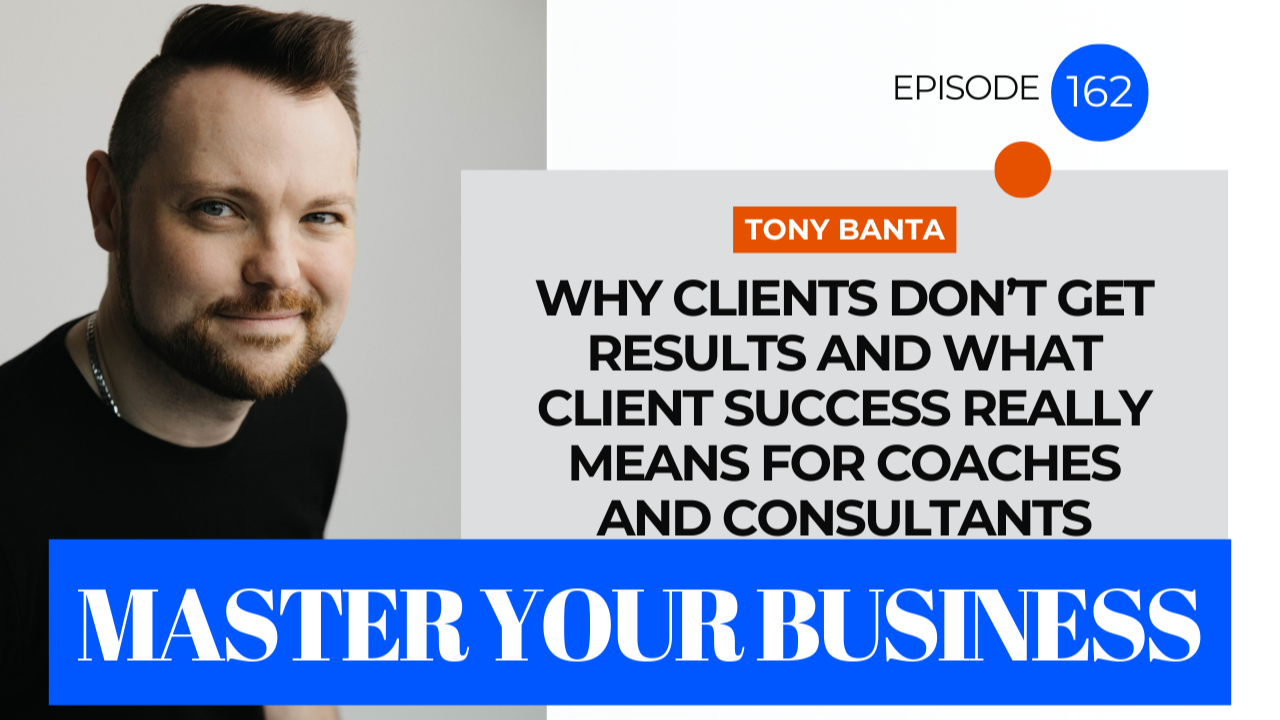
Podcast episode title: Tony Banta: Client Success Is Everything (Here’s Why)
If your clients are smart, capable, and motivated, yet still aren’t getting results, this will hit close to home. Because when outcomes slow down, most founders assume the problem is effort, mindset, or strategy. So they add more. More support. More content. More time.
And the business gets heavier. So do the decisions and the responsibility you start for feel clients achieving success.
I sat down with Tony Banta, client success architect and author of Liberating Potential, to unpack a simpler, more confronting truth. Clients don’t get results because of what happens after the sale. Or more accurately, because of what doesn’t.
This conversation is especially relevant if you’re a coach, consultant, or professional service provider building toward six or seven figures and wondering why results feel inconsistent across clients, even when your offer is solid.
Key Takeaways
- Define client success as an outcome you can identify early, not something you hope shows up at the end
- Build trust through consistency, because clients only share the real problem when they feel safe
- Treat referrals as a trust signal, not a nice-to-have
- Simplify the next step so resistance cannot hide behind confusion or overwhelm
- Fix the biggest drop-off in your client journey before optimising anything else
“People will only tell you the important things when they trust you.” — Tony Banta
Why Client Success Starts With Outcomes, Not Activity
Many businesses confuse motion with progress. Clients attend calls. Watch videos. Tick boxes. And still stay stuck.
Tony cuts through this quickly.
“If we’re running a business, and our job is to help clients, then how well they achieve the outcomes that they’re looking for is kind of our entire business.”
Client success is not participation. It is movement toward the result the client came for.
When you define success this way, delivery changes. Onboarding improves. Messaging gets clearer. You stop selling access and start selling progress.
Practical shift you can make this week:
- Write the outcome your client is buying in one sentence
- Identify one early indicator that proves they are moving, not just consuming
This alone improves client success for coaches more than most new frameworks ever will.
Trust Comes Before Truth, Every Time
Clients don’t always tell you what’s really going on. Not because they’re dishonest. Because they don’t feel safe enough yet.
Tony is direct about this.
“The trust is perhaps the most important thing.”
He references Brené Brown’s research on trust and the marble jar concept. Trust is built through small deposits over time, not one big moment. If you want the framework, her Anatomy of Trust is worth reading: https://brenebrown.com/resources/anatomy-of-trust/
In practice, trust shows up in unsexy places.
- You start on time.
- Follow up when you said you would.
- Communicate changes early.
- Do not overpromise and scramble later.
Reliability builds trust faster than charisma ever will.
Why Referrals Are the Most Honest Growth Metric
If you want to know whether clients truly trust you, look at who they refer.
Tony links referrals directly to customer acquisition cost, which reframes trust as a business signal, not a feeling.
“For every client that you bring in, how many people do they refer? That is a direct measure of trust.”
Referrals are proof. A client is putting their reputation on the line. If referrals are low, it doesn’t always mean your work is poor. It may mean the outcome is unclear, the relationship stayed shallow, or the client doesn’t know how to describe the win.
Simple way to act on this:
- Track referrals monthly
- Ask at the moment of peak satisfaction
- Give clients one sentence they can use to introduce you
This is referral marketing framework for consultants without the awkwardness.
Find the Drop-Off in the Client Journey
Most founders try to improve everything at once. That creates complexity, not results for you or for your clients.
Tony uses a constraint mindset. Find the biggest drop-off in the client journey and fix that first.
Ask yourself:
- Where do clients stop submitting work?
- Where do they disappear or delay?
- Where do the same questions keep showing up?
That point is the constraint. Fixing it often unlocks better results everywhere else.
This is client journey mapping for service providers without overengineering it.
Simplify the Next Step So Resistance Can’t Hide
Sometimes resistance is emotional. Sometimes it’s just friction. If the next step takes 10 to 20 hours, everything can hide inside that gap. Overwhelm. Perfectionism. Real life.
Tony’s approach is to simplify the practical path so you can see what’s actually happening.
“If we simplify that down… it’s a lot harder for things to hide.”
Practical examples:
- Replace a big task with one worksheet
- Replace “build the whole thing” with “draft the first version”
- Replace “do this for 30 days” with “do this twice this week”
When the step is small, follow-through improves. And if it doesn’t, you can coach the real block instead of guessing.
Measuring What Matters Without Lying to Yourself
Tony also offers a reality check on metrics. Early on, small numbers distort the picture. One difficult client can skew your perception.
So he asks a deceptively simple question.
Does it feel better?
If working with clients consistently feels heavy or strained, that’s data. Not drama.
As your business matures, metrics such as customer acquisition cost, lifetime value, retention, and referrals begin to tell a clearer story. Client success shows up there, too.
Conclusion
If your clients aren’t getting results, the answer is rarely more content or more effort.
It’s clarity, trust and simplicity.
Define client success as outcomes. Build trust through reliability. Track referrals as a signal. Simplify the next step. Fix the biggest drop-off first.
If you want the full conversation with Tony Banta, including how to think about trust, referrals, and measurement without fooling yourself, listen to the full episode of the Master Your Business Podcast.
Frequently Asked Questions
What is client success in a coaching business?
Client success is how well clients achieve the outcome they came for, not just attendance or completion.
Why do clients not get results even when they are motivated?
Friction, unclear steps, and low trust can block action even when motivation is high.
How do I build trust with clients quickly?
Be reliable. Communicate clearly. Do what you say you will do, consistently.
What is the clearest metric for client trust?
Referrals, because clients only refer when they believe in the outcome.
How do I reduce resistance without doing more work?
Make the next step smaller and faster so the real block becomes visible.
Related Articles and Resources
Liberating Potential by Tony Banta https://tonybanta.com
Brené Brown Anatomy of Trust https://brenebrown.com/resources/anatomy-of-trust/
Connect With Tony Banta
Website: https://tonybanta.com
Connect with the Host — Deirdre Martin
🌐 deirdremartin.ie
📱 LinkedIn
🧠 Work With Deirdre: Book a call → https://calendly.com/deirdremartincx/first-business-soiree-instagram
About Tony Banta
Tony Banta is a systems engineer turned client success architect who helps high-impact founders and leadership teams design organisations that scale with integrity, clarity, and ease. Over the past decade, Tony has guided companies from $1M to $30M+ and helped client-businesses generate more than $168 million in additional booked revenue through strategic back-end sales and client success optimisation.
Drawing from data on more than 300,000 client journeys across dozens of industries, Tony’s frameworks fuse Lean/Six Sigma Process Improvement, Industrial Psychology, and continuous innovation into one consistent outcome: growth that flows from alignment.
A former self-taught software developer, Tony realised early in his career that even the best code can’t compensate for broken leadership dynamics or inefficient systems. That insight shaped his life’s work: helping organisations remove friction, unlock client transformation, and scale sustainably.
Tony’s writing has been featured in Forbes, The Huffington Post, and Recruiter Magazine. He is also the creator of the long-running program The Client Success System®, and author of the 2026 playbook Liberating Potential.
Watch or listen to the full episode
Apple Podcasts → https://podcasts.apple.com/us/podcast/the-master-your-business-podcast/id1667327376
YouTube → https://youtube.com/@deirdremartinmyb?si=haAZF5yY4X8pYSbN
Full Transcript
[00:00:00] Why Clients Don’t Get Results
[00:00:05] Deirdre Martin: [00:00:00] Most coaches and consultants think they have a marketing problem, but if you've ever had clients who crush it, and then clients who disappear into the abyss, even though they both get the same level of support, you do not have a marketing problem. You have a delivery model problem and today, oh my God, we are going there.
I'm Deirdre Martin, your biggest cheerleader for business and your sassy but strategic guide to building a business that actually feels good to run. And this episode, this one is a masterclass because I'm joined by Tony Banta, systems engineer turned client success architect. The man who has studied 300,000 plus client journeys helped founders generate 168 million in extra revenue.
And basically crack the fricking code and why some clients thrive and why some stall out even when everything looks good or great on the surface. This bit's wild. Tony shows you the exact [00:01:00] behavioral patterns, psychological blocks, and delivery systems gaps.
That determine whether your clients become your biggest wins or your most painful question marks. So if you've ever wondered, why isn't this client moving forward, or what am I missing? Or is it me or is it them? Today you're getting answers. And stay with us until the end, because Tony is giving away 10 signed copies of his new book, liberating Potential exclusively to Master Your Business listeners.
So stay and I will tell you how to grab one later on. By the end of this episode, you'll finally understand why some clients succeed, others don't. Who doesn't wanna know that?
And what to fix in your delivery model starting today, right? Let's do this.
Tony, welcome to the Master Your Business Podcast. So it's thrilled to have you here.
[00:01:53] Tony Banta: It's so great to be with you, Deirdre.
[00:01:56] Deirdre Martin: Well, Tony, you and I chatted in [00:02:00] Vancouver at the Mastermind that we both attended, and you told me you're writing a book, which is pretty much done, and I've brought you here to talk about the book, which is all about client success or customer success.
So before we dive into the book, tell us.
[00:02:16] What Client Success Really Means
[00:02:16] Deirdre Martin: Client success, customer success, what is it? Let's start there.
[00:02:22] Tony Banta: Well, in a word client success is everything. That, like I would say if we're running a business and our job is to help clients, then how well they achieve the outcomes that they're looking for is kind of our entire business.
And. Of course, there's, you know, lots more to a business. We could talk about the, you know, marketing, we could talk about the influence on the, on the community. But at the end of the day, the businesses that help their clients, the like or customers achieve the success that they want are the ones that are gonna last.
And the ones that don't are, it [00:03:00] doesn't matter you 'cause we're not gonna remember their name.
[00:03:02] Why Strategy Alone Doesn’t Create Results
[00:03:02] Deirdre Martin: So true, and I totally agree with you, but one thing that I feel is that a lot of people focus on getting the clients and then they focus on amazing delivery. But maybe forget about the success part.
Can you speak to that?
[00:03:21] Tony Banta: Yes. And I love that question and that I so appreciate that you. You know, your experience in, you know, seeing the way that people think and the way that they operate, that, you know, with all of your clients that like, that you do an amazing job, that like leading as we've talked about it, the delivery is important, you know, absolutely.
The, like the operations of a business are important. But I like to differentiate between. Efficiency that, which I think a lot of people think about the let's efficiently the, like, let's efficiently the, you know, move people, [00:04:00] you know, through the onboarding process. Let's the, you know, let's the like help the, like, let's deliver, let's, you know, control costs while the, you know, while producing the best quality, the, you know, widgets if we happen to be an AI product business.
But the other side of that is effectiveness. And efficiency before effectiveness is a really bad formula. Are we allowed to, like, are we allowed to use profanity? I noticed that most of your Yes. Like most of your episodes have the explicit tag. Is that okay? Go for when we put efficiency first before effectiveness.
We just do stupid shit faster and the like more efficiently. The flip side is where success comes in. The, this is, some of my background is in lean and six Sigma and which are consulting. They are consulting methodologies. Six Sigma famously sort of pioneered by a General [00:05:00] electric. That was the study of the, like the, like, it was looking at how well are we accomplishing the purpose, the, like the customer's requirements, the, like, how well are we accomplishing that?
It was the effectiveness. And so client success is the effectiveness that like it is if our clients are, you know, coming to us so that they can be more fit. Then at the end of a three month program, are they more fit or if they come to us so that they can, you know, get a promotion at work.
The, you know, a lot of amazing programs the, like, around, you know, leadership and around career development. You know, do they, are they able to do that? At the end of the day, that's client success.
[00:05:45] Why Clients Don’t Tell You the Real Problem
[00:05:45] Tony Banta: To make it the, like, super practical. And the same thing is true for customer success
I bought the, like a little widget, the, like, I've been tinkering in my spare time with a smart home with a bunch of, you know, smart home tech 'cause I'm an [00:06:00] engineer at heart, so I love to, so I love to tinker the, and I bought the, like I just looked at it, it was two years ago, I bought a little widget that supposed to make my fireplace my gas fireplace.
Smart. Well, it had terrible instructions. It had no the like, like it was the, like it required me to do electrical wiring mixed with a gas fireplace. That made me very nervous. And so it sat on my shelf for the last two years. Well, that created no success. That created no value in my life. The, and just now the, like with the help of I, they're like, I got a custom GPT that will like teach me some of the electrical wiring that like that I needed to make it work.
And just now do I have it working. But if I were running that particular company, that particular department, they're like, I would be looking at, you know, what are the percentage of people that have the device sitting on the shelf that like, as opposed to have it working.
You know, what's the percentage of [00:07:00] people who know how to create the automations around it so that their home feels that, you know, beautiful and functional. As opposed to the ones that are, you know, frustrated, you know, returning the, you know, or like me just setting it on the shelf and when I see it, I feel bad because.
It's created no value.
[00:07:17] Deirdre Martin: Yeah, I have so many things that are just sitting there that are not done yet. I kind of blame my husband that they're not done, but then I'm like, Deirdre, it's actually your own fault. Get to figure out and do it. But you're so right. Like when things are too complicated or too difficult, people won't take action.
And I'd love to hear what your thoughts are from a coaching perspective on this, because consulting is a little bit different. Coaching, and a lot of the people listening are typically coaches or consultants. But with a coach, the idea is that you ask the people questions that they're resourceful and whole, and that they have the capability of doing the thing, right?
That they write their own [00:08:00] instructions and move forward.
[00:08:02] Trust as the Foundation of Client Success
[00:08:02] Deirdre Martin: So how do you suggest that somebody who is a coach can help their clients achieve better customer success?
[00:08:13] Tony Banta: This is a great question. There are two thoughts that I would share. The first thought is I think narrowly defined.
Their business roles are going away. So, so people that define themselves as a coach. And certainly if you are a coach, you are, you know, certified in the, you know, one or a few, you know, coaching methodologies that you can, that you know you can work for other people. You can do, you know, you could just be a coach and there's absolutely nothing wrong with that.
But to run a business that like to run a coaching business, I think it's important for people to widen. The, their definition the, just a little bit. That's not to say [00:09:00] that we shouldn't be a good coach. That's not to say that we should, you know, violate the, like, violate you know, the best practices of coaching.
But if we're running a business. To help people get to an outcome. It's our job to bring in whatever tools and tactics and conditions are going to create the best version of the outcome. And so what that means in practice is the, like hybrid, and I say this all the time to people. I especially say this for clients that are agencies who think that their job is to provide a service.
That like, and I say you, you kind of have to be a little bit of a coach or consultant too, that like, you kind of need some of that because people can't necessarily that, you know, just take the agency service and accomplish success. So, so when you blend those that you get to create a far outsized result that like then sort of staying in a rigid line, the, [00:10:00] with that said.
As a coach that, like as a leader, the like of clients, the, even if your primary delivery mechanism is coaching sessions, that you still have the ability to design the pathway and the experience so that you can optimize for client's success. So I totally agree with you around the difference of coaching and consulting.
And in truth, it's a really bad formula when people try and do both at the same time. You end up kind of doing neither well. So it's a really good idea to be clear about what you're doing though, like in every client interaction. But you still, it's still up to you to design the process, and sometimes that looks like, I know that the, like I know that you like to make these the like hyper practical for you, for your listeners, which I love.
The, what that means in practice is. The, you get to design what happens [00:11:00] around the coaching sessions, so, so is there a questionnaire? Is there data that they're tracking that you know you can implement? Things that Yeah. That create a consultative result? While the session that you get to have still can be purely coaching, they're like, you can arrange it in such a way so that the clients are coming back and saying, you know, I didn't, they like track my, the, you know, data this week.
'cause it feels really bad to look at the numbers and then you can just be a coach. And say, that's really interesting. What do you think about that? The, you know, where is that the, like, where is that showing up? They're like, what do you think could be a possible resolution to that? They're like, you can then the, like still be a coach, but you've created the environment that, like you've brought the leadership to create the conditions so that you can still help the client get to that, like get to that ultimate result with a much higher level of success.
[00:11:59] Deirdre Martin: That's such [00:12:00] a great explanation, Tony, and I think what's really interesting to add to that is recently I read a statistic that where when you qualify the clients that you're gonna work with from a coaching perspective, if they're ready, like really ready to do the work, they're 40% more likely to achieve the success that they sign up.
For you to work with you for in the first instance. So like you're 40% of the way there if you qualify them and make sure they're ready before they even start. And then the other 60%, you know, that's where all of your strategies you've just mentioned there come into play. And what I'd love for you to share, Tony, is when people look at their success metrics and client success metrics, and here's something interesting, actually, let me just go back a step.
When I started the advanced coaching diploma that I did in 2025 with neuroscience, one of the very first sessions we did, one of the very first [00:13:00] classes, our coach supervisor said that you shouldn't measure your success by our client's results. So interesting. But at the same time, I was like, what? Of course, I measure my success by my client's results.
If my clients are not making progress, well that's kind of on me, right? And so when I look back at some of the results and successes that my clients have, there's somewhere I'm. Fuck. Yeah, that was amazing. And there's others where I'm like, damn, why didn't that work out better? And I don't, you know?
Mm-hmm. It's like trying to figure that out. And for me, I feel a bit guilty. I feel a bit of ashamed, bit ashamed, and I'm like, Hmm. So, you know what do you suggest when people are looking at, you know, how many clients actually achieved the success, how many didn't? Like what should they do around that piece?
[00:13:51] Tony Banta: Yes. I love your level of care and I just wanna call that out, that like, for a moment, that like you are, that like you are [00:14:00] my people that, you know, you are, that like you are the best. That, like, that like, that our industry has to, you know, has to offer, the, because you do care.
The, and some of that is your own, you know, your own drive. But I also know that's because the, like, you know that every one of the clients is a human who is capable of incredible things. And so when they're not, when they're struggling, of course your mind goes to say that, like, what should we do?
What can we do that, you know, I totally agree and. So much of life. This is, I think, you know, part of the, like growing up is that we learn that there really are no absolutes that like so much of life is a balance between the, like, between multiple things. The, you know, like masculine and feminine is a perfect example that like one is not that, you know, despite some of the things we may read on the, you know, dark corners of the internet.
The like, neither one is good. The, like, the, like neither one is inherently good [00:15:00] and the other inherently bad. We kind of need both to create life. And I think the same thing is true of what your, you know, of what your certification program leader said that where it is really important as a coach to have a level of detachment of the results that happen in the micro.
And because there is, because there's nothing worse. And I've been here, right? I've made this mistake where, you know, when we care more than our client does about their result, really weird things happen. The like, it is not a good, we do not give a that, like we do not lead them with the best experience that we should.
That like, or the like coach them the like with the right experience. So we need to have a detachment in the micro that we need to be okay with any of our clients failing because at the end of the day, they need to do the work. And if we the, like, if we get in there [00:16:00] like a helicopter parent. They're like, if we get in there the, you know, end care more than they do, we actually disempower them, which is perhaps the worst thing that we can do.
The flip side of that though and this is the differentiator that I would make, is the micro versus the macro, the in the micro that we need to be Okay. You know, as I was just saying. But in the macro, looking at the aggregate of the data. We very much want to track the results that are created.
I think a really important thing to say to coaches that are just starting out is the it's really important that what Deidre said there is even more important for you. That you could have a string of clients who really struggle. And that may have nothing to do with how well you are coaching them a lot of the time.
To just reference back to the statistic that Deirdre said a lot of the time it's because we are we're bringing on the wrong clients though, like we're [00:17:00] attracting the wrong clients. And so that may be the outcome though. Like that may be the kind of conclusion that we draw from looking at that, from looking at that macro data.
But we do want to still understand what went wrong, that, you know, whenever I am, and we do that, like we do a lot of client fulfillment, the like audits that, like where we'll go into an organization, we'll collect a whole bunch of data that we've done this, that, you know, we've done this, that like hundreds of times.
[00:17:30] Where Clients Drop Off in the Journey
[00:17:30] Tony Banta: That like we have data on over 300,000 client journeys that like over the last decade. So we've seen a lot of these and. That when we do that, we obsess over the clients that didn't get good results. And when I say obsess. We get to do that, that like with our client, because we have a level of detachment.
So that's, so, that's much easier for us to do than it is for them to obsess over that. I wouldn't, you know, necessarily say that a coach should [00:18:00] obsess over their own, you know, client's results. But the reason why do is because we wanna understand what really happened. And so we look at that data in a container that, with the coach or the consultant or the, you know, the practitioner, whatever it happens to be.
The, but with a level of curiosity and with very specific instructions so that we can look at it from a systems perspective so that we can say what was missing, what did that client need and a good percentage of the time, there was nothing that the organization could have done.
It was probably a client who shouldn't have been enrolled. And that's a tricky, that's a tricky line to draw. We can of course talk some more about how we draw that line, but the thing that we see, the thing that we see overall is there's almost always. 10%, sometimes even 20%, that of a client population who will never get the results that are discussed and promised in the [00:19:00] marketing no matter what they do.
The not, no matter what the client does, no matter what the organization does, no matter what the firm, the coach, the consultant does. The flip side is also true. This is the 80 20 rule. The Pareto principle 10 to 20% of the client population will get great results no matter what you do.
The thing that's really important is the 60 to 80% in the middle. That's the group that we can actually affect. And the really important thing is that, and this is what almost every organization gets wrong. Is that all of the attention goes to the 10 to 20% at the bottom and the 10 to 20% at the top.
Like that's where all the attention goes. We wanna spend time with the winners 'cause they make us feel good. 'Cause that's fun. The, and we feel bad, or at least those of us who, you know, care the like, like we do feel bad when people are struggling. And so we want to lean into that group of people that like where a much better question [00:20:00] is looking at the behavioral indicators.
So that we can, so that we can map, you know, what the, like what actually differentiates someone from the bottom, the, you know, 10 to 20, the top 10 to 20, and then the middle 60 to 80. And then how do we help the people that are at the bottom step into the role, step into the identity of being part of the middle, 60 to 80.
They'll like, give them the invitation, create more structure. There are a bunch of ways that we can do that but create friction around their misbehavior so that it's harder for them to get away with the, like, doing the behaviors that have them stuck in the bottom, the, like in the bottom category.
And then how do we maximize success in that, the, like in that middle 60, because that's the ball game.
[00:20:48] Deirdre Martin: Oof. I'm like, yeah, 60 to 80%. Those are the ones we can work on. So.
[00:20:55] Simplifying the Client Journey to Improve Results
[00:20:55] Deirdre Martin: Take us back a step with this, Tony, and tell me like what are the typical [00:21:00] behaviors or what are the patterns that you see that makes people be in that bottom 10% or stuck in the 60 to 80% and not be able to move up to the top 10?
[00:21:13] Tony Banta: Yeah, so I'll answer the second part of that first. The most common thing for the people that are in the middle, the most common, the, you know, barrier to keep the people in the middle from going into the group in the top is really just time. It's really time sustainability. They're like accountability. Because a good percentage of them that like will eventually graduate into the highly successful group.
But I should say that. The 10 to 20% who get results no matter what. And this may sound weird, but I almost don't care about them. That, you know, they're gonna be great. That like they're coming into our programs, like with the mindset, with the resources that, you know, with all of those things that they're going to be great [00:22:00] no matter what the, you know, on a decades long timescale, we don't need to worry about Apple.
They're like, they're gonna be just fine. The, like, we don't need to worry the like, because they can mess up the, like massively a lot and they'll still be fine. And that's kind of the same way that I think about the, like those clients that are in that top, that are in that top category that like, what I want is, I want the 30th percentile to move to the 60th percentile.
Right? They're like, that's like, those are the deltas that I'm looking for because as a value creation. That, like that's where we can create the like massive value creation. Now we still talk about the successes in our marketing of the top, you know, 10 to 20% because they're great. 'cause they're great stories.
And I don't think there's anything wrong with that. They're like, they're great stories that inspire other people so that they know what's possible, which is incredibly value producing for the bottom, for, you know, the bottom, the like 80% of a client, the, you know, population for them to be able to look and [00:23:00] say the, like, they can do it.
So I must be able to do, you know, something close to it. So the, like, we should still, you know, talk about them. We should still celebrate those successes. We also shouldn't identify, we also shouldn't link our identity to those successes. 'cause the truth is they'd be successful no matter what we did.
You know, we could, the, like, we could send 'em a fortune cookie and they would still turn it into, you know, they would still turn it into more success. So we shouldn't connect our identity there. That's a trap. But in terms of the question, the, like the first part of your question. Is, what are those behavioral indicators that keep people in the bottom 10 to 20% who seem to never get results no matter what we do with them?
It's going to be different depending on what your subject matter is, the, like, who your clients are, what you work with. But the common through lines are people who don't show up. They have people who are disempowered. So they don't believe that what [00:24:00] they can do will actually make a difference.
And there's a lot that we could talk about there in terms of the, like, in terms of empowerment, creating empowerment, you know, where that comes from, the ways that some programs actually to like disempower clients in some weird ways. There's lots of things that we could, you know, talk about there, but that's a very common through line.
And then third it is, that usually that people run into predictable, repeatable resistance. That, at that, like at all of the stages, at the, you know, through all of the stages of a program. 'cause the data that I shared, the, you know, or the the heuristic of the top 10 to 20, the bottom 10 to 20, and then the middle 60 to 80.
We can also look at that data for every stage of our program. So if we have a program that's five stages, some of those people that are in there will be the same. And of course, the people that are in the bottom 10 to 20 probably won't make it [00:25:00] past the first couple of stages. That's part of the problem.
They're like, they move too slowly. They don't, they're like, they don't get the things that they need to do and keep moving. But we can look at where people are, the. The on a stage by stage basis because different people and different, you know, kinds of people, their success will fluctuate and shift as they move through a program because as they say, they're like new levels, new devils.
And somebody that may be really great at the first stages of a program may really run into hidden resistance. And I say hidden resistance because. That if we're not asking the right questions and looking at the right data that we may just think somebody got busy, like we look at the surface level excuses of where people drop off, but there's always a much more interesting story that lives underneath the, like those surface level excuses and
the client may be blinded to that story [00:26:00] themselves. But that doesn't make it any less interesting. I think that makes it even more interesting to, to find out what was really going on there.
[00:26:06] Deirdre Martin: That's so true because yeah, sometimes it's like on the outset you kind of know what's happening.
They're busy, they're in the middle of a launch, they're doing whatever, their full flow in client delivery. 'cause they just won that new contract. And so sometimes you do see people drop off and then come back, or they don't show up, but they're saying they're doing the work. When you check in and it's like.
Oof. Are they doing it or are they not?
[00:26:33] Connection, Boundaries, and Client Outcomes
[00:26:33] Deirdre Martin: And so I'm curious, what could a business owner who's listening do to be able to distinguish between, it's a journey kind of system problem that they've created versus it's a behavioral, psychological problem with the client if they're feeling disempowered or something like that.
[00:26:51] Tony Banta: So I wouldn't differentiate between those two. I would say they're exactly the same. That like, I would say the journey systems, [00:27:00] things that are, there are the very things that create the psychological resistance or the, you know, like the individual, the like resistance. And the truth is it's hard to know.
That, like, it's hard to know exactly what's going on an individual basis that like, when I work with my top tier clients, I spend a lot of time with them. The, you know, I go, they're like reasonably deep. And then we've had programs where the, you know, we have groups of people that we're serving, you know, 20 to like 30, sometimes 50 people at a time.
And the, it's not, I can't go that deep. So the. The approach that I would take to that leader where I can have really candid and deep conversations with them, where I can ask them that, you know, Hey, you shared with me that, you know, you're really afraid of, stepping into the spotlight because.
The, you know, of this story that you, told me when you were a kid or, you know, something like that. Whatever the situation happens to be. I can do that [00:28:00] with a private client where we go deep. I can't really do that in a group. Call with other people, and that's not exactly the same. There are some things that I can, there are some things that we can do to, you know, help people think of those things for themselves and then show up.
But in truth that's a trickier terrain that, you know, like, anyway. But the way that I would go about looking at it is look for the pockets of hidden value in the data. So when you look at. The amount of time that it takes or the levels of success. It's going to depend, you know, greatly on the, like, what your program is.
But if we take the, you know, a standard, the like biz op program of like creating your, you know, your ideal, the, like your ideal offer, the, you know, selling that to a small group of the, you know, people, they're like scaling that with some, you know, marketing, things like that. If we take that as a for instance, then you look [00:29:00] at the client results at each of those stages, the biggest gaps that you see that, like this is the theory of constraints that like you just look at in the same way that you would optimize a marketing funnel that like where you look at where the biggest drop off is in the funnel.
The, you know, you're running ads they land on the landing page. You know, do they convert for the free offer? You know, do they buy the next one? We just look at where the biggest gaps are and then we go to work resolving that. The same thing is true for the client journey that we just look at where the.
That, where are the biggest, the like gaps where people fall off? Like, and then we go to work and say, if we try to do other things or if we, that, you know, that's, this is a great, that's a great opportunity to survey the clients that are there, that, you know, find out what's going on that like where they are at that stage.
And then we go to work, you know, seeing how we can the, like, how we can resolve that. I should give one note about how we resolve that [00:30:00] sometimes the way we resolve. The deeper the like emotional journey of the clients is by making the practical journey easier so that we smoke out the emotions. So if we're asking clients to do things that require a big lift.
There are lots of reasons why that may be hard for someone to do. It could be because they have emotional resistance to doing that, but it could just be, it could just be time. They're like, if we're asking clients to do something, the like, where the step, the before they bring back the results is gonna be 10, you know, 20 hours.
That's a lot to ask someone to do. There's a lot that can hide in there. If we simplify that down, give them one worksheet where they bring that one worksheet back, and then we have them the, you know, make five that, you know, cold calls or, you know, something that they're something like that. With the result of that worksheet, it's a lot harder for things to hide, so we just make it really, really easy.
This is [00:31:00] also where I mentioned before, I love to talk with agencies about building in coaching and consulting. This is also where I love to talk about the, you know, growing the like coaches and consultants and say, add an agency service in there that like, add a piece where you can do some of that for them.
That, because that will then that like reduce that resistance that like, and smoke out what's really going on for them. Because at the end of the day, we want them to realize what's going on for them. We want them to have a degree of ownership around that. And to let their desire to move through that resistance, be stronger than whatever that resistance is.
[00:31:37] Deirdre Martin: Oh my gosh. I love that and actually really resonates with me too, because a lot of the clients I have in Millionize, they do that. They were consultants initially, but then they have the agency piece or else vice versa. I've had clients as well who've come and they were. Agency, but they wanted to actually switch to more consultancy and coaching.
So it's interesting to see that [00:32:00] and the shift that people go through in their businesses. Well, that's such a great explanation, Tony. Thank you for that. And I think like for somebody who's listening and they're thinking, okay. Just give it to me straight, Tony. Be straight with me telling me what are the exact steps that I should create?
[00:32:19] How to Fix Client Success Without More Work
[00:32:19] Deirdre Martin: If my business is brand new, clean slate, I'm literally going out. What exactly do I need to do step by step to guarantee that as much of those 60 to 80% are getting the good results.
[00:32:34] Tony Banta: Yeah, so. When you're starting out, because the answer is gonna be different there for the, you know, starting out and in the, you know, low six figures, the like range as opposed to a more mature, the, you know, business.
But for the people starting out, it's all about connection. Like it's all about the depth of the relationship between you and the client. And that brings up a lot of [00:33:00] interesting resistance for leaders. Where there are feelings of, you know, where there's resistance in the leader themselves, where they want to have some arbitrary that, you know, boundaries and limits because they may struggle with, you know, people pleasing or like, you know, you and I, sometimes they care too much and that's the, like, that's hard.
They're like, that's hard to do. But. Looking at that resistance head on and figuring out what you need. 'cause I'm not suggesting when I say connection that you have no boundaries or things like that. That's insane. Of course you wanna have boundaries with your clients that like, but you also wanna have boundaries that empower, that like, and support deep connection because when you're starting out the depth of the relationship is the most important thing.
The like, and specifically in that connection where you get to sit in the certainty of what you know is possible, that like, and then in your connection with the client, [00:34:00] they can feel that from you along with the psychological safety and trust so that they can tell you what's really going on for them.
Like those early clients and those early days in a business. Are, they're like magical because the, like, you get to, that is your job. Your job is still figuring out what the product is, even though you've created the, you know, client journey. And if you have not yet, the, a Deidra has a great, the download for that, the, that like you want to identify the client journey that like of course, but then you're refining that, then you're that like you're playing that out. You're seeing, okay, how does this work in reality? How does this work with the first five clients? With the first 10 clients that like once we go to.
You know, 30 clients, like, that's when we actually get some statistical confidence that like, where we can see, you know, where are the people dropping off. Which is the most important thing that, like when you say, you know, when you say they tell it to me straight. The real [00:35:00] trick is you're not gonna have statistical confidence until you get to 30 and then about a hundred.
And so there are gonna be two different levels there. You could bring on five clients where you enroll the wrong clients and there's no amount of connection that's gonna make them successful. That like, and that's really good data. Like if that's what you're finding to work on your marketing, that like.
Now, if you are doing that and you're saying to yourself. I don't know what to say to the cl like, the client is saying this thing to me and like, I see that they can be successful, but I don't know what to say, or I don't know the, you know, I don't know how to lead them through this, the, like block that's there.
Well then that might be a good idea to refine, you know, your abilities as a coach to, you know, get some help so that, like you can have another set of eyes. Look at those, you know, client journeys. And then see that, you know, what is really going on there. But a lot of the time in those early days, get more clients, get, like, get better clients.
They're like, but also, you know, as much as you can to like, [00:36:00] you know, spend time connecting with them. And that's a great way that you can go above and beyond. In the surprise and delight, the like sort of way with your, the, like, with your client experience. Like, when I had group programs, when I would have a free afternoon, the, like, when we would be, you know, finished with all of the things, like I would do a popup, the, like, I would do a popup, the like ask me anything where I would drop a message in the group.
I think we were using Slack at the time. I would, you know, drop a message in the group and say, Hey, I have an hour. They're like, does anybody want to hop on the, you know, does anybody want to hop on Zoom? And like, we'll like, look at things together. And then I'd get three people that would, you know, hop on would feel amazing for me.
That like, but they felt surprised. They were like, oh my gosh, like, that's so cool. That like, and then I would have only three people there. So even though it was a group program with 50, the, like with 50 people, the, like, depending on the time the like enrolled, the i, the, like, I was able to have a much more the like intimate, the like connected conversation [00:37:00] there.
I always learned way more about it, the like at the end that like then I knew, you know, going in and it cost me an hour where I got to have fun.
[00:37:09] Deirdre Martin: That's such a nice idea and simple thing to put out to people as well. And you know, I'm thinking like, how could you do that? Even on Instagram stories or LinkedIn, you could say it's like.
It's 2:30 PM right now on whatever date, and at three 30 I'm gonna have an hour. If you want to come and hop in the Zoom and ask me anything, you could go live and do it. I'm gonna be live in one hour, come and ask me anything and just be there. Yeah. That's so nice. And that Tony with this then, right? So connection and relationships is like big, huge, massive.
It's the thing. So. I think, you know, people pleasing is something that's huge for a lot of my clients, particularly the women, right. And what I've seen come up, and this was a huge [00:38:00] part of what I did over the last few years in my in. The service that I provide to my clients was helping them actually craft customer journeys with boundaries because the people pleasing turned into scope creep and crazy shit that people were doing and not getting paid for, and then burning themselves out, and it was a whole cycle.
So, you know, they're people pleasing, but not necessarily focusing on the right things in terms of results. So calls a great idea to help with connection, but what else do you feel, or in your experience, helps deepen connection and really enhance the client relationship?
[00:38:43] Tony Banta: Yeah, this, that's a powerful, that's a super powerful question.
The trust is perhaps the most important thing. The that people will only tell you the important things when they [00:39:00] trust you and the data on trust that, like Brene Brown has done some really interesting work. The, on that, like of course her work on the, you know, vulnerability is incredible.
[00:39:09] The “Marble Jar” Theory of Building Trust
[00:39:09] Tony Banta: In some of her more recent work, she's done a lot of, she's done some research on trust and the sorts of things that build trust and she has this analogy of a marble jar. That she the like that she uses, which is when that, like, that when we think of the people that we can trust with the big things, with the existential things, you know, with the things that are scary, which are gonna be really important.
That when we're on a transformational journey which a lot of programs still like our, or that's what they, that's what they promise. So she talks about the, you know, people will go to the ones that have a large, the like jar of marbles as opposed to one that has, you know, very few and the marbles that are the kinds of things that build the marbles in the jar.
What she was surprised [00:40:00] by in the data, and this really surprised me too but when I reflected on my own life, this was really true that. It's not the big things that, it's not the big things that add up to those marbles in the jar. Sometimes it's remembering a family member's name. They're like, sometimes it's the, you know, asking a question that, you know, that shows a deeper level of care in someone's life for, you know, what's going on for them.
And of course we can use that, you know, we can use the like CRMs for that. You know, we already use, you know, like AI tracking all of our meetings. The system that I use allows for some custom system prompts. One of the ones that I built in there that like was when people share personal stories to like, I want a list and bullet points of those personal stories at the end of the meeting notes.
So then I don't even have to remember it. That which is cheating, you know, maybe that like, but I care enough that I want that there, that like, I [00:41:00] want to remember it. I also just don't want to have to be hypervigilant when I'm, you know, running the meeting to have to remember those things. So there are all kinds of little, you know, little ways like that, that you can build trust with someone.
And of course, you know, as a. As a service provider, as a the, you know, leader, perhaps the best trust that you can build is incredibly simple, but it is just doing what you say you're gonna do. You know, show up to meetings that, like, when you say that they're gonna, that like when you say that they're gonna happen that, you know, or if not that, like, be that, like get in front of that and like let people know.
'cause of course things happen, you know, like, like meetings run late. The, you know, clients have emergencies, then we have to shift things. Those things happen all the time. That, you know, communicate that. And whenever you say you're going to do something for a client, do it. Which also loops us back to the people pleasing 'cause that's also the reason why you can't indulge.
Like in agreeing to things that aren't the [00:42:00] right things to agree to. 'cause then very quickly people that like very quickly people get overloaded and then they can't, they'll like be in their integrity in all of those little ways, which then erodes trust. And can kind of create a bit of a death spiral.
So, so those are some of the things that I would say about the, like building that connection.
[00:42:21] Deirdre Martin: And that's great because then, you know, the idea is that if they trust you, they're probably going to action the things that you've set out for them to do because you've got that connection and relationship with them.
But then how do you measure it or how do you track. That it's working. How do you track that this is having an impact on your business when you put in that level of care and connection with those clients?
[00:42:45] Tony Banta: That's a great question too. I remember I was in a self-help program about a decade, maybe more than a decade ago, like 12 years ago.
It was right after my father died. And I was in rough shape. [00:43:00] It was not a good time. And I was in this self-help program. That had a big community. And I remember saying there was, you know, like, they like encouraged us to, you know, call each other and like use the community as support.
And I remember having a conversation that, like with my friend Eileen from the community, and I said, Eileen, I need the metrics. They're like, I don't even know if any of this stuff is working. They're like, I need the metrics. They're like, what are the, like, how do I measure the, like this? Like how do I even know if like, this isn't just all painful for nothing.
The, and I was very frustrated. And so again, Eileen said to me that, well, does it feel better? Because if it doesn't, then it's not working, and if it does feel better, then it's working. And I would sort of say the same thing. I'm like, don't worry. I'll talk about the, like metrics in a minute. That like, but I like when it comes to connection and client relationships.
I would kind of use that [00:44:00] as the, especially when you're smaller, lots of metrics work when you're, you know, when you're larger, they're like, but if you're working with your first, you know, like 10 clients or if you, the, you know, like me for big chunks of my career, work very deeply with a relatively small number of clients.
The data's gonna be skewed 'cause you're living in the law of small, you know, small numbers. So I would encourage getting in touch with how it feels. If you don't feel good after a client call, that's a really good thing to do. Some introspection on, you know, journaling. They like, write some notes down.
They like maybe put the transcript of the call through, you know, through chat GPT and they'll like, ask it to like, do an analysis. The like of the, like why the call didn't feel good, the, like, share how it felt that like, I would wanna understand why that doesn't feel good. Because if you don't feel good when you're interacting with clients, that's a really, that is the best data, that is the best data point that I could ever tell you.
Because there's something there that like, there's [00:45:00] something that like where you are not in right relationship that like with either the program, the individual themselves, the like, or your relationship with like, like with client work. Because all the things that I'm talking about should feel good, like we're made to connect.
Like, I love that, you know, we are in a, the ADRA and I are in mastermind together and they're like, we just had a call last night. And I was, I felt great after that call. Like it was so much fun. We got to like, we got to laugh, we got to learn some new things that like we're made to connect. And so if there's something that is.
That is feeling weird about that or that's feeling strenuous about that for you. That doesn't necessarily mean you're going in the wrong direction, but it does mean that you probably want to find out why. You probably wanna find out a little bit more that like inside of that, because there will be really good lessons outside of that.
[00:45:54] The Metrics That Actually Signal Growth
[00:45:54] Tony Banta: I promised that I'd share about some statistics. The big three statistics, they're like, we call these the [00:46:00] platinum three. They're like, the big three statistics that you wanna look at are your client acquisition cost, the lifetime gross profit and unit profitability.
And none of those directly measure connection or. You know, clients trust or those things, but inside of those metrics, there absolutely is. They're like, there absolutely is the, like those things, for instance, customer acquisition cost.
[00:46:29] Referrals as a Measure of Client Success
[00:46:29] Tony Banta: When you look at, when you look at customer acquisition cost, one of the really important sub metrics underneath that is what is your referral coefficient for every client that you bring in, how many people do they refer?
That is a direct, the like measure of trust. If people trust you, they're gonna send people to you. If they don't, they're not. So looking at that is a really important thing. If you are doing some of the things we're [00:47:00] talking about in this episode, you're having some deeper conversations with people that like look at that referral coefficient over time.
They're like over, you know, three months and then see if you have some more people that Yeah. That are referring. If you see that, if you see that number going up. And again, if you're in the law of small numbers that you know, that may be harder to see, you may have a huge referral coefficient because, you know, last quarter you had no people refer.
In this quarter you had one person refer a hundred percent improvement. Which is great. But that's the that, you know, I would look at the, like some of those, the some of those metrics. The same thing by the way in the lifetime gross profit is, are people sticking with you longer?
Are they buying more than just the first thing that they buy?
[00:47:43] Deirdre Martin: I think those metrics are so important. a lot of my clients say Deirdre, all my clients come to me by referrals, but they don't know how to turn that tap on or turn that off.
So I have recorded an episode about how to turn on the referral tap, because actually you can do it, you just need to [00:48:00] know how. But I've had clients say this to me, Tony. Deirdre, I'm not referring people to you because I don't want them to learn these strategies and take all my clients. And I'm like, that's a bullshit answer.
There's enough clients in the world for you to be rich and for them to be rich as well. So like, don't worry about it, you know? But yeah. But go the go
[00:48:22] Tony Banta: get better friends. Yeah. But like, I would never say I don't want my friends to win so that I can, so that I can win more. Get better friends people.
[00:48:30] Deirdre Martin: Yeah. Right. I'm like that's nuts. But those are super nuts. Important. That is nuts.
[00:48:34] Final Thoughts on Client Success and Trust
[00:48:34] Deirdre Martin: Tony, we have to wrap up, I'm afraid. But it's been so enjoyable learning from you and hearing about some of the things that are in the book and speaking of the book, tell us a little bit more about that. When's it out?
What's it called? Where can people find it?
[00:48:50] Tony Banta: Thank you so much. It. So the book is the title is a Liberating Potential and it is the client success Playbook for unlocking [00:49:00] predictable profit and the lasting impact and unlimited growth. It is going to be released in the spring.
We're locking down an exact date, but either the end of February, the beginning of March, somewhere in there.
[00:49:13] Deirdre Martin: Amazing. And where will people be able to get it?
[00:49:17] Tony Banta: So it will be it will be on the, like Amazon you know, all of the online the, you know, places that you are used to getting books. You can get links to there from my website. And you can also get signed copies there if you go to tony banta.com.
[00:49:34] Deirdre Martin: Yeah. Fantastic. And Tony, where can people find you or how could they work with you if they want to get more in on this customer success stuff?
[00:49:44] Tony Banta: Yeah, absolutely. So the best place to find me is tony banta.com. We have a couple different, you know, programs and ways that we work with clients there.
And we'll explain that. And in case you couldn't tell, I love to connect. So if this did have an impact that, you know, [00:50:00] leave that, you know, leave a comment that, you know, leave a review, I'll see that. Like maybe we can get, maybe we can get people to leave some extra reviews for Deirdre.
The, like on the podcast apps mentioning this episode, but the, you know, tag us in a social media that, you know, I'm thrilled to, to respond there as well.
[00:50:16] Deirdre Martin: Fantastic. Tony, thank you so much. It's been such a pleasure having you on the show.
[00:50:21] Tony Banta: You too, Deirdre. So good to see you.
[00:50:23] Deirdre Martin: You too.
If you are like me, your brain is buzzing right now, and that's definitely a good sign because Tony doesn't just teach client success. He exposes the hidden patterns most business owners never see until it's costing them energy, money, and honestly their confidence. So here are the big three things I want you to hang onto first.
Success isn't random. 60 to 80% middle group he talked about. That's where your entire business is. One shift them and everything changes. Second, effectiveness beats efficiency every damn time. Doing the right things faster is still the wrong fucking thing. And [00:51:00] third, if a handful of clients always struggle, it's not a moral failure.
It's a systems invitation. And now you know what to look for. Your one action for today. Pick one stage of your client journey onboarding, first milestone, midpoint, and ask where do people slow down? That's your lever. Move that, and you'll feel everything else. Shift immediately.
And don't forget, Tony is giving away 10 signed copies of his brand new book, liberating Potential to Master Your Business Listeners. All the details are in the show notes. Go put your name in the hat for this one. Trust me, you will want it. Secondly, the customer journey map checklist that Tony mentioned in the episode.
That one's mine. It's there for you to grab for free as well. I will share the link in the show notes, but folks, do me a favor. If this episode hit home for you, share with one entrepreneur who needs to hear it, and as always. Rate, review, follow. It helps the show reach more brilliant humans like you. Until next time, keep mastering your [00:52:00] business.
Get the next one in your inbox. One idea a week on becoming known, generating demand and growing beyond yourself.
We hate SPAM. And we will never sell your information, for any reason.