
The Three-Layer Competitive Intelligence Framework Every Consultant Needs in 2026
Apr 21, 2026
Most consultants are only seeing one layer of the picture. Here's what the full view reveals.
Key Takeaways
- Broaden your definition of a competitor. A competitor is any path your client takes instead of hiring you, including tools, internal workarounds and the choice to do nothing.
- Map three competitive layers, not one. Position against direct competitors, adjacent alternatives and structural disruptors like AI to sharpen your messaging and pricing.
- AI often feels safer, not better. Many clients choose AI because it lowers perceived risk and commitment, yet they frequently feel disappointed when the outcomes lack strategic impact.
- Speak to hesitation. If your messaging doesn’t address the real fear or commitment hurdle, cheaper or faster options will look more appealing.
- Review your competitive landscape regularly. Markets shift quickly with new specialists and technologies. A quarterly review keeps your positioning grounded in reality.
When you lose a seemingly perfect client, it’s easy to chalk it up to bad timing or fierce competition. Yet the real issue often lies in what you’re not seeing. Many consultants, coaches and expert advisors define competition by resemblance, others who share the same title or serve a similar niche. They spend hours studying peer websites, social media pages, comparing offers and tweaking prices. But the client who vanished didn’t always pick someone on that list.
Sometimes they chose a template, a course or a software tool. Sometimes they kept the work in-house. Sometimes they filed the project under “later” because it felt less risky. If your competitive intelligence is built around people who look like you, you’re making decisions with only a sliver of the full picture. The result is confused pricing, unpredictable sales conversations and messaging that lands in theory but fails in practice.
This article reframes how to think about competition for consultants and expert service providers. You’ll learn the three layers of competition shaping buying decisions in 2026, why AI isn’t your biggest threat, and practical steps to map your market so you can position with confidence and clarity.
Why traditional competitor research falls short
Many experts approach competitor research by looking for people who resemble them. They note price points, follow social feeds and occasionally adjust their offers accordingly. That exercise can be useful, but it leaves out a huge part of the decision your client is making.
Imagine a brand strategist who watches other brand strategists religiously. Their pricing feels reasonable compared to the market, and they’re confident about their process. Then a prospect comes along, someone who has the budget, understands the value and seems ready to proceed. A few days later, that prospect disappears. What happened? Often, they didn’t hire another strategist at all. They bought a self-paced programme, hired a marketing agency that bundled messaging into a bigger retainer, or decided to postpone the project because it felt like a safer choice.
When you assume every lost client went to a direct rival, you build your positioning against the wrong comparison. You may highlight differentiators your prospect wasn’t even considering while overlooking the actual hesitations driving their decision. As a result, your messaging feels off-key, your pricing feels questioned, and your proposals end up in a black hole.
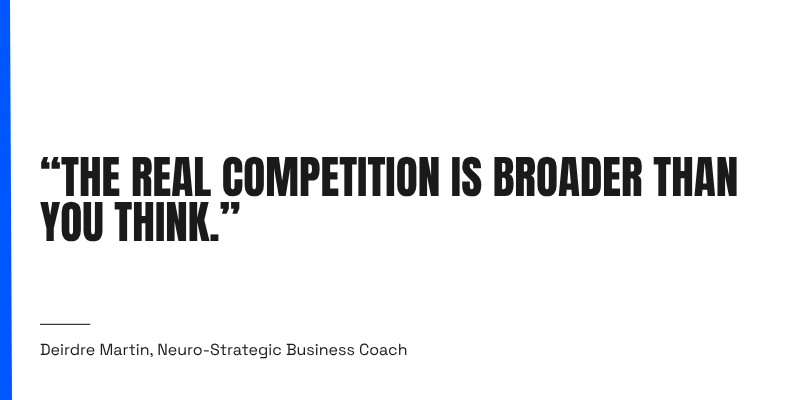
A competitor is any path your client takes instead of hiring you
Here’s the reframe: a competitor is not just someone who does what you do. It’s any path your client takes instead of hiring you. That includes:
- Direct competitors - other consultants, coaches or agencies solving the same problem in a similar way.
- Adjacent alternatives - different services addressing the same underlying issue with a different delivery model, for example courses, group programmes, generalist agencies or internal teams.
- Structural disruptors - tools, templates, AI platforms and the option to postpone or downgrade the project.
Once you accept this broader definition, your strategic question changes. Instead of asking how you stand out from other consultants, you begin asking what your client is comparing you to, and how you become the clearest, safest, most credible option in that set.
You’ll notice that the options competing for your client’s budget are varied. Some alternatives promise lower prices or lower commitment. Others promise speed or access to community. None of them necessarily offer better outcomes, but to your clients, they often feel less risky.
Let’s look at this in three layers.
Direct competitors still matter
Layer one is your most familiar territory, where you start with the obvious. Direct competitors are people or firms who share your category, operate at a similar level and serve a similar audience. You should know who they are, how they price and what they offer.
- Look beyond titles. Map your peers by their business models, not just job descriptions. A high-touch fractional COO is not competing directly with a low-fee group coaching programme, even if both operate in the operations function.
- Plot price and specialisation. Visualise your competitors on a simple chart with price on one axis and depth of specialisation on the other. This helps reveal gaps, like high-priced generalists or affordable specialists, that you could occupy.
- Update regularly. Remote delivery and fractional models have quickly reshaped markets. A six-month-old map may already be outdated.
Layer one is essential, but it isn’t sufficient. If you stop here, you miss the alternatives that often win the deal.
How To Map Your Market.
Stop competing on job titles. A strategic market map reveals the gaps your competitors are ignoring, allowing you to position your expertise where it holds the most value.
Look Beyond Titles.
Map your peers by their business models, not just job descriptions. Two experts operating in the exact same function are not competing if their delivery models are fundamentally different.
Deep integration, premium retainer, bespoke strategic execution.
Low-fee, highly scalable, light-touch curriculum delivery.
Both operate in the operations function.
They are not competing directly.
Plot Price & Specialisation.
Visualise your competitors on a simple chart with price on one axis and depth of specialisation on the other. This helps reveal gaps (like high-priced generalists or affordable specialists) that you could occupy.
Update Regularly
Remote delivery and fractional models have quickly reshaped markets. A six‑month‑old map may already be outdated. Treat your positioning as a living architecture, not a static document.
Adjacent alternatives are competing for the same client decision you want to win
This layer accounts for options that solve the same problem through a different delivery model. Clients may not move in your professional circles or use the same language, but they’re still competing for the same decision.
Examples:
- A leadership coach competes with executive education programmes, organisational psychologists, HR consultancies and group training providers.
- A brand strategist competes with marketing agencies that bundle messaging, self-paced branding courses, AI positioning tools and experienced internal marketers.
- A growth strategist competes with community memberships, masterminds or general business courses.
These alternatives often appear cheaper or less risky than hiring an expert. A prospect might think, “I’ll test a DIY programme before investing in a consultant.” Or they may choose a generalist agency because the service is bundled into a broader retainer. If your messaging only compares you to other specialists, you’re missing the real points of comparison your clients make.
A useful diagnostic question for this layer is:
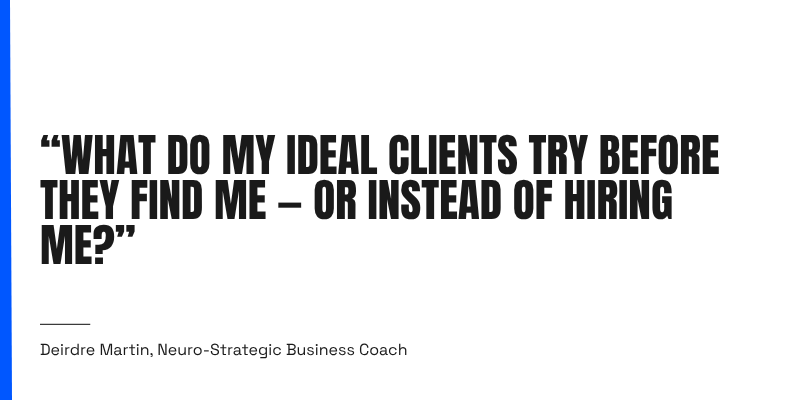
That question surfaces more actionable insight than hours spent analysing competitors’ Instagram reels.
Structural disruptors and why AI wins on perceived risk
The third layer includes tools, templates, AI platforms and the choice to postpone action. These options are changing markets faster than most people realise. They’re attractive because they lower perceived commitment, not because they guarantee better results.
Recent years have seen a surge in AI platforms that promise to handle tasks once reserved for human experts. They automate research, draft proposals and even attempt to offer strategic insights. Many clients see these solutions as a way to dip a toe without hiring someone. The outcomes often disappoint. They may get speed, but not strategic depth.
This doesn’t mean AI is useless. It means your prospect is comparing your premium service to a low-risk, low-commitment alternative. AI reduces perceived risk because it appears cheaper and easier to reverse. A DIY programme or template feels like a small experiment. Postponing the project feels safer than making a bigger commitment now.
If you ignore these structural disruptors, you may find yourself losing clients to options that shouldn’t even be in the same league. But if you address them directly, by positioning yourself as the strategic judgment AI cannot provide, you turn them into an ally. You make it clear that AI is a tool you use, not the value you sell. Your value lives in your ability to make sense of data, prioritise what matters and design an outcome. AI and templates can assist, but they don’t replace judgment.
Why many “no’s” aren’t about price at all
When a prospect ghosts you after a promising call, it’s natural to think they found a cheaper provider. Price does play a role, but it’s rarely the root cause. More often, the prospect:
- Doesn’t feel ready to commit to a full engagement.
- Worries about disrupting their business or team.
- Fears making a wrong decision and being blamed for it.
- Is unsure which solution matches their immediate needs.
- Is tempted by a tool or course that feels like a safer, easier first step.
This is why you need to speak directly to the underlying hesitation, not just to your credentials. When your messaging addresses the real decision, including the fear of commitment and the lure of lower-risk alternatives, you position yourself as a strategic partner rather than a risky expense. Instead of saying, “I’m the best at what I do,” frame why your expertise produces outcomes that DIY tools or AI cannot, and why now is the right moment to invest.
Practical steps to sharpen your positioning
Here’s how to apply these insights without getting lost in analysis:
- Define the right question. Stop asking, “What are my competitors doing?” Start asking, “What lower-risk alternatives are my clients considering, and why do they feel safer?”
- Map all three layers. Create a document or spreadsheet with columns for direct competitors, adjacent alternatives and structural disruptors. Note the price, promise and perceived risk of each.
- Listen to where clients speak honestly. Review discovery call notes, proposal feedback, DMs, community threads and even Reddit discussions to find the language clients use when they talk about hesitations and alternatives.
- Identify the gaps in your messaging. Where do you blend in? Where do you sound distinct? Where do you avoid mentioning the objections your prospects bring up?
- Change one thing and measure. Update a headline, restructure your offer or create a low-commitment entry point. Test. Measure. Don’t rely on research alone. Insights become valuable only when they lead to action.
Remember, competitive intelligence without decisions is just an expensive research project. The goal is to make one clear change, observe the impact and build from there.
FAQ
What is competitive intelligence for consultants?
It’s the practice of understanding every alternative your client may choose instead of hiring you, including direct rivals, adjacent services, tools, templates and delay. The aim is to build your strategy around the full decision your client is making.
Is AI replacing consultants?
Not in any meaningful way. AI handles repetitive tasks and data analysis, but clients quickly discover that it doesn’t provide the judgment and strategic guidance needed for transformation. It’s better to position AI as a tool you use rather than the value you provide.
How often should I update my competitive landscape?
At least every quarter. New specialists, fractional models and technological shifts, including AI, reshape markets quickly. A fresh review keeps your positioning relevant.
What’s the biggest mistake consultants make with competitor research?
Focusing only on peers who look like them. Real competition includes any path that addresses the client’s problem, even if it looks completely different from your service.
Should I lower my price if clients pick cheaper tools?
Not automatically. First diagnose whether the prospect’s choice was about price or about perceived risk and commitment. It’s often the latter. Address the hesitation before you adjust your pricing.
Related reading
- How to Write a Brand Message That Attracts High Paying Clients
- Think Like a 7-Figure Business Owner Before You Become One
Tools and resources
Clarity Checklist - A diagnostic tool to identify gaps in your positioning, pricing, systems and mindset.
AI Positioning Tools - Platforms that generate positioning suggestions quickly. Useful as a starting point, but not a substitute for human judgment.
Peer Communities - Groups where experts share frameworks, accountability and support. Great for networking and resources, but not a replacement for tailored expertise.
SparkToro - Audience research tool that reveals where your ideal clients spend time online, what they read and what they trust. Invaluable for layer two and layer three intelligence gathering.
Perplexity AI - Useful for rapid competitive landscape research and surfacing how competitors and adjacent alternatives are described across multiple sources.
Google Trends - Shows rising and declining search interest in competing services and delivery models in your market over time.
Reddit and Substack search - Not dedicated tools, but two of the best places to see how ideal clients speak candidly about what they are trying, considering and frustrated by. Go here before you go to competitor websites.
Conclusion
The biggest threat to your business isn’t always a better consultant. It’s a decision you can’t see. By expanding your definition of competition, mapping all three layers and addressing the real hesitation behind your prospect’s decision, you turn information into your strategic advantage. AI, templates and DIY solutions may lower perceived risk, but they rarely deliver the outcomes clients expect. When you position yourself as the strategic judgment that makes those tools effective, you become the obvious choice.
The best positioning comes from clarity. Not from guessing or reacting, but from understanding the actual choices your clients face. Use the three-layer framework as your compass, and build a practice that stands resilient, no matter how noisy the market becomes.
Full Transcript
[00:00:00]
[00:00:00] Why clients choose something else
[00:00:00] Deirdre Martin: At some point in the last year, a client, you were absolutely right for, chose something else, not a better consultant, perhaps, maybe something else completely different. And the reason your pipeline can't tell you what it is, is because of your competitive intelligence. Your competitive intelligence wasn't built to see it.
[00:00:20] The 3 layers of competition most consultants miss
[00:00:20] Deirdre Martin: In 2026 your competitive landscape has three distinct layers, and most consultants are actually only monitoring one and the layer they're ignoring. That's precisely where client decisions are being made before you are ever even in the conversation. What I'm giving you today is a framework that maps the full picture, the obvious rivals, the adjacent alternatives and the structural disruptors.
Your ideal clients are already weighing against you right now with and subtly without telling you. And when you can see all three layers, you're positioning sharpens, your pricing becomes more defensible, and your go-to market [00:01:00] strategy finally has something solid to stand on. So let's build it. So here's the mistake, and I wanna name it precisely because fixing it vaguely won't fix it at all.
Most consultants define their competitive set by category resemblance. People who share their title or who operate in a similar niche who have maybe got a comparable price point, they track those people position against those people and assume that if a client doesn't hire them, that that client went somewhere on their list.
Right? But they often don't. Here's the moment that I want you to sit with.
[00:01:38] What clients actually choose instead of hiring you
[00:01:38] Deirdre Martin: Think about the last time a genuinely good conversation didn't turn into a client, someone who clearly had the problem that you solve. They clearly had the budget. They seemed to understand the value that you provide, and then you got this polite kind of email saying they were going in a different direction.
Or maybe they just completely ghosted you. Most consultants put that in, [00:02:00] the timing wasn't right, pile and they move on. But timing is almost never the real answer. What usually happened was that the client found something else, not necessarily someone else, but something that felt like a lower risk path to solving the same problem.
Something that didn't require the same level of commitment, and because that's something, didn't share your job title, it probably never made it onto your radar. And that's the gap. It's not a one-off ping. It's literally structural. So let me share with you a quick example about brand strategist. If you are a brand strategist working with a scaling service business, direct competitors might be, other brand strategists.
That's kind of obvious, but your full competitive set now includes AI positioning tools done for you, content agencies, self-directed brand programs, marketing consultants who build bundle messaging into their broader retainers, and the client who decides [00:03:00] the problem is real but not urgent enough, and then files it under later.
That's also something you're competing with. And all of those are competing for the same decision in the client's brain. And if your competitive intelligence doesn't account for them, you're building your positioning only on a partial glance of what the landscape in the market actually looks like for your business.
And partial maps produce predictable gaps. That's it.
[00:03:29] What a real competitor actually is
[00:03:29] Deirdre Martin: So there's a reframe that fixes this, and it's in one sentence. A competitor is not just someone who does what you do. A competitor is any path that your client takes instead of hiring you. It could be people, tools, models. Price structures the option of doing nothing.
And once that lands, the question changes completely. Not from how am I different from other consultants, but what is the fullest set of decisions [00:04:00] that my client is now weighing up right now, and how do I become the most obvious answer, the right answer for them across all of it? And that question leads you to be able to create sharper positioning.
Pricing that's justifiable and defensible messaging that speaks to the actual decision that your client is making and not the narrow comparison that you assumed that they were running.
[00:04:26] Layer 1: Direct competitors and positioning gaps
[00:04:26] Deirdre Martin: So here's the framework
layer one, your direct competitors. It's where you have the same offer and the same audience. People who share your category. Possibly they serve a similar client to you and they operate at a similar level to you. You know that this layer exists. The question is whether you've mapped it recently enough to reflect what is relevant and current in the market today, because it has shifted too.
There are more specialists, more people have started businesses working for themselves. There are more niche [00:05:00] practitioners. There are more people providing fractional services and models at really senior levels. There's more international competition that remote delivery has made accessible over the last few years.
So if your last serious audit of this layer was six months ago, your reference points are already drifting. So the most useful exercise to do on this is to map your closest rivals by business model and pricing structure, not just by title, and then plot your positioning on a simple chart. Price on one axis and depth of specialization on the other.
And when you look at this, you'll almost always find some positioning gaps that your direct competitors have left wide open territory that's yours if you can see it clearly enough to claim it, that's layer one. It's necessary, but on its own, it's not sufficient.
[00:05:51] Layer 2: Same problem, different solution
[00:05:51] Deirdre Martin: Layer two is where you have the same problem, but a different method.
So what I mean by this is maybe you have [00:06:00] or provide the same client problem. But how you solve that problem is with a completely different delivery model. For example, a leadership coach working with scaling founders, your adjacent set could include people like organizational psychologists or HR consultancies with development arms, executive education programs, group training providers, all sorts, right?
They have the same growth ceiling that they're addressing. There's a different approach with a different price, a different promise, but absolutely it's the same client decision. They don't move in your professional circles. Those people, they don't look like competition, but they are. So the one question that diagnosis, this layer for your business immediately is, what did my ideal clients try before they find me or instead of finding me?
And when you figure that out. That's your layer two.
[00:06:56] Layer 3: AI and structural disruptors
[00:06:56] Deirdre Martin: Layer number three is where you have a different [00:07:00] model, faster moving than you think. And this is the layer reshaping expert markets in 2026 faster than anything else. And the one that's absent from almost every consultant's competitive thinking is ai.
AI tools delivering core elements of your offer at a fraction of the price or. It could be well built, self-directed programs by other credible practitioners or peer communities with structured frameworks and expert access. All built in on demand platforms, offering senior strategic thinking without the commitment of a traditional engagement.
And the qualified client who's identified the problem, decided the timing isn't right and deferred, which almost never gets counted as a competitive loss, but functions exactly like one. None of those, not one carry your professional title, and none of them appear on any traditional competitor list, but they're competing for something far more fundamental than [00:08:00] budget.
They're competing for your client's conviction that they need what you specifically provide. That's a messaging problem before it's a sales problem and you can't fix the positioning problem that you haven't accurately diagnosed. So what mapping this layer gives you is precision because once you can see the full picture, you stop trying to be everything across an undefined market landscape and it helps you or allows you to become far more specific about what you deliver. That genuinely cannot be replicated at any other price point or through any other delivery model. The depth of judgment that you provide, the custom thinking, the kind of intelligence that doesn't come in a program, a community or a tool, that's where your uncopyable defensible differentiation lives.
So three layers, and here's what happens when someone actually maps all of them. It's amazing.
Let me tell you about.
[00:08:59] Case study: Losing clients to AI in real businesses
[00:09:11] Deirdre Martin: [00:09:00] Quantity surveying client that I was working with a number of years ago, and for a number of years, they had a really strong niche, a strong track record, but for several months they had an unpredictable pipeline. They had good months, they had quiet months, but there was no pattern, nothing really obvious to explain the difference.
And they were producing consistent content. They had a very active presence and there was nothing dramatically new from direct competitors that they could see. No obvious variable that was cropping up. But when we looked at the full competitive landscape, what Surface did nothing to do with their direct competitors.
But actually that a significant portion of their clients, what they were starting to do was to leverage AI tools more. And so they had already got senior people in their business quite often, who were doing a lot of the work that my client was doing. But then they were leveraging AI for another level of thinking.
And what that did was it lowered the perceived risk. There's no PAYE, [00:10:00] there's no, well, there's VAT for sure, but not as much as somebody would pay if they actually hired you. What the difference was was not better outcomes than what my client would've provided, but it resolved a specific hesitation that their business had never previously addressed commitment risk.
So their messaging answered why I'm the best quantity surveying business to solve your problem. But the question the clients were asking is, is now the right time to invest in an outsourced quantity surveyor to make this level of commitment? Two completely different questions. One direct competitor list, one significant blind spot.
That once they could see it, the fix was pretty specific. They didn't need to lower their prices. They didn't need to change their offer. They just needed to address the commitment risk directly included and mentioned in their positioning. Once they named it, they were able to reframe how their engagement model reduced it.
They built a [00:11:00] clear entry point that dissolved any hesitation with clients before it became an unstated reason not to work with them. That resulted in pipeline consistency. It then meant they didn't have to work any harder, but because they were finally answering the question that the clients were actually asking.
[00:11:18] Why AI wins decisions, even when it's wors
[00:11:18] Deirdre Martin: Another client coach had really premium brand, fantastic reputation, and what was happening to them was they would send a proposal after a great conversation and not following it up in the way that I would typically recommend. This was before we were working together, but what was happening was a week later, they literally got the response back to say, I'm actually gonna use AI to coach me.
Might sound like who will get AI to coach them, but honestly, this is happening out there right now. And it was budget led, right? That's what my client thought, but it's not, the decision wasn't between her and ai, it was between a high commitment investment and something that gave the [00:12:00] client just enough structure to feel like they were having forward momentum.
But without the risk, and that meant that they didn't win the client or that, you know, AI didn't win because it was better. It won because it answered a hesitation that my client's positioning never spoke to. Imagine that her messaging had named that hesitation directly articulated precisely why the depth of the work that she does with clients produces outcomes that AI can't.
Well then. If she'd done that and demonstrated that the investment is structured around the client's results and not the coach's time, that's not a harder sales conversation. It's a more precise positioning conversation, and it starts with knowing what you're actually competing against. Right.
[00:12:49] The biggest mistakes consultants make with competitors
[00:12:49] Deirdre Martin: So there are common traps that I see cropping up for clients who are consultants and coaches all of the time.
Trap One is watching direct competitors so [00:13:00] closely that you start sounding like them, and the more you study only the people in your immediate category, the more you risk drifting toward them. Positioning, your messaging, your offers, and the whole lot basically converging until the whole group and niche actually starts to sound so similar and real differentiation becomes genuinely hard to establish for your clients.
And the point is that you have a design brief for what you're offering as opposed to looking at those people and thinking, oh, I'm just gonna create and middle build or model something that they've done. And the other thing that happens with this is that when you're looking at your direct competitors, it's really easy to fall into the trap of comparison.
And comparison is quite literally the thief of joy. The more you start to look at somebody else's business, you start to feel like you are not as far along as you should be. That's not even trap two. Trap two is only doing this, only looking at your competitors when something goes [00:14:00] wrong. Competitive intelligence that activates when you feel commercially threatened is not an intelligence practice.
It's the stress response. The experts with the clearest competitive pictures, they're looking at the market all of the time, not just when they feel pressured to, but because when they're regulated, that's when they see it most clearly, not when they're stressed out or when the money's not coming in.
So build a rhythm, build a plan for when you're going to evaluate this. Maybe it's quarterly, maybe it's half yearly, but don't extend it even beyond that because things are changing so fast, particularly with AI and make that a non-negotiable. Trap three is what unstructured competitor monitoring does for the brain.
For anyone whose professional identity is tied to their practice, which at the expert level is most of us, right? But watching competitors without a system triggers a threat response. The part of your brain that detects danger doesn't distinguish [00:15:00] between a rival successful launch or what appears to be successful on social media.
And an actual threat to your business, it can treat both as danger. So when that happens, what looks like strategic thinking is actually defensive mechanisms in your brain firing on all cylinders. And so what people tend to do is they react and they adjust their positioning or they make messaging decisions driven by anxiety and that fear that they're not getting enough of the market share.
Rather than competitive or strategic intelligence, and the fix is systemization scheduled, structured, separated from the moment of that revenue fear, right? And when it's deliberate, when you do this as a deliberate practice rather than a reaction, the quality of what you see and what you decide is categorically different, so different.
Trap four one audit. And then done. The market keeps moving. You [00:16:00] can't just audit once what you mapped out a year ago, two years ago, or when you started your business. That's like archeology, right? It's like a rare artifact at this stage. So a light review every quarter is ideal, and when you do that, it will compound in ways a single deep dive never will.
[00:16:20] Practical steps to fix your positioning
[00:16:20] Deirdre Martin: So here are some practical next steps. First, define the question first, not let me see what competitors are doing, but what pricing gaps exist in my vertical right now, or which delivery models are my clients considering instead of working at my level. It's a specific question, but it will give you actionable output.
And yes, it's open-ended to browse a long open-ended.
Two, map all three layers without filtering. Get the full picture first. Look at your direct competitors. Look at adjacent competitors, and then look at non-traditional disruptors. If layer three feels uncomfortable. Great. [00:17:00] That discomfort is data. It's showing you the gap between your current model and what's actually going on in the world that your ideal clients are navigating.
Step three is go where your clients speak, not where your competitors post reviews on vertical specific platforms. That's what I'm talking about, Reddit, sub substack, wherever else, and the questions in your community that your ideal clients are actually using and asking you. Look at discovery call notes that reveal what alternatives a client has or a prospect has been weighing up in their brains about what they need to do to solve this problem.
That's where positioning gaps reveal themselves really clearly, competitors', websites or social media won't show you that. Four, find your differentiation gaps. Oh my gosh. I can't tell you how important this is. Where are you genuinely, clearly differentiated? What makes you so uniquely uncopyable and where are you at risk of being perceived as interchangeable?
Because [00:18:00] those gaps are urgent, not future quarter work, not adjustments that are probably costing you qualified opportunities right now. Five, make one specific decision and measure it, whether it's pricing, positioning, language, or refinement to how you open a commercial conversation and implement that one thing at a time.
Track it. Competitive intelligence that produces no decision is just expensive research. It's a waste of your time. So one changed variable with the track result. That's the beginning of a compounding asset.
[00:18:35] The shift that changes your pipeline fast
[00:18:35] Deirdre Martin: Here's what I see consistently. The consultants who do this mapping exercise and find it uncomfortable, they're almost always sitting on a positioning gap that's been costing them qualified opportunities for longer than they realize or would care to admit, and not because the work isn't excellent, right?
Their work is fricking amazing. But because the messaging hasn't been built against an accurate picture of what their clients are [00:19:00] actually deciding, and the ones who find it clarifying, they almost always identify one specific thing and then they can reframe, they can make one shift in how they describe their value relative to everything else available.
And that one tiny thing, that one change, it could change the quality of their pipeline within a quarter, within a couple of weeks. And that thing is different for every single niche and for every single business, which is why I wanna ask you something specific before I finish.
[00:19:29] Which layer is costing you clients right now
[00:19:29] Deirdre Martin: Which layer is your biggest gap right now?
Is it layer one, your direct competitor set, where you know things have shifted more than your current positioning? Flat. Is it layer two where clients are looking at adjacent alternatives and your messaging is no clear answer for them? Or is it layer three, the structural disruptors, the alternatives your clients are weighing up that maybe you haven't factored or built into your positioning yet?
Let me know. Name, your niche and your layer. And what I can give you there is not a general observation. It's a specific read [00:20:00] on where the most significant positioning gaps tend to sit in your space. The consultants who ask that question out loud with that level of honesty are almost always the ones who make the sharpest positioning moves in the following quarter, and that results in more clients.
[00:20:17] What separates resilient businesses in 2026
[00:20:17] Deirdre Martin: The experts who build the most commercially resilient businesses in 2026 won't be the loudest or the biggest influencers on social media. They won't be the ones who post the most prolific content. They won't be the ones who outspent everyone else on ads or visibility.
They'll be the ones who built a precise, honest picture of the full decision their ideal clients were making, and became the most obvious right answer to that decision, not the most available answer, the most precise one, and that precision. Starts with seeing the full competitive landscape. So now you have the framework, go build it, and until next time, keep mastering your business.
Get the next one in your inbox. One idea a week on becoming known, generating demand and growing beyond yourself.
We hate SPAM. And we will never sell your information, for any reason.